A studio for bird study

Tag: photography

Black Tern in the High Prairie

by Bryce W. Robinson

BLTE

I think one of my favorite birds is the Black Tern- Chlidonias niger. They are visually striking birds, and their habits are equally intriguing. I remember last summer, making my way down through Canada, bound for the border, then Chicago. Once I hit southern Saskatchewan, the land became scattered with small ponds and marsh lands. It was a lush scene, full of birds. They call these scattered bodies of water on the high prairie the prairie potholes. They are the remnants of the last glacial maximum, and now are home to multitudes of waterfowl, and birds alike.

Black Terns are common in this part of North America. One afternoon, I pulled over at a small pond, where a group of Black Terns were coursing the sky, feeding on the open water. I watched their behavior for some time, and soon realized that they were feeding young, somewhere hidden in the reeds. I could hear the juvenile birds begging. It was impossible to locate a bird. They were simply too deep, safe in the marsh.

At this time of the year, some of the terns had already started their pre-basic molt. It interested me that not all of the birds in the flock had started molting. I know very little about the molt cycle of the Black Tern, but this variation between individuals stuck with me.

I hope to find myself watching Black Terns again, sometime in the late summer this year. If I do find a few, I’ll be paying attention to their plumage, the date, and what aspects might be influencing their individual molt timing. I’m sure someone like Steve Howell, who has studied the various molt strategies between taxa, and knows a thing or two, could offer some insight.


Juvenile Rough-legged Hawk- Buteo lagopus

by Bryce W. Robinson

IMG_3005I haven’t been taking photos of raptors lately. I think I need to devote my next free day to hitting the open western road, solely in search of raptors.

I took this photo last winter at Farmington Bay, in Utah. I miss that place. Idaho has good raptors, but nothing compares to the close looks that you obtain at Farmington Bay.


Study What is Common

by Bryce W. Robinson

SOSP_2014_0103

Song Sparrow- Melospiza melodia.

Study what is common. I’ve heard this piece of advice many times, and I think it is one of the most important keys to becoming a better birder. I’m a relatively inexperienced birder, and I’ve been seeing a lot of progress in my birding in the last year. I believe my growth has come solely on my conscious decision to stop and study every bird I see, even those that are around me everyday.

I see the Song Sparrow- Melospiza melodia, daily. I know the bird well, but I still seem to learn something every time I’m watching and listening to them. The more you watch, the more you notice, and there is so much satisfaction in that discovery.

The Song Sparrow flocks I have been around lately have been very diverse in plumage. The diversity in plumage is a function of their different subspecies. I’d like to learn the appearance of each subspecies, so that I can better understand where the individuals I interact with during the winter breed. I’ve done so with the Dark-eyed Junco, and I really enjoy seeing mixed flocks of individuals from completely separate populations. Some of the most satisfying moments in my birding lately have been finding birds that are out of their expected range, and having the background knowledge to understand how far out of the way they’ve wandered.

A Zonotrichia Christmas Bird Count

by Bryce W. Robinson

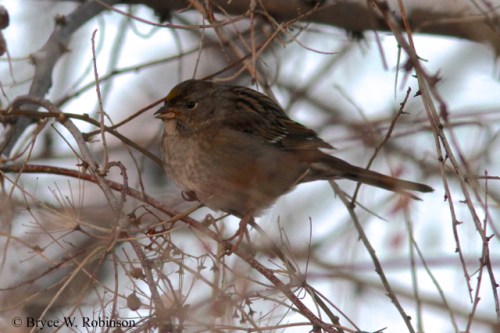
GCSP

First-cycle Golden-crowned Sparrow- Zonotrichia atricapilla

Yesterday I joined Jay Carlisle, Heidi Ware, and a number of other folks for the Nampa Christmas Bird Count in south western Idaho. The day started out right. We began at Caldwell Ponds before sunrise for an attempt at turning up a few owls. Sure enough, a few Barn Owls hunted the fields, trying to squeeze in a meal before light.

When it was light enough, we started working the thickets for sparrows. Flocks of White-crowned Sparrows were sounding off, which is always promising, as they often hold something special in their ranks. Sure enough, Jay called out two Golden-crowned Sparrows. The Golden-crowned Sparrow is hard to come by in Idaho, but each year Jay and Heidi have participated in the Nampa CBC, they have found a GCSP at Caldwell Ponds.

I stayed behind with the sparrows to attempt some photos. The birds were rather tolerant before the sun rose. I managed a decent photo of one GCSP, but in poor light. When the sun finally rose, the birds seemed to avoid me, and although I spent ten minutes stalking the birds, I never managed  a photo in the golden morning light.
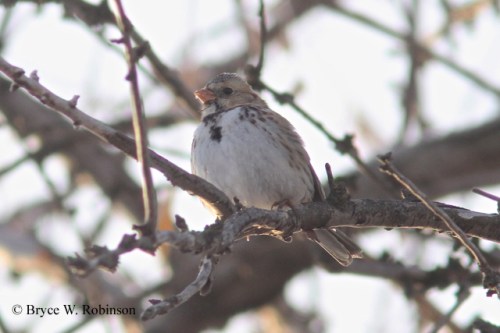
HASP

First-cycle Harris’s Sparrow- Zonotrichia querula

When I caught up to the group, they were working a thicket, sifting through another healthy flock of White-crowned Sparrows. I went around the group to head off some outside individuals. While sorting through a small group, I spotted a recognizable pattern deep in a bush. I didn’t want to cry wolf, so I held my tongue for a bit. Soon enough, the bird popped up onto the top of the bush, and showed itself. I alerted the group, Harris’s Sparrow!, our third Zonotrichia species for the hour.
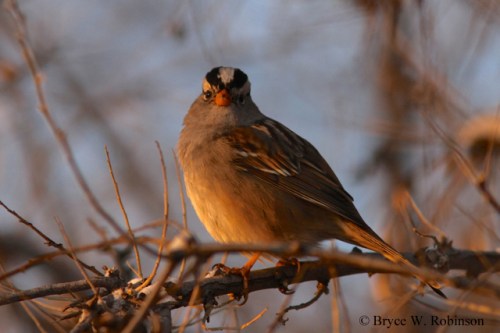
"Gambel's" White-crowned Sparrow- Zonotrichia leucophrys gambelii

“Gambel’s” White-crowned Sparrow- Zonotrichia leucophrys gambelii

I soon realized that after getting the hardest Zonotrichia, the GCSP, so early in the day, seeing all four was a distinct possibility. All we needed to find was the White-throated Sparrow, an uncommon bird for winter in Idaho. The bird is uncommon, but multiple individuals are found every year. In fact, I had found one two weeks ago in Boise. The reality of reaching the goal was there.

Later in the day, I split off from the group with Heidi. We were charged with checking a few hotspots, and we both had one bird on our mind. Heidi has never seen all four Zonotrichia in a day, so the goal was looking sweet to her eyes as well.

For the rest of the day we sifted through sparrow’s with no sign of the fourth Zonotrichia. We turned up other good birds, Savannah Sparrow, Lincoln’s Sparrow, and two Bewick’s Wrens. But by the end of the day, as the sun set and we continued to look through White-crowned Sparrow flocks, we came away without our prize.

Well, we almost “pulled a Zonie”! I kept telling Heidi I was going to make “a Zonie” the term for seeing all of North Americas Zonotrichia species in one day. It’s a worthy goal, and a respectable badge, that deserves some title, even if it is a bit dorky.

I didn’t realize how doable a Zonie is for Idaho, but it sure is. I’ll be after that goal now. I have heard and seen photos of a man in southern California that had all four at his feeder one day. That is remarkable. So now I have a new goal on the horizon, to see and photograph all four of North America’s Zonotrichia sparrows in a day, or simply, to pull a “Zonie”. Let’s hope it doesn’t turn into a nemesis goal, or white whale, or whatever you might call it.

Here’s the bird that got away.
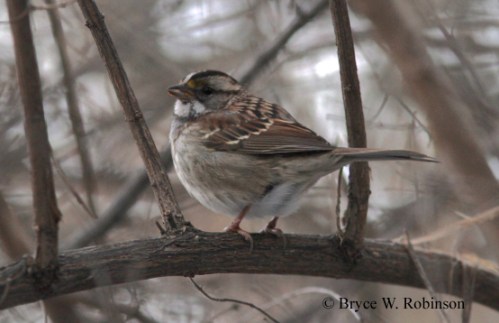
WTSP

Adult White-throated Sparrow- Zonotrichia albicollis