A studio for bird study

Tag: photography

Published in the Wilson Journal of Ornithology: First record in birds of nestling relocation following nest collapse

by Bryce W. Robinson

IMG_0787.jpg

Photo of a female Gyrfalcon holding a surviving nestling following partial collapse of the nest. Photo published in Robinson, B. W., N. Paprocki, D. A. Anderson, and M. J. Bechard. 2017. First record of nestling relocation by adult birds following nest collapse. Wilson Journal of Ornithology 129 (1) 216-221 

Since I’ve been hard at work in central America for the past month, I haven’t had the time to share a recently published article from my Gyrfalcon work. The article details the behavioral response of a female Gyrfalcon following the partial collapse of a nest. The photo above shows her holding the only surviving nestling following the partial collapse of their nest on a cliff side in Alaska. Just moments later, the female took the nestling to safety at another ledge farther down the cliffside. This behavioral response to threat is the first documented case in altricial birds!
Read the full article: 

Robinson, B. W., N. Paprocki, D. A. Anderson, and M. J. Bechard. 2017. First record of nestling relocation by adult birds following nest collapse. Wilson Journal of Ornithology 129 (1) 216-221

First Idaho Record of Red-flanked Bluetail – December 2016

by Bryce W. Robinson

_MG_5166.jpg

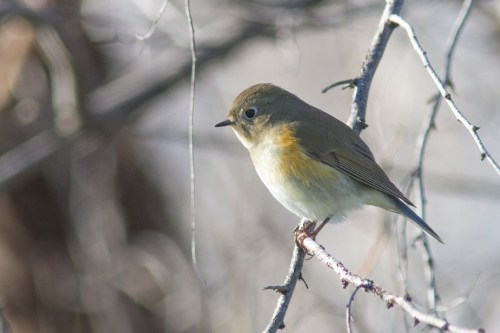
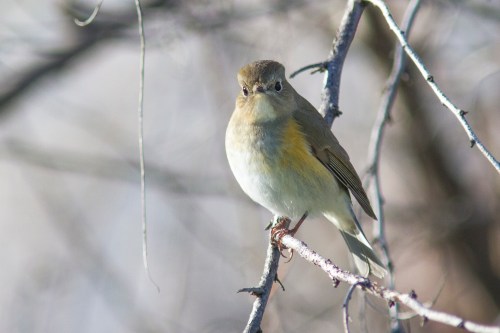
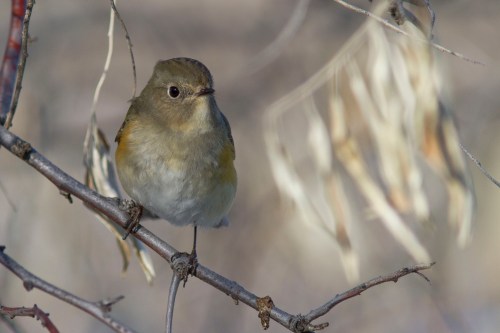
On 31 December 2016 I made the five hour trip from Boise to Lewiston to see Idaho’s first record of Red-flanked Bluetail (Tarsiger cyanurus). On arrival, the bird already had a crowd watching it forage along the Russian Olives that bordered the river.

_mg_5271

It was a sunny and relatively warm morning, and the bird was actively foraging. It would appear on the tree edge and making foraging sallies to the ground. It looked like the bird was eating the Russian Olive fruits, but one of my photos show it with an arthropod in its bill as well.

_MG_5140.jpg

It made its way foraging between four trees along the river, heading south to the last tree and then returning north. Occasionally it would disappear low in the trees along the rivers edge, and return to foraging within a few minutes.

My favorite aspects of this bird were its subtle hues in the plumage, particularly the blue throughout and the white throat patch. I also enjoyed its behaviors, such as the constant tail dabbing. The bird was extremely cooperative, providing all watching with excellent views. At times when it would come to the ground to forage, it would do so only feet from the birders. I’d say it was behaving about the best anyone could hope for concerning a high profile vagrant.

I spent some time attempting to capture video of the bird perched on a limb, tail dabbing. I mostly was unsuccessful, but did manage the following clip that is poor quality. It’s worth sharing just to show the birds behavior.


The Red-flanked Bluetail was a great end to 2016, which was a bummer of a year for so many reasons, but was incredible and profitable regarding birds. Hopefully 2017 will match or exceed. Happy New Year.

Barred Owl (Strix varia) Hunting at Mid-day

by Bryce W. Robinson


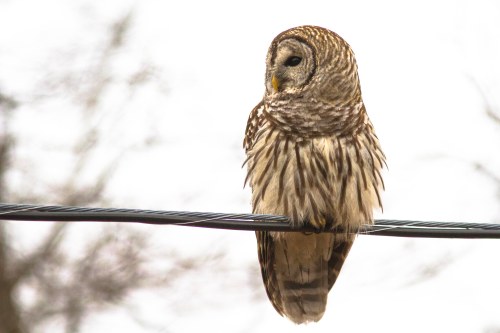
While out for a day of birding Maryland natural areas, Caitlin and I saw a Barred Owl perched on a power line along a two lane highway. I was shocked to see the bird on the line in the open, but more shocked at its alert behavior. The bird was hunting the road edge and it was mid-day.

I’m relatively uneducated about the Barred Owl. I thought these birds were strictly nocturnal and rarely active during the day. After doing some research, I’ve learned they occasionally hunt in daylight, however mostly in the first hour following sunset (Mazur and James 2000) . Despite some tendency towards daytime activity, it stills seems shocking this bird would actively hunt a road edge in the daylight. Either way, I thought I’d share.

_mg_4891


Referenced literature:

Mazur, Kurt M. and Paul C. James. (2000). Barred Owl (Strix varia), The Birds of North America (P. G. Rodewald, Ed.). Ithaca: Cornell Lab of Ornithology; Retrieved from the Birds of North America: https://birdsna.org/Species-Account/bna/species/brdowl

2nd ABA Record of Common Scoter (Melanitta nigra) in Oregon

by Bryce W. Robinson


I had a great weekend. A few friends and I made the short road trip from Boise to the Oregon coast to see the ABA areas second record of Common Scoter (Melanitta nigra). The Common Scoter breeds across Europe and Asia, and most closely resembles the Black Scoter (Melanitta americana). The first record for this species was surprisingly only last year in Northern California.

We had no trouble finding the bird when we arrived, because there were already many birders on location. We were lucky though, it was high tide and the bird had come up river to preen and feed. I stood on a bridge with the bird nearly directly below me and took photos and video.

_MG_4118.jpg

Male Common Scoter (Melanitta nigra). Second ABA record, Lincoln City, Oregon. November 2016.

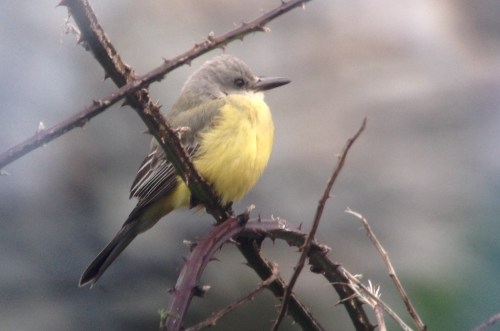
We birded the area after getting our fill, including sea watching which never disappoints folks from inland. We also bagged another lost bird, a Tropical Kingbird a few miles down the road from the scoter stake-out. Overall it was an excellent trip with good friends.

FullSizeRender-1.jpg

Digiscoped photo of a Tropical Kingbird (Tyrannus melancholicus) in Lincoln City, Oregon.