A studio for bird study

Tag: project

Avian Keratin Disorder (AKD), Bill Deformities in Birds and Recent Breakthroughs

by Bryce W. Robinson
2l3a1740

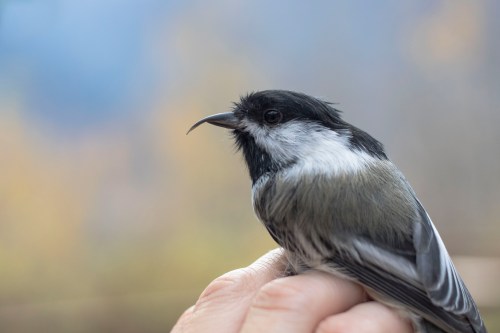
Photo 1. Female Black-capped Chickadee (Poecile atricapilla) with bill deformity.

I recently had the pleasure of spending a few days with my friend Rachel Richardson of USGS trapping birds in the Eagle River Valley of south-central Alaska. We captured a few species such as Black-capped and Boreal Chickadees (Poecile atricapilla and P. hudsonicus, respectively), and Red-breasted Nuthatch (Sitta canadensis). USGS has been trapping in these areas for years with the main focus of monitoring bill deformities, the prevalence of Avian Keratin Disorder, and the prevailing causes of a new found virus, Poecivirus.

The Alaska Science Center of USGS in Anchorage is part of a team of researchers, including the California Academy of Sciences, and the University of California San Francisco that have been investigating the causes of Avian Keratin Disorder for over ten years. Avian Keratin Disorder was first documented in Alaska in the 1990’s by Colleen Handel of USGS who leads the research team at the Alaska Science Center. In an article in Molecular Biology that came out in July 2016 (Zylberberg 2016), the team reports on the discovery of a new virus they termed Poecivirus, which may be responsible for the bill deformities.

Appropriately, the discovery is receiving a good deal of press. Below are a few links to national and international articles that detail the work and the discovery. All are worth a read (or a watch):

A new article by the Associated Press

Science Daily’s article

National Geographic article detailing the work effort
Alaska Daily News Article

An APN video on USA Today

2l3a1766

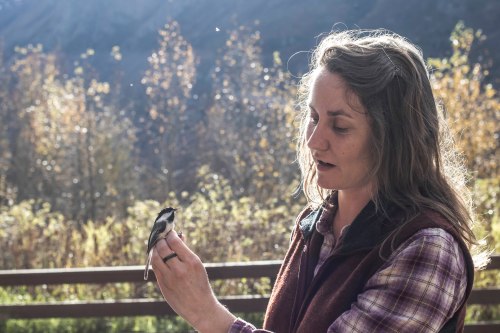
Photo 2. Rachel Richardson of the USGS Alaska Science Center holding a female Black-capped Chickadee (Poecile atricapilla) with a bill deformity.

On the day I spent with Rachel in the field trapping birds, we only had one Black-capped Chickadee show up with a deformity. However, the one bird had an interesting story. This female (Photo 1) was first captured in 2015 and had no signs of any deformity. This year she obviously has a developing deformity. Her bill grew 5.1 mm in one year, a 70% increase in length. Whether or not this developing deformity will impact her ability to forage, preen, or even breed and provision young is yet to be determined. There are reports of deformed birds successfully rearing offspring, however it is without question that the deformities present a handicap that will ultimately reduce the individuals fitness.

It is important to track the rates and severity of deformities across the world. Because of this, the Alaska Science Center has developed a submission form for anyone to report their sightings of deformities. Please contribute to this effort and submit details of any sightings of elongated bills, including photos and location along with any other evidence for Avian Keratin Disorder at the following website:

Beak Deformity Observation Record Report
2l3a1759

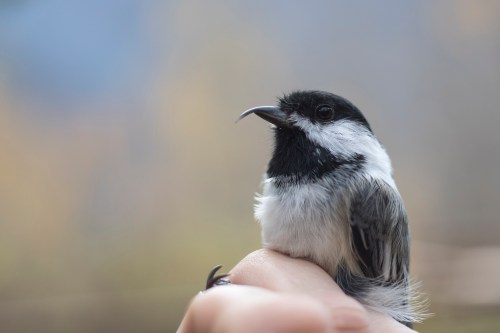
Photo 3. Female Black-capped Chickadee (Poecile atricapilla) with bill deformity.

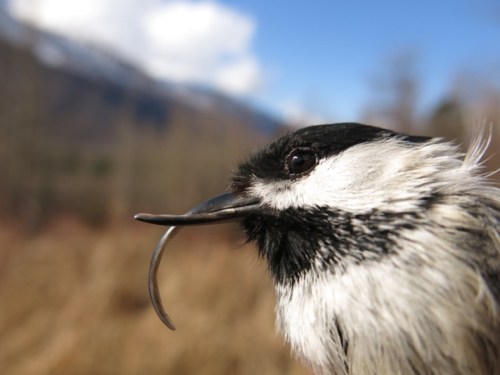
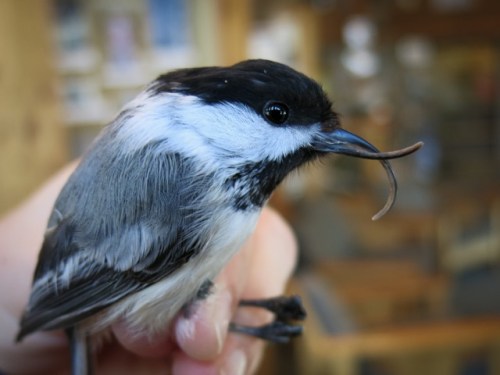
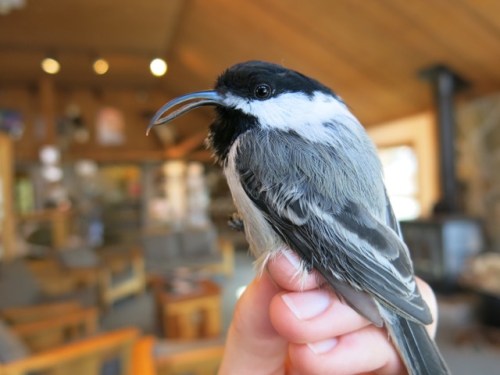
Below are additional examples of AKD in Chickadees that have been captured as part of the Alaska Science Center’s efforts near Anchorage. These individuals unfortunately have more developed deformities than the chickadee we caught while I was tagging along.
IMG_8665.jpeg

Photo 4. Black-capped Chickadee (Poecile atricapillus) with bill deformity. Photo copyright Rachel M. Richardson.
Black-capped Chickadee2_Richardson.jpeg

Photo 5. Black-capped Chickadee (Poecile atricapillus) with bill deformity. Photo copyright Rachel M. Richardson.
IMG_0028.jpeg

Photo 6. Black-capped Chickadee (Poecile atricapilla) with bill deformity. Photo copyright Rachel M. Richardson.

It’s excellent to have a breakthrough and a step forward. However, the problem still remains as well as the daunting task of discovering the correlation between Poecivirus and bill deformities, the causes of both, and what role humanity plays in the prevalence and transmission of either. I’d like to tip my hat to those who have done so much great work on this issue thus far. Keep up the good work.

Referenced Literature
  1. Maxine Zylberberg, Caroline Van Hemert, John P. Dumbacher, Colleen M. Handel, Tarik Tihan and Joseph L. DeRisi. Novel Picornavirus Associated with Avian Keratin Disorder in Alaskan BirdsmBio, July 2016 DOI: 10.1128/mBio.00874-16
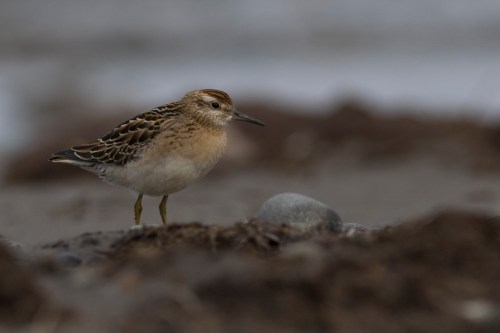
Sharp-tailed Sandpiper (Calidris acuminata) on the Alaska Peninsula

by Bryce W. Robinson

2l3a0673

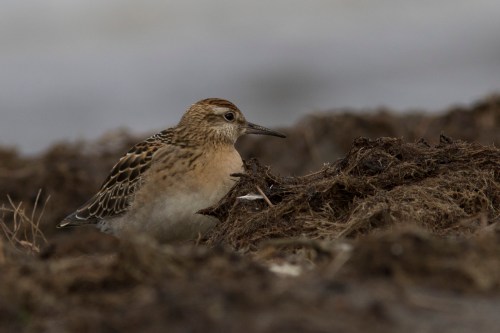
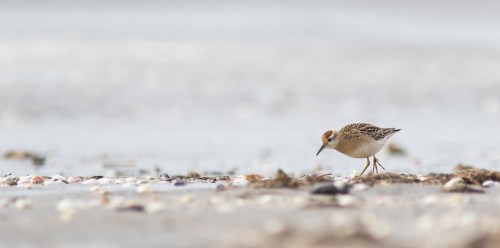
The Sharp-tailed Sandpiper (Calidris acuminata) breeds in eastern Siberia and winters in the south Pacific, but a large portion of the juvenile cohort pass through western Alaska on their first fall migration. While I was on the Alaska Peninsula waiting for Bar-tailed Godwits (Limosa lapponica) in September, I got to see a few late moving juvenile Sharp-tailed Sandpipers mixed in with massive Dunlin (Calidris alpina) flocks.

2l3a0629

At high tide each day our group would hide in the elymus grass and watch shorebirds come into the high rack line to roost. On one occasion, I noticed the opportunity to photograph a juvenile sharpie, so crept on my belly towards the roosted flock. Once I was close enough to take quality photos, I raised my camera. At the same time the flock took to the air and my chance seemed ruined. I thought it odd though, because the roosting Dunlin are usually tolerant if you are careful and move slowly. I looked around and saw a Bald Eagle passing overhead, which was certainly the reason for the panic. I cursed a bit and looked around to see when the flock might return to roost. As I scanned around, I noticed a lone bird still roosted in the rack line. It was the sharpie, which hadn’t pushed to the air with the Dunlin flock. It’s an interesting note, and something I’ve observed with the few Rock Sandpipers that were associating with the Dunlin flocks as well. On few occasions, the other species opted to stay put despite the flock erupting into flight.

2l3a0611

I’d love the opportunity to get to know Sharp-tailed Sandpipers better. Like other birds of the region, the juveniles represent one of the excellent species along the migratory route of the west coast of Alaska that make the place so unique and alluring.

Fork-tailed Storm Petrel (Oceanodrama furcata) Foraging on Tidal Flats: Part 1

by Bryce W. Robinson

Video 1. Dan Ruthrauff photographs passing Fork-tailed Storm Petrel as the tide comes in. Bristol Bay coast, Alaska. September 2016.

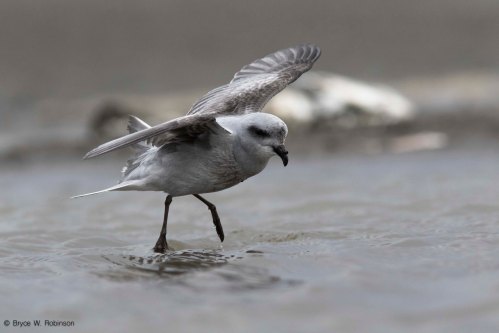
Over my time on the Bristol Bay coast near the village of Egegik on the Alaska Peninsula, I was privy to one of the most incredible experiences I’ve ever had with birdlife. The experience is captured in video 1, which shows Dan Ruthrauff kneeling on tidal flats at low tide photographing passing Fork-tailed Storm Petrels at close range. I’d never heard of anything like this for any pelagic bird. It turned out to be a regular occurrence, but still appears quite novel so far as we understand Fork-tailed Storm Petrel foraging behaviors.

2L3A9888.jpg

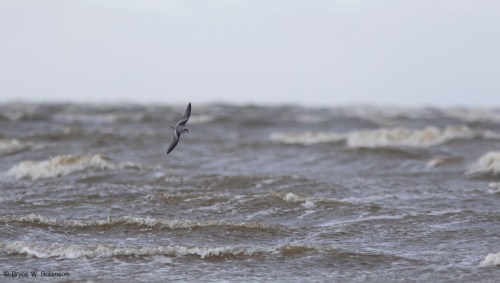
Photo 1. Fork-tailed Storm Petrel arcing down amidst a dynamic soar in high winds. This photo was taken from the shoreline at high tide. Bristol Bay coast, Alaska. September 2016.

Typical experiences with Fork-tailed Storm Petrels are like the image above: A dynamic soaring Hydrobatid at relatively close range. It’s very exciting, but nothing like walking through tidal flats surrounded by the birds.

2L3A1376.jpg

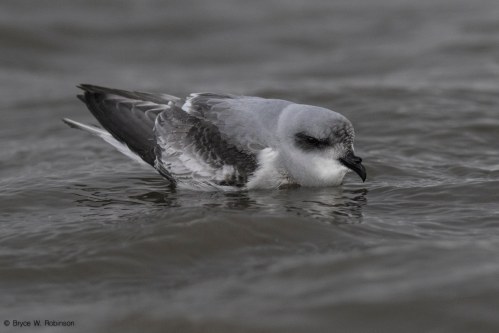
Photo 2. Fork-tailed Storm Petrel at rest on the water. I was standing in ankle deep water when this photo was taken. Bristol Bay coast, Alaska. September 2016

Other more typical experiences can provide observations such as the above photo, where calm water and resting birds near a boat might provide great views. Photo 2 is a bird that I stood near in ankle deep water. This bird was taking a moment to rest from foraging and seemed non-plussed by me. I’ve never heard of anything like it.

2L3A1113.jpg

Photo 3. Fork-tailed Storm Petrel (Oceanodrama furcata) dabbing on water. I was lying on my belly when this photo was taken. Bristol Bay coast, Alaska. September 2016

The experiences continued for the entire two weeks I was on the Bristol Bay coast. After reading through the literature, the behavior seems undocumented and may warrant publication as a note. I’m excited to organize, avail myself of the literature, and share this experience with a crowd more knowledgeable and literate than myself. For me, experiences like these make field ornithology one of the best things about life.

Gyrfalcon Project Update

by Bryce W. Robinson

Female Gyrfalcon - Falco rusticolus

Here in western Alaska the bulk of the breeding Gyrfalcons are fledging young at the moment. We were able to install all ten cameras in nests this summer, and starting tomorrow will begin taking them out of the finished nests. I’ve been extremely pleased with the quality of the images that these cameras take. I’ll be spending all winter sorting through the photos to identify prey items brought to the nest. This will be a long process, as I should have somewhere around 1.2 million photos to look through. Quite an undertaking, but I’m excited to start the task.

It’s been a tough season to this point, full of challenges and some failures, but I’m happy with the success we’ve had to this point. Getting all ten cameras placed was a goal of mine, and I’m happy to have that success. For my first year, and the first year of the project, it has gone well. Above all it has been nothing short of an education. There are certainly fruits in difficulties, mistakes, and failures. Next year, I’ll have some experience to draw upon to increase the success and further the project goals.