Wintering raptors take precedence above any winter birding, in my book. True, the lakes and wetlands hold an impressive variety of waterfowl and seabirds en route to their wintering grounds, but nothing can be as exciting as the invasion of the bird worlds proudest members. I find feeder watching very rewarding as an opportunity at close range study, however, the birds of prey that populate the agricultural areas throughout the winter months provide easy insight into a world otherwise difficult and distant. Many raptors become docile and tolerant during the winter months as they attempt to conserve their energy with the limited resources they have. Territoriality is dropped, and birds crowd fields, fence-lines, wheel-lines, tree-lines, and roost-sites. Even birds of varying species tolerate one another as they watch for prey.
Last weekend, conducting winter raptor surveys around Beaver and Milford, Utah, I observed a field full of Ferruginous and Red-tailed Hawks. The Red-tailed Hawks mainly rested on a retired wheel-line, but the Ferruginous Hawks seemed to prefer the ground. As I scanned the field and took note of numbers, I observed one Ferruginous Hawk running as a dinosaur might. The bird was in pursuit of some furry creature foolish enough to come above ground. Such behaviors are the reason winter ecology is so intriguing. It seems the birds let go of all reservations to ensure their survival through the harsh and unforgiving months.
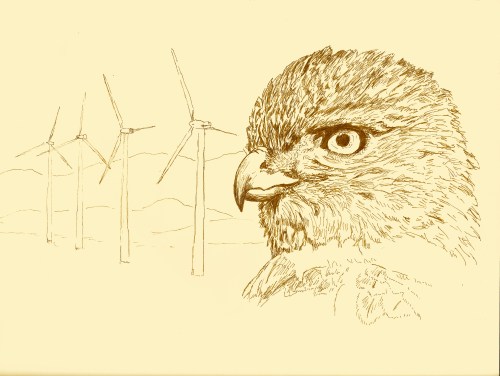
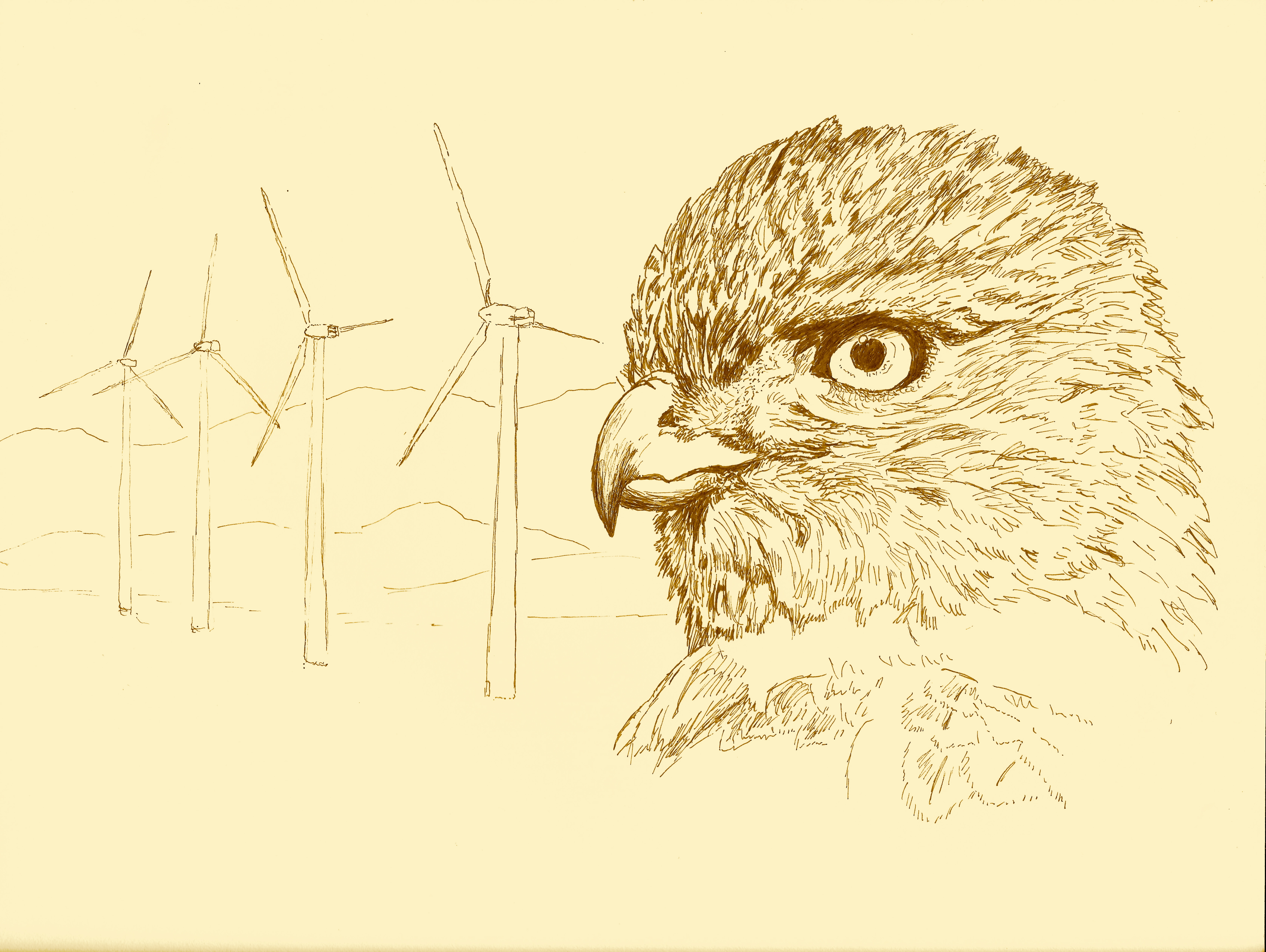
HawkWatch International conducts winter surveys every year with the help of a very dedicated volunteer staff of Citizen Scientists. I have been involved in the past, but this year I was asked to take on some part time work conducting winter surveys for a proposed energy development project for the Cedar City Office of the Bureau of Land Management. Currently, northeast of Milford, there is a large wind farm as well as a geo-thermal plant. In hopes of expanding and developing more areas for renewable energy, the BLM has approached HawkWatch International to conduct a comprehensive study of the raptor populations that exist in the proposed areas. The findings from the study will contribute to the environmental impact statement(EIS) that will be necessary for any energy development in the area. I am happy that I am involved in making sure the correct steps are taken before developing lands for renewable energy, and that I am not conducting surveys to help ensure the creation of anything that burns fossil fuels for energy. It all seems pretty moral to me, which is exactly what I want to be doing in my life.
I love the American west, and all of the creatures that inhabit it. Yes, that does include humans, however, it was revitalizing to have a respite from city living, some solitude and satisfying loneliness as I searched for the big cats of the bird world. One thing that the surveys have provided me, and perhaps the most important, is the opportunity to get out and study birds firsthand. In only the first stint of the season, I have already found valuable learning experiences, and my knowledge has grown considerably. It would be foolish not to share what I have learned. so share I shall. The following discussion details identifying age groups in the Golden Eagle, made possible through photographs.
THE GOLDEN EAGLE- Aquila chrysaetos
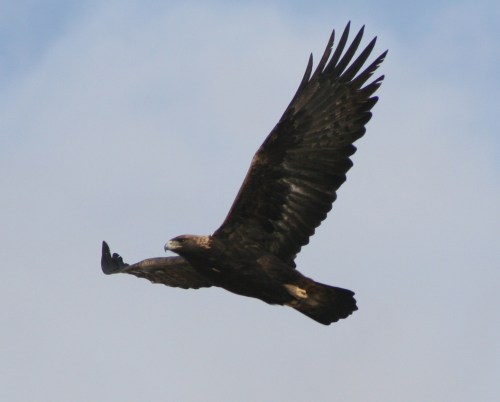
I came upon a number of eagles in the days I travelled the countryside. Many were in the air riding thermals, but I did have the luck of finding a few birds perched atop power poles. As I have learned more about raptors, I have worked towards honing my identification skills to sex and age, where appropriate. Aging eagles is tricky, but it is a necessary tool for understanding the dynamics of the populations especially in surveys for development. Correctly identifying immature birds from adults is critical for a precise analysis of the status of populations, but I have strived to take it a step further in pinpointing the bird to its relative age. As eagles in general do not gain adult plumage until their fifth year of life, it becomes a challenge to tell the age of an immature bird. I decided to reach out for help from one of the nation’s leading raptor experts, Jerry Liguori. His help has been invaluable.
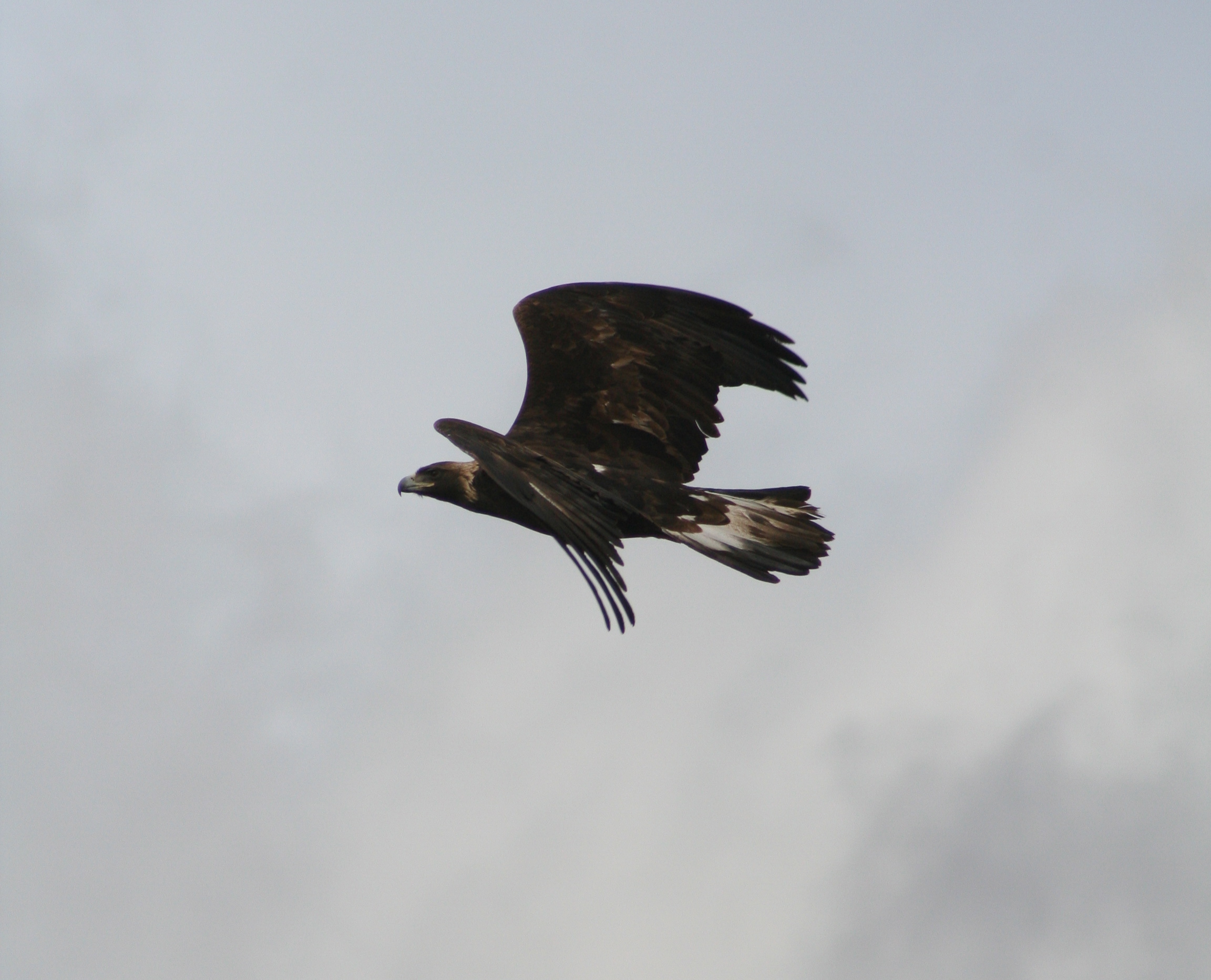
The Golden Eagle I would like to discuss was a bird I found atop a power pole just north of Milford. I was en route to the geothermal plant on my survey area, but I could not fight the urge to pull over and bother the poor bird. After a few minutes of tolerating my intrusion, the large eagle lifted from the pole. My camera went into action as the bird retreated into the air. My photos have afforded me a few good looks at the plumage of this bird, and the opportunity to analyze and learn what can help me make a conclusive decision in ageing Golden Eagles.

As a general rule, I have always used the presence of white on the wings as an indicator of a juvenile or subadult bird. As I have learned more, I have come to the realization that this criterion has its holes. The presence of white on the wings should never be used as an indicator of age. The certain indicator differentiating an adult from an immature bird is the presence of white on the tail, or the lack of complete adult feather sets. As the bird ages, it staggers its molt. By Year 3-4, or when the bird is in Basic III plumage, it molts its inner and outer most tail feathers creating a dark central band, or split looking tail.
As seen in the preceding picture, the bird I found had a seemingly complete white band on its tail, so it must not have reached Basic III plumage. Another hint to its age is the presence of the tawny “bar” on the top side of the wing. This bar that comprises the Upper-wing coverts can tell us whether the bird is a juvenile or not. If the tawny bar is lacking, then the bird is a juvenile, still in its first year. This bird has an obvious bar, so it must be in its second year, at least.
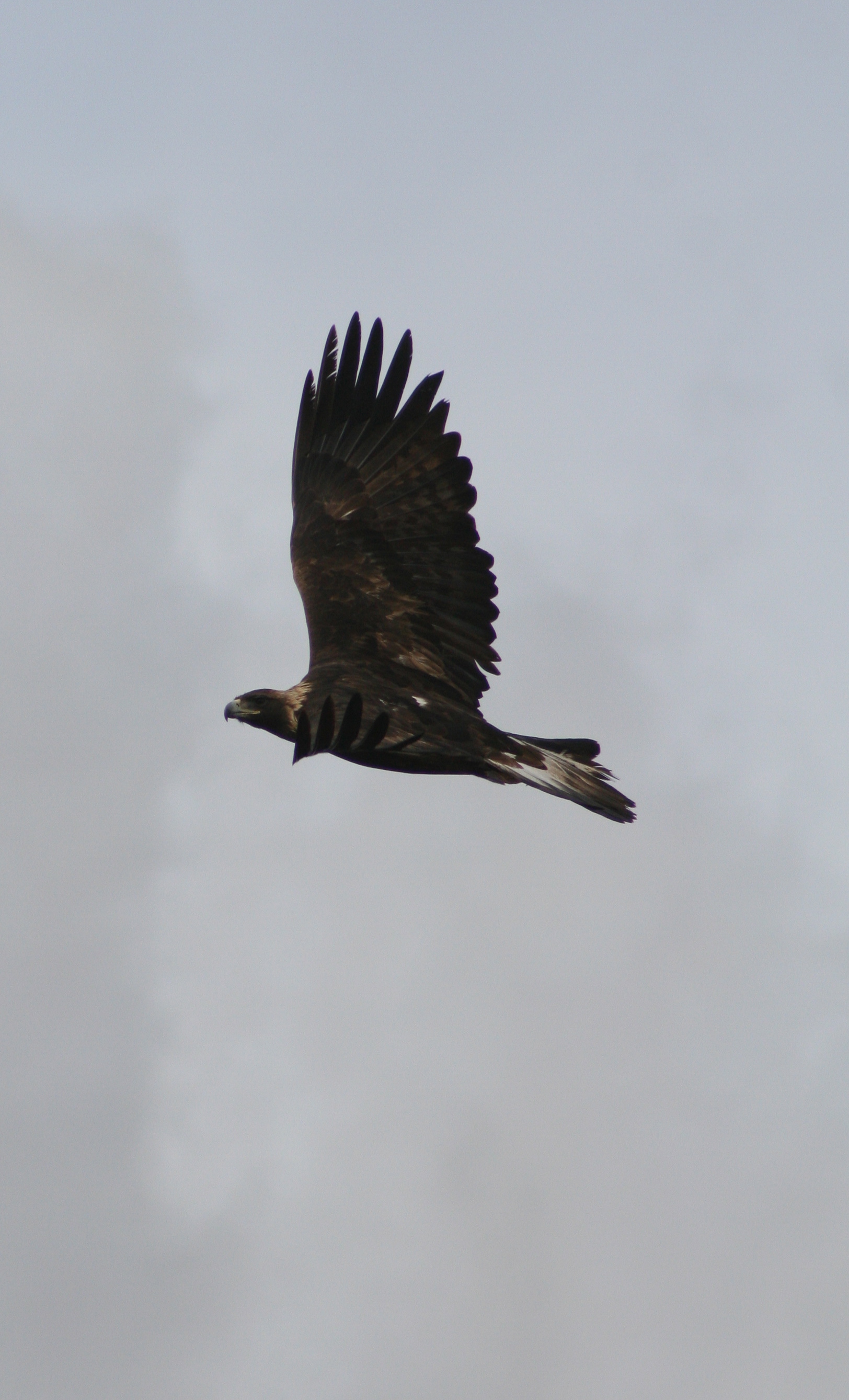
The conclusive factors indicating this birds age come from another photo showing the remiges. Assessing molt in the field can be difficult, in reality, nearly impossible, so photos provide the opportunity for a careful look at birds. Look at the primaries and secondaries for any disparities or anything that stands out. Even before I consulted Jerry Liguori, I had picked up on the fact that P9 and P10 on this bird looked very worn.
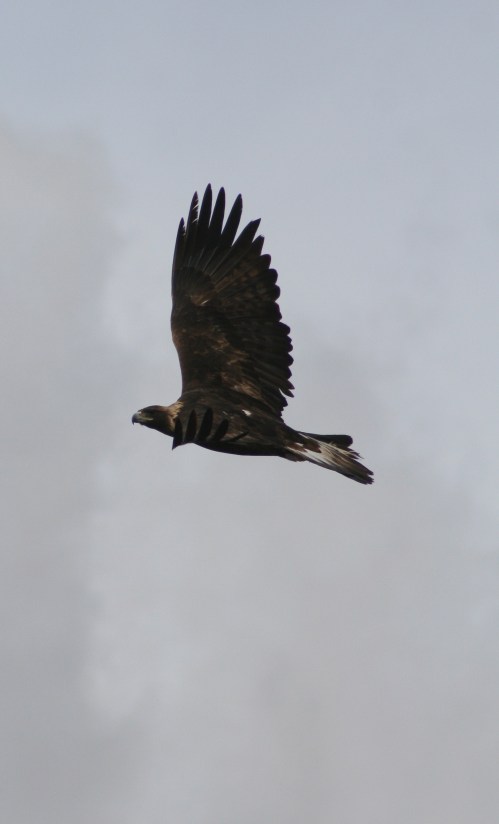
Often P1-P4 will molt in the first basic molt of the bird, then the next year P5-P8 will fall. The bird retains P9 and P10 into its third year. As the photo suggests, the worn and ragged look of P9 and P10 indicates just this fact. Also, the secondaries will drop in like fashion, and a bird in Basic II plumage may retain S3,S4, S8, or S9. These feathers protrude slightly past the trailing edge of the wing, as they are longer than the newer feathers. The bird I photographed shows this perfectly. S1 and S2 are obviously recessed in relation to S3. S8 and S9 stick out like a sore thumb. Seems conclusive to me. With the help of the camera, and some schooling from Jerry Liguori, I now have a precise identification; An immature Golden Eagle in basic II plumage, a 2-3 year old bird.
I would like to thank Jerry for his help with this discussion. My gratitude and respect is given for those willing to share their knowledge. The world would be nothing without those that are willing to teach.
I will soon be posting about juvenile Red-tailed Hawks, and Merlins.
Till then, happy birding.
B William




 ornithologi.com