
A studio for bird study

Tag: research

Fork-tailed Storm Petrel (Oceanodrama furcata) Foraging on Tidal Flats: Part 1

by Bryce W. Robinson

Video 1. Dan Ruthrauff photographs passing Fork-tailed Storm Petrel as the tide comes in. Bristol Bay coast, Alaska. September 2016.

Over my time on the Bristol Bay coast near the village of Egegik on the Alaska Peninsula, I was privy to one of the most incredible experiences I’ve ever had with birdlife. The experience is captured in video 1, which shows Dan Ruthrauff kneeling on tidal flats at low tide photographing passing Fork-tailed Storm Petrels at close range. I’d never heard of anything like this for any pelagic bird. It turned out to be a regular occurrence, but still appears quite novel so far as we understand Fork-tailed Storm Petrel foraging behaviors.
2L3A9888.jpg

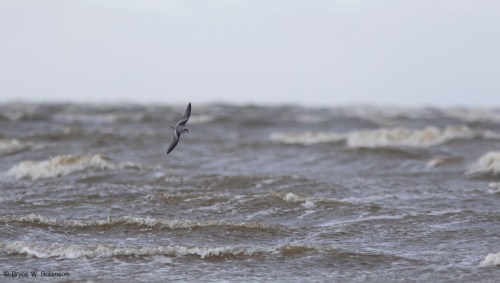
Photo 1. Fork-tailed Storm Petrel arcing down amidst a dynamic soar in high winds. This photo was taken from the shoreline at high tide. Bristol Bay coast, Alaska. September 2016.

Typical experiences with Fork-tailed Storm Petrels are like the image above: A dynamic soaring Hydrobatid at relatively close range. It’s very exciting, but nothing like walking through tidal flats surrounded by the birds.
2L3A1376.jpg

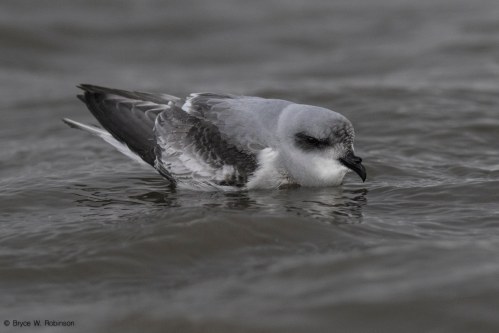
Photo 2. Fork-tailed Storm Petrel at rest on the water. I was standing in ankle deep water when this photo was taken. Bristol Bay coast, Alaska. September 2016

Other more typical experiences can provide observations such as the above photo, where calm water and resting birds near a boat might provide great views. Photo 2 is a bird that I stood near in ankle deep water. This bird was taking a moment to rest from foraging and seemed non-plussed by me. I’ve never heard of anything like it.
2L3A1113.jpg

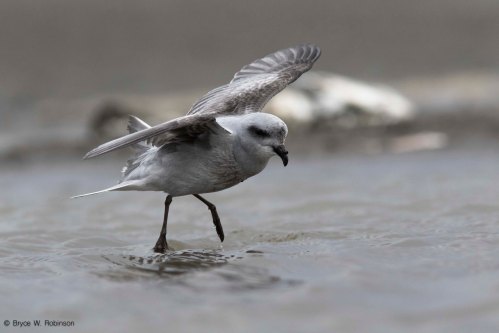
Photo 3. Fork-tailed Storm Petrel (Oceanodrama furcata) dabbing on water. I was lying on my belly when this photo was taken. Bristol Bay coast, Alaska. September 2016

The experiences continued for the entire two weeks I was on the Bristol Bay coast. After reading through the literature, the behavior seems undocumented and may warrant publication as a note. I’m excited to organize, avail myself of the literature, and share this experience with a crowd more knowledgeable and literate than myself. For me, experiences like these make field ornithology one of the best things about life.
Black-bellied Plover (Pluvialis squatarola) Feeding on a Jellyfish

by Bryce W. Robinson


For the past two weeks I stayed at a small cabin along the Bristol Bay coast of the Alaska Peninsula near the village of Egegik.  I was part of an expedition to trap staging Bar-tailed Godwits (Limosa lapponica) led by the shorebird aficionado Dan Ruthrauff of USGS, accompanied by Lucas DeCicco, Stuart Fety, and Jaime Welfelt. We had poor luck with godwits, but had a spectacular time with the avifauna that was present. I have a lot of content to share from the expedition, and will start by sharing a clip of a Black-bellied Plover (Pluvialis squatarola) feeding on a beached Hydromedusae (Jellyfish).

Although not mentioned in any literature on diet of the Black-bellied Plover (so far as I’ve found), there is discussion of the behavior for Rock Sandpiper (Calidris ptilocnemis; Gill et al. 2002). Apparently the birds feed on the gonads of washed up jellyfish. There were many jellyfish that were left on the tidal flats each day as the tide receded, providing an ample food source for staging plovers preparing for the next leg of their fall migration.

Referenced literature:

Gill, Robert E., Pavel S. Tomkovich and Brian J. McCaffery. (2002). Rock Sandpiper (Calidris ptilocnemis), The Birds of North America (P. G. Rodewald, Ed.). Ithaca: Cornell Lab of Ornithology; Retrieved from the Birds of North America: https://birdsna.org/Species-Account/bna/species/rocsan

DOI: 10.2173/bna.686


Spurting and Filter Feeding Behaviors of a Juvenile Red-necked Stint (Calidris ruficollis)

by Bryce W. Robinson


Apart from its scarcity and place as a formidable ID challenge, juvenile Red-necked Stint (Calidris ruficollis) is an excellent late summer encounter in Alaska because of its focus on feeding and building fat stores for migration. This focus makes the stint a great subject for close proximity observation, photography, and video. Interactive birds that tolerate your respectful but close proximity are the most fun.

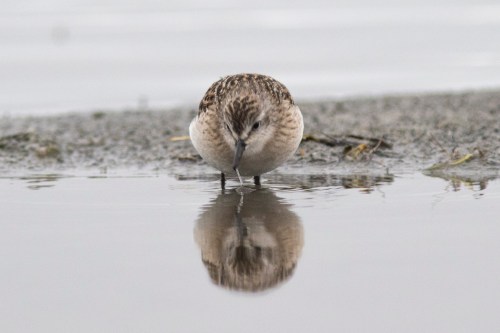
While taking advantage of one such bird, I noticed a somewhat atypical feeding behavior. I was able to capture the behavior in the clip above, as the bird sifts through the water, filter feeding in a way, and consumes small items when it happens upon them. I’ve seen this before in other peeps, but it is certainly an uncommon feeding behavior.

Spurting is an even more uncommon feeding behavior, but one that is regular in many shorebird species (Fellows 2013). Fellows (2013) offers the following description of the behavior: “the bird dips its bill into the water for a couple of seconds, or sometimes a bit longer, presumably to obtain food. It then withdraws its bill and slightly pushes its head forward, usually (though not always) with the bill lowered and then ejects or spurts a stream of water, as if ridding itself  of surplus liquid taken in while feeding underwater. The bill is then reinserted in the water and the sequence is repeated“.

I’d never seen anything spurt before until I watched this juvenile Red-necked Stint  filter feed in shallow water this summer. Unfortunately the video above doesn’t capture anything but filtering, but I was able to manage a decent photo of a spurting event.

2L3A8935.jpg

Photo 1. A spurting juvenile Red-necked Stint at Safety Sound, Alaska. Note the stream of water trailing from the birds bill.

I feel quite fortunate to bear witness to spurting behavior. Special thanks to my friend Luke for not only knowing the name of the behavior, but also letting me know of a note that names and details the behavior in shorebirds (Fellows 2013). Excellent behavior and excellent birding.

Referenced Literature:

Fellows, B. 2013. Spurting Behaviour in Wading Birds. Wader Study Group Bulletin 120(3) pp. 208-209

White Wagtail Breeding in Teller, Alaska

by Bryce W. Robinson


Working again in Nome this summer, although for a relatively short time, provided me with the opportunity to attempt to see some of the birds of the region that I had missed in previous years. One such bird was the White Wagtail (Motacilla alba). Before traveling to Nome, my friend Luke had informed me that he had already seen the species in a lagoon near the Red Knot camp, so my chances were promising.

Red Knot work was in full swing when I reached Nome, which limited the chance to try for the wagtails. In the meantime came a report of a White Wagtail AND a Common Ringed Plover (Charadrius hiaticula) in Teller some 40 miles from our camp. On 5 July, a day of rain and weather, we took advantage of the inability to work with Knots and headed to Teller to try for both birds.

2L3A0610

An alarm calling adult White Wagtail (Motacilla alba) in Teller, Alaska.

When we reached Teller we began the search, more focused on the plover than the wagtail as the bird was a lifer for most in the group and the wagtail was not. After 20 minutes of fruitless plover searching Luke spotted our other target, a wagtail at the north end of the village. Luke and I both set out to photograph and film the bird and soon realized it was carrying food. Another adult appeared, also with food, and our minds tipped to the possibility that these birds bred in the area. Jim (head of the Red Knot project) watched the food carrying adult and followed it back to an electricity box on the side of a nearby building. The bird entered the utility box, and exited without the food. We quickly backed the truck up below the box to gain access and check for nestlings. Sure enough a grass nest sat in the corner of the box containing small nestlings.

IMG_3945

Electricity box containing a White Wagtail (Motacilla alba) nest. Teller, Alaska.

IMG_2210

White Wagtail (Motacilla alba) nest. Teller, Alaska.

After quickly documenting the nesting situation we left and let the adults return to provisioning the young. At the end of the day we left Teller with an excellent experience with White Wagtail, but unfortunately no Common Ringed Plover. Such is birding.

A few weeks later on 22 July, Luke and I returned to Teller on another poor weather day to check on the success of the brood. We soon found multiple juvenile wagtails chasing the adults, begging for food. Luke mentioned that White Wagtail had bred in Teller in years past, but I was left feeling like I had just struck oil – My first White Wagtails, breeding at that!

2L3A8201

Juvenile White Wagtail (Motacilla alba). Teller, Alaska.

The experienced left me excited. I’ve found that the best way to deal with the hangover excitement of a great birding experience is to illustrate, so after the initial sighting of the adults in early July I took advantage of the next day of weather and painted a White Wagtail on the inset of my Nome 2016 sketch journal.

IMG_0441

White Wagtail (Motacilla alba) in the inset of a 2016 field season sketch book for birds of the Seward Peninsula, Alaska. 

Seeing a bird species for the first time, and one that is quite uncommon in North America at that, is the best of birding. Especially if it feels like its been a long time coming. To see the bird and gain a first hand account of its breeding habits, well that is something else. It has a context, and context is what makes my experiences fruitful. I love life histories of birds, especially regarding breeding. I consider this experience to be the example of the what I seek when I step out the door aimed at observing birdlife.

July 2016 in Nome, Alaska had some magic, or something. But it seems that it was a continuation of a theme that started in early May. I bet that if you were to ask anyone that traveled to Nome, AK in the summer of 2016 they would agree. It was special summer, and I can’t wait to hear reports of what the fall brings in the region.