
A studio for bird study

Tag: research

Banding Nestling Gyrfalcons in Western Alaska

by Bryce W. Robinson
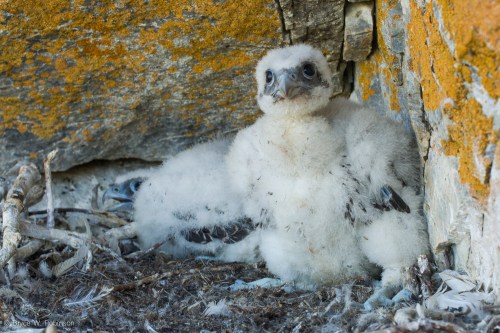
Gyrfalcon Nestlings

Photo 1. Gyrfalcon nestlings just after seeing their very first human being. One nestling is attempting to hide, while the other looks boldly into the eyes of the onlooking researcher.

The best part of working on a project focused on nesting Gyrfalcons is interacting with the nestlings. I can’t help but spend a moment or two to admire them each time I get one in my hands. They are young, yet full of personality and intelligence. I lose the ability to articulate the experience of dropping into a nest, and being the first human these nestlings have ever seen. Their response is remarkable, as they recognize me as an intruder and prepare to fight. There is, however, a certain degree of curiosity in their eyes. What impresses me most is their confidence, seen in their posture and stare.
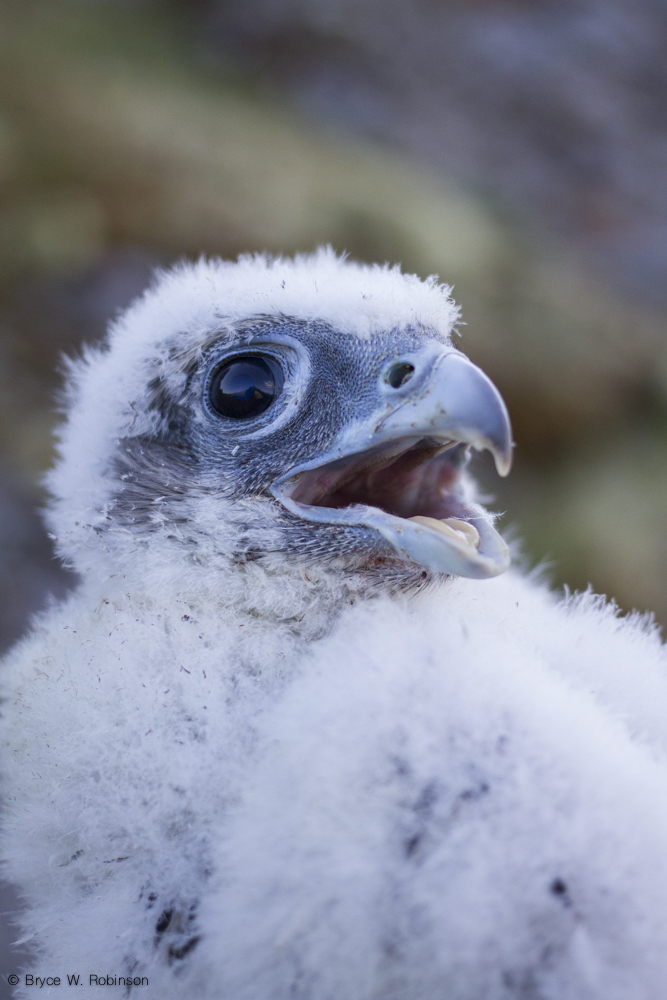
Female Gyrfalcon Nestling

Photo 2. A tenacious young female Gyrfalcon, age 25 days. She is full of fight and intelligence. This attitude will serve her well after she leaves the nest and needs to learn to hunt and kill to survive.

We schedule our second round of nest entries when the nestlings are 25 days old. At this point their legs have fully developed, so we can outfit them with aluminum USGS leg bands. These bands give them a unique identification number, so that if the bird is caught or found researchers can tell where the bird came from, and where it went.

Banding Gyrfalcon Nestlings

Photo 3. Crimping the “lock-on” band. Most Gyrfalcons take band size 7B. We put bands on the right leg, and crimp a metal fold-over to ensure this piece of leg jewelry stays with the bird for its entire life.

As the nestlings grow, they begin to realize the tools that evolution has provided them to hunt, kill, and defend themselves. When we enter the nests to band, the nestlings have developed into fighters. They bite, rip, and use their talons to lash at intruding researchers. Because of this newly developed tenacity, working with them takes its toll.

Part of the Work

Photo 4. A hand weathered by tenacious Gyrfalcon nestlings. This is part of the work. The young are held in a way that they are unable to bite the hands of the researcher, but they are intelligent and talented. Often, they figure a way to make us pay for the important data we collect.

It’s great to see youngsters that have so much fight. This aggressiveness will translate into behaviors necessary for their survival. Although the most aggressive young are not the most enjoyable to handle, it means the birds have what it takes to be a large falcon in the Arctic.
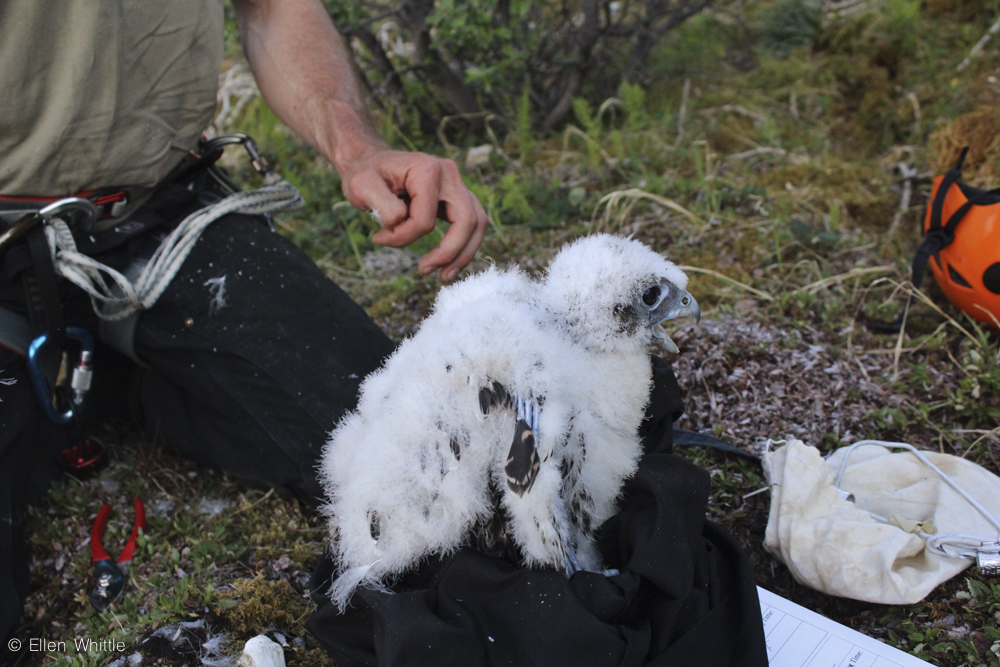
weight

Photo 5. Weighing a young Gyrfalcon. We weigh the nestlings to help calculate a general age, if unknown. Weight also helps us determine the health of the nestling.

Apart from banding, we have a number of other tasks to complete while handling the young. We take DNA samples, weights, wing and tail measurements to estimate age, and check for parasites. After each nestling receives its treatment, we switch out batteries and memory card in the nest camera. We will not come back to the nest until the young have left, so it’s important to make sure the camera continues taking data until the end.

So far, we’ve been to three of our twelve nests. Our hands have a lot more abuse ahead of them, but we are excited to continue nonetheless. More pictures and stories to come.

Thanks to Ellen Whittle for the photos of the work

Field Notes on Nesting Golden-crowned Sparrow

by Bryce W. Robinson

GCSP

Figure 1. Female Golden-crowned Sparrow – Zonotrichia atricapilla.

One of the perks of conducting research on Gyrfalcon’s in western Alaska is the time in the field to experience and study Alaska’s unique and diverse avifauna. I had never found the nest of a Golden-crowned Sparrow (Zonotrichia atricapilla) (Figure 1 & 3) until recently. The nest was at the base of a small willow shrub on a sparsely vegetated hillside dominated by lichen covered tundra. It was constructed of grass, was situated on the ground, and contained five eggs (Figure 2.). The egg color was a greenish blue with reddish brown splotching evenly spaced, but densely concentrated on the broad end of the asymmetrical elliptic egg (Figure 2).

GCSP_nest

Figure 2. Golden-crowned Sparrow nest. Note the Musk Ox guard hair in the bowl of the nest.

One thing I missed in the hurried attempt to photograph the nest and leave quickly was the hair in the bowl. It appears that the sparrow used the coarse guard hair of Musk Ox to line the nest bowl. Nests display the architectural and creative genius of birds. I am fascinated to see materials such as Musk Ox hair used in a nest, particularly in only one section such as the bowl. The area where I found the nest was covered with the fine wool from a Musk Ox, termed Qiviut. Why the bird did not use this fine wool, and chose coarse guard hair is enough to wonder upon.

GCSP

Figure 2. Female Golden-crowned Sparrow – Zonotrichia atricapilla.

While I was investigating the nest, the female remained close. I was impressed by her vigilance. She was anxious to continue incubating her clutch. I took her vigilance as a signal that my presence needed to be short, so I recorded the information I needed and quickly retreated. It’s an invaluable opportunity to be in such a place, where many unique and understudied birds are nesting all around. Truly, I’m in a field lab ripe for study, and I can’t take that for granted.

Notes on Gyrfalcon Molt

by Bryce W. Robinson

Adult Male Gyrfalcon - Falco rusticolus

Photo 1. Adult Male Gyrfalcon – Falco rusticolus

I like to pay attention to molt in birds. There are many aspects of a birds life history that can be reflected by their strategy for feather replacement. A great example is something I’ve been watching with the nesting Gyrfalcons I’ve been working with lately.

Last summer, I noticed something about the molt between male and female Gyrfalcons. While I was entering nests to install cameras in the early nesting period (mostly during incubation), I noticed that males were behind females in their molt progression. Following my initial observation, I started paying closer attention to each bird. I continue to take notes on this, and wanted to share the molt of a pair from a nest I visited recently.

Adult Female Gyrfalcon - Falco rusticolus

Photo 2. Adult Female Gyrfalcon – Falco rusticolus

You can see that the male (photo 1) has just dropped his fifth primary. Falcons generally begin their primary molt at P 4&5 and progress in two directions. The female (photo 2) has dropped her third, fourth, fifth, and sixth primaries. You can see P 4&5 are growing in already.

This illustrates a few simple things in the life of a Gyrfalcon. One, that energetics govern the ability to molt. Two, that male and female Gyrfalcons have different energetic roles and energy budgets during incubation and early brood rearing. They have different roles in the process. These are illustrated by the fact that they differ in the progression of their molt.

Later, the rates even out as both adults need to provision for their growing brood. I hope to get photos of this pair on my next visit to the nest in a few weeks.

Recording Evening Grosbeak Calls in the South Hills

by Bryce W. Robinson

Female Evening Grosbeak - Coccothraustes vespertinus.

Female Evening Grosbeak – Coccothraustes vespertinus.

Last weekend I journeyed to the Sawtooth National Forest in Southern Idaho. I was focused on recording the “South Hills” subspecies of the Red Crossbill. Due to the absence of Red Squirrel in the South Hills, the Lodgepole Pine of that area are absent of a seed predator, save the Red Crossbill. As such, the Red Crossbill have a steady food supply throughout the year, causing them to be resident rather than the typical seasonal nomadism of other Red Crossbills. The relationship with the Lodgepole Pine has become an arms race of sorts, where tree and bird are adapting one after another to overcome the each others adaptive advantage. This in turn has shaped the morphology of the crossbills. They are now distinct in morphological characters such as bill shape, but they are also distinct in call type which is likely a result of their long isolation from other crossbill populations. Thus is the reason for my interest in obtaining an audio recording. For a more complete story about the “South Hills” Red Crossbill (Type 9), see Benkman et al. 2009.

This is all in depth (and perhaps unnecessary) background to why I ventured to the South Hills. Regardless, I spent hours searching all areas that I was able, but to no avail. I couldn’t find the crossbills. Some roads were not open due to remaining snow, so my ability to search was limited. Still, I was disappointed. The birding was good nonetheless. So much so, in fact, that I was able to find another project to augment the absence of the Crossbills.

I found a small flock of Evening Grosbeak, a nomadic mountain dwelling finch that one does not happen upon enough.  The grosbeaks were vocal, so I took the opportunity to record their calls. After all, I didn’t want to leave empty handed. I’m happy I did, because after some research I’ve discovered that the Evening Grosbeaks are like the Red Crossbill, as they too have a number of distinct call types that correspond to particular groups. At the moment there are 4 recognized types.

Male Evening Grosbeak - Coccothraustes vespertinus

Male Evening Grosbeak – Coccothraustes vespertinus

Here is the recording I took of the Evening Grosbeak vocalizations:

http://www.xeno-canto.org/236817

From the spectrograms of this series of calls, I was able to identify the call type for this group, which corresponds to geographical origin and even perhaps subspecies (Sewall et al. 2004). The call type for these birds is Type 1 as we would expect in this area. Type 1 is a group that inhabits the northwestern portion of the range of the Evening Grosbeak. Below I’ve presented the first spectrogram of an identifiable call note in black and white, followed by a colored spectrogram. I couldn’t decide which was more attractive. Forgive the formatting of the spectrograms as well, I’m just starting to get a hang of how to produce these images.

BWR_EVGR_01

Figure 1. Two call notes given by an Evening Grosbeak. Time is shown on the x-axis in seconds, and frequency is shown on the y-axis in kHz. The call note on the left is the typical sweep call not unlike the flight call. This is the signature referred to as Type 1. The second call is a broad-band fluttered call. This particular bird was giving paired calls most often as illustrated, but at times calls were paired as two sweep calls (figure 2). Note the fundamental (darkest) with the first harmonic above each call.

Figure 1 shows a paired call, where the second call is quite different. The bird I was recording was repeating this sequence. I’ll need to research further to discover what the role of particular calls are, if it is even known. It is curious why these calls are paired, and why at times the bird would switch to a pair of the same call note (figure 2).

BWR_EVGR_02

Figure 2. Paired call of Evening Grosbeak, both as sweep Type 1 calls. This paired call was less common than the pair seen in figure 2 for the individual calling.

I’ve been learning quite a bit about bioacoustics, the role of sound in nature, and how to properly analyze sounds using particular software. I decided to take on this objective to test my ability to go into the field, find my subject, get a proper recording, look at the sound using software, produce spectrograms, and communicate ideas. I “failed” at my objective of finding my target subject, but in doing so I stumbled upon something that taught me quite a bit. I’m happy about that, as it is a lesson in making an effort. Inevitably there is always something to gain.

Perhaps one of the most important discoveries that came from recording the grosbeaks was finding an eBird article discussing one Ph.D. students aspirations to catalogue the different types of calls, where the true boundaries are, and how much intermixing happens between individuals where type boundaries occur. The students name is Aaron N. K. Haiman at University of California, Davis. He has requested that anyone and everyone record call notes of Evening Grosbeaks and share with him. So, I’ll be sending him my recordings along with the information on location, time of day, etc. to give the recording context.

All in all, I’d say I had a Saturday well spent.

Referenced Information:

Benkman, C.W., J.W. Smith, P.C. Keenan, T.l. Parchman, and L. Santisteban. 2009. A new species of Red Crossbill (Fringillidae: Loxia) from Idaho. The Condor 111(1):169–176

Sewall, K., R. Kelsey, and T.P. Hahn. 2004. Discrete variants of Evening Grosbeak flight calls. The Condor 106:161–165

http://ebird.org/content/me/news/evening-grosbeak-flight-call-types-how-much-overlap-occurs/