A studio for bird study

Tag: science

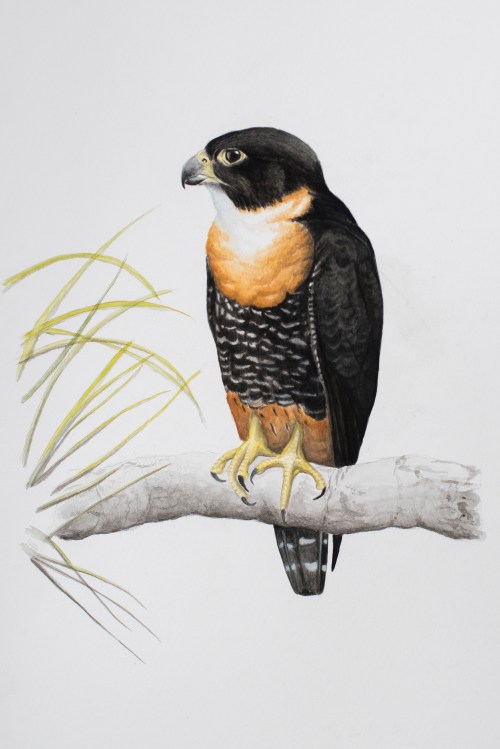
Orange-breasted Falcon Painting

by Bryce W. Robinson
2L3A4376.jpg

Orange-breasted Falcon (Falco deiroleucus). Gouache on watercolor paper. ©Bryce W. Robinson.

In a short time I’ll be heading south to northern Central America (primarily Belize and Guatemala) to research Orange-breasted Falcons (Falco deiroleucus). I’ll be working with The Peregrine Fund on their Orange-breasted Falcon project. My main focus will be assessing occupancy at historical territories, investigating potential territories, nest monitoring, banding nestlings, and assessing nest success. All work that I’m familiar with, but in a completely different system.

With the new system comes new opportunities to start fresh and learn. As a birder, my mouth is watering from the anticipation of learning new birdlife to a degree I have yet to experience. Field work with the falcon will be a great vehicle for learning this new bird life, as I’ll be immersed in the system daily, always paying attention to what is around me.

Alaska is an exciting place for an ornithologist, because it is still somewhat a frontier in our basic understanding of some of its birdlife. The Neotropics are similar, but to a greater degree. Due to the nature of the system, and the magnitude of its biodiversity, there is much work still to be done to fill in gaps in our basic understanding of the natural history of some species. This frontier is where I want to be, so I consider myself quite fortunate to begin a potentially five month stint in a place where so many opportunities lay.

I’ll be blogging birdlife along the way, including videos, photos, field sketches and stories. It’ll be a content heavy time, and I’m looking forward to it.

 

Great Blue Heron (Ardea herodias) Watercolor Painting

by Bryce W. Robinson

gbhe

When I was a kid, I poured over the Great Blue Heron (Ardea herodias). I’d spend hours near my house in Ithaca, NY, stalking this bird to get a better look. I was studying the bird, its habits and its behaviors, though I didn’t quite realize what I was doing at the time. I’d also spend hours sketching the bird. It was the first bird I drew, and I drew tirelessly.

Since I was a kid I’ve done a few Great Blue Heron illustrations and started a few paintings, but due to my diversified passion for birdlife I haven’t finished a painting of this subject since I was a kid. Finally, I had the opportunity to do so.

I look at the painting and I see loads to improve upon, but it’s so satisfying to see my illustrations as a child against the painting above. As I do, I reflect on my journey thus far in life and look forward to many more paintings to come.

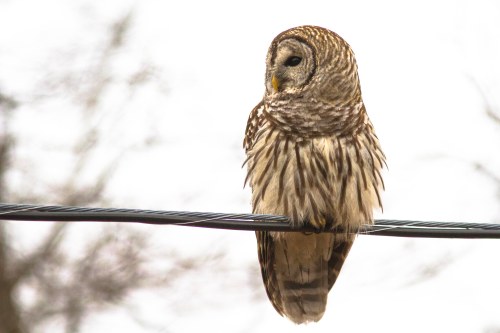
Barred Owl (Strix varia) Hunting at Mid-day

by Bryce W. Robinson


While out for a day of birding Maryland natural areas, Caitlin and I saw a Barred Owl perched on a power line along a two lane highway. I was shocked to see the bird on the line in the open, but more shocked at its alert behavior. The bird was hunting the road edge and it was mid-day.

I’m relatively uneducated about the Barred Owl. I thought these birds were strictly nocturnal and rarely active during the day. After doing some research, I’ve learned they occasionally hunt in daylight, however mostly in the first hour following sunset (Mazur and James 2000) . Despite some tendency towards daytime activity, it stills seems shocking this bird would actively hunt a road edge in the daylight. Either way, I thought I’d share.

_mg_4891


Referenced literature:

Mazur, Kurt M. and Paul C. James. (2000). Barred Owl (Strix varia), The Birds of North America (P. G. Rodewald, Ed.). Ithaca: Cornell Lab of Ornithology; Retrieved from the Birds of North America: https://birdsna.org/Species-Account/bna/species/brdowl

A Green Heron GIF to illustrate Tail Flicking Behavior

by Bryce W. Robinson

GRHE.gif

While photographing a vagrant juvenile Green Heron (Butorides virescens anthonyi) along the Boise River in early November, I noticed a behavior I wasn’t aware of for this species. When I would get a bit too close the heron would notice me, stop foraging, and flick it’s tail while it slowly walked away, as if it had a nervous tick.

Tail flicking is a behavior that many species exhibit. A recent study with the Black Phoebe found support for the explanation that tail flicking was a sign of vigilance to predators, a topic I’ve written about here. When the bird flicked its tail, the predator got the cue that the bird was aware of its presence and the predator had lost the advantage of surprise. This seemed to make sense in explaining the behavior of the Green Heron I stalked on the Boise River. Each time it began flicking its tail, I’d let off until it relaxed and continued to forage.