A studio for bird study

Tag: tundra

A Highlight of Birding- Breeding Sabine’s Gulls

by Bryce W. Robinson

IMG_7996

I can write a book about how many birding highlights I had this past summer on Alaska’s north slope. It seemed every day I had a memorable experience that will last a lifetime.

I’ve mentioned before that Richard Crossley came to Prudhoe Bay on my last week of work in the region. I agreed to guide him around the oil fields for a day and show him where I had seen particular species. He, of course, had an agenda, and I was tasked to help him out.

We had a hell of a day. I think we started around 8 in the morning, and by midnight, I was still wandering around the tundra photographing birds. He was very keen on finding the Sabine’s Gulls, a bird of which I had seen little. Still, I had a reliable spot that would likely turn up a few gulls, in the least. Just after midnight, we headed that way.

We stopped near the spot I planned to check, only to photograph a small group of Semipalmated and Pectoral Sandpipers. While Richard took photos, I scanned about. I then saw a single Sabine’s some yards away. I alerted Richard. After scanning about a bit, we found a dozen more.

Excitedly we approached the group of gulls and began photographing. The gulls would lift off, and take turns harassing us. Such behavior is typical of breeding birds, defending their young. I took advantage of their tenacity and let my shutter fly. After gathering more photos than necessary, I began the search for the young. Soon enough I found a single bird across a pond, sitting with an adult. It was nothing more than a single ball of grey fluff. So adorable, and so vulnerable.

Our intrusion lasted only a moment. We recognized the stress we were causing the birds, and left. It couldn’t have been better; finding Sabine’s, which I’d barely seen, and having the opportunity to see both adult and young at such close proximity. The experience will stick with me for my lifetime.

The tragedy comes with the benefits of digital photography. Through some glitch, I lost nearly all photos from that evening. Luckily, I have one. It is a photo in the striking midnight sun of the arctic, of a bird I will never forget, and hope to see again, somewhere on the open arctic tundra.

 

Hoary Redpolls on the Breeding Grounds

by Bryce W. Robinson

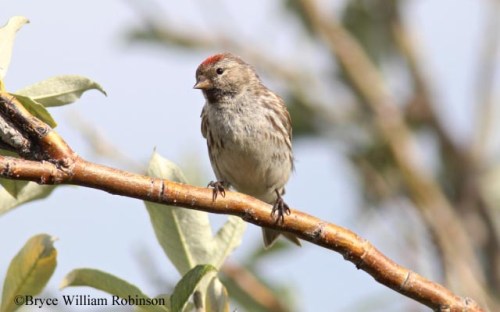
IMG_8096 copyBirders are obsessed with finding vagrants, the wayward members of any given species. They love the game of the rare encounter of a lost bird, and they love the game for good reason. I have had a year where I’ve experienced an aspect of birding quite the opposite of that game that the birders love. This year, I’ve been fortunate to be the vagrant myself, encountering many of North America’s species for the first time, but on their home grounds. This experience has been extremely satisfying, and I’d like to touch upon a few aspects of why, with one species, Carduelis hornemanni, the Hoary Redpoll.

IMG_8170 copy

On my way south from the Arctic Coastal Plain this past July, accompanied by Caitlin Davis and Richard Crossley, I resolved to experience a number of species as much as I was able. On the top of the list was the Hoary Redpoll. Luckily, both Richard and Caitlin were not in any hurry, and had the same agenda as myself. So we stopped a number of times along the Sagavanirktok River to search through the willow thickets in search of redpolls, among other species.

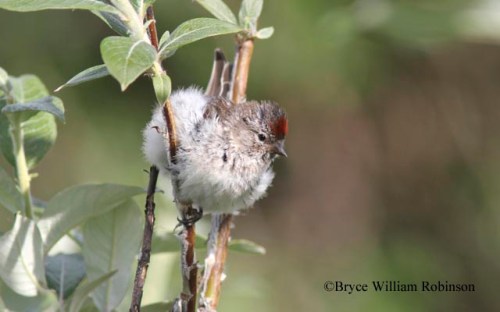
We were successful, as expected. One family group of redpolls were a bit cooperative, so I stood with Richard taking photos of as many individuals as I could as they passed along through the tickets. Richard and I discussed what we were seeing, and one topic of our discussions still sticks in my mind. The redpolls were not the bright white birds I had expected. Richard spoke openly about his ideas of the counterintuitive aspect of birds wearing darker, rather than our expectations of feathers fading to light. I liked his ideas, and thought it rather intuitive actually, that white feathers would degrade with age and the worn appearance would give the birds a dirty, dusky look. That certainly is what we saw with the redpolls.

IMG_8120 copy

The most satisfying aspect of seeing the Hoary Redpoll on its breeding grounds was seeing the juvenile birds in their juvenal plumage. Those birders that fail to wander to the extreme north and into the breeding range of the Hoary Redpoll will not get to see the birds at this stage, as the redpolls undergo their pre-formative molt before they depart for their wintering grounds. This was exciting for me, as I am making it an effort to experience as many bird species as possible at each stage of their lives. I want to see it all.

IMG_8112 copy

This experience introduced me to a new concept. I gained two lifers from seeing the Hoary Redpolls on their breeding grounds; of course the life bird, but also a life plumage type for the bird. As you age in your birding, you begin losing the opportunities of firsts, as far as species go, but if you supplement the experience with firsts for ages and plumage types, the list grows and the opportunity for new experiences becomes almost endless. Birding is wonderful in this regards, as it parallels the creed that in learning, the more you learn, the more you learn you didn’t know. And then the journey becomes endless, and to me, that is beautiful.


The Parasitic Jaeger, An Interactive Bird

by Bryce W. Robinson

IMG_7599 copy

One of my favorite parts of working on the tundra was experiencing the breeding behaviors of the Parasitic Jaegers, first hand.  In early June, when I first arrived on the tundra, I was impressed by the number of all three of North Americas Jaeger species. Many times, I watched dramatic pursuits of shorebirds, where two jaegers would cooperatively chase and capture their prey. As winged predators such as raptors seem to fascinate me above all else, these hunting forays were captivating. I had heard, but really had no idea the jaeger was such a fierce bird.

When the snow finally melted completely, the Pomarine Jaegers left the area. The large numbers of Long-tailed Jaegers seemed to decrease drastically as well. For some reason, the Parasitic Jaegers stayed, and formed territories. Luckily, one study plot of which I frequented, had a nesting pair of Parasitic Jaegers. I interacted with these birds for the entire season, and I’d like to share some of my encounters.

IMG_3094 copy

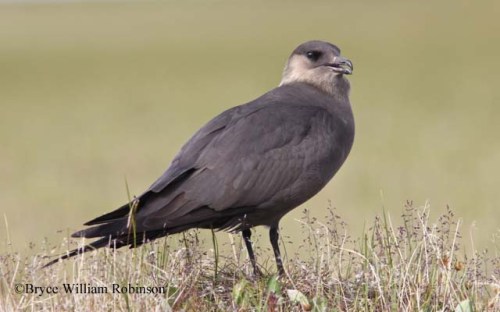
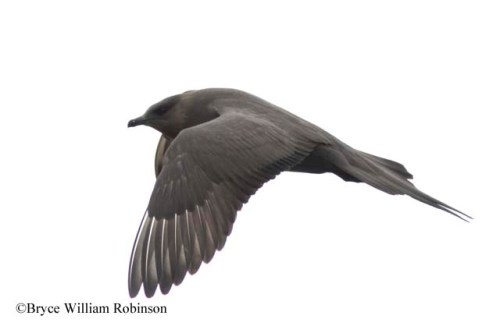
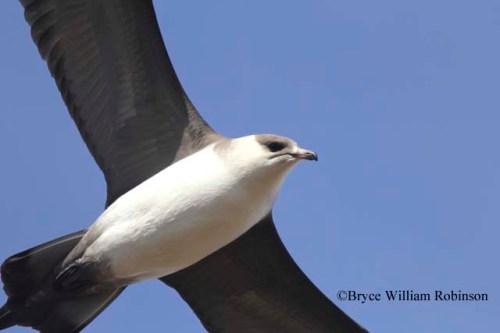
For the first few weeks, every time I walked through the jaeger’s territory, the birds would simply circle, vocalizing occasionally. This mild and cooperative behavior would soon change. In the meantime, it was enjoyable to photograph the birds, and contemplate their different plumages. The bird of which I believe is the male, sexed by behavior, is a solid dark morph. The female, is a very light and unmarked bird, quite unlike her mate.

IMG_3855 copy

When the birds actually initiated their nest, they became highly interactive creatures. The closer I came to the nest location, the more aggressive the jaegers became. Vocalizing constantly, the birds dove at my head. It was amusing to watch the birds heading straight for my face, and drop their cute little webbed feet. If it were a raptor with serious talons, the game would have been different, but webbed feet were ultimately non-threatening, and only made me giggle.

IMG_6403

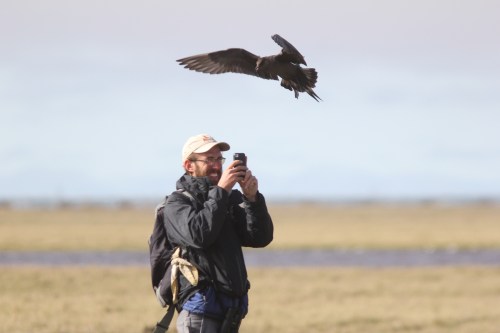
Above is a photo of me, giggling. I’m glad my girlfriend Caitlin was there with the camera to capture my elation. I think the photo shows how much this bird nerd enjoys bothering nesting Jaegers, and how much jaegers dislike bird nerds bothering their nest. In this instance, I was trying to record the experience of having birds swipe at your head. I took videos on multiple occasions, almost every time we walked through the territory, but only once was I smart enough to turn my phone and get a video formatted correctly. Below you can watch the jaegers attack me on a foggy day, and experience one of the many reasons I loved working on the arctic tundra.

New to the World, The Pectoral Sandpiper

by Bryce W. Robinson

IMG_7083 copy

I know I’ve promised photos of the chicks I’ve seen on the tundra, and have yet to share anything. I’ll admit, photographing these little things is a lot more challenging than I had imagined. They seem to never stop moving, and if you don’t keep a keen eye trained to them at all times, they hunker under some grass, no longer to be seen.

I have had a bit of luck, mainly with chicks that are a bit older. One thing I like about looking at lone chicks, is the exercise of identifying the bird. It is a bit tricky, but it forces you to pay attention to certain helpful traits, and ignore body plumage altogether. The first thing I noticed about the young Pectoral Sandpiper pictured above, is the distinctive bill. Pale at the base, dark at the tip, with a slight down curve, thinning at the end. Obviously a Pec!