A studio for bird study

Tag: video

Northern Hawk Owl- Surnia ulula

by Bryce W. Robinson

Yesterday, I travelled well out of my way with Caitlin Davis and Heidi Ware in search of a wayward Northern Hawk Owl. The journey to Moscow, Idaho from Boise is very long. Really, it’s too long if you don’t have a solid guarantee to see your target. We weren’t guaranteed, but it was a promising bet, enough to make us shoot for it.

Only minutes after arriving in town, we had located the owl. It was impossible for me to set the scene with my camera, given my 300mm lens and lack of any alternatives. I’ll have to attempt to paint the picture using words. It’s important, as the experience was quite peculiar.

For whatever reason, this hawk owl had decided to settle in the middle of town, to hunt an overgrown irrigation ditch next to a shopping center. The irrigation ditch is now unused. The area has succumbed to commercialization, with a shopping mall to the north, and what appeared to be a doctors office of some sort, and more store fronts to the south. Now the ditch serves as a remnant of a natural area, with a jogging path running alongside, so pedestrians can feel a bit of nature as they pass through the community. Here, the hawk owl felt enough nature to sit and hunt, for a few days at least. What a strange creature.

I’m captivated by bird behavior. Of all places, this bird felt comfortable enough to hunt along a busy roadside, in the middle of town. Optimal hunting habitat is not limited in the area surrounding Moscow. It’s quite rural there, with the surrounding farmlands likely boasting a host of mammalian prey.

I can come up many reasons why the bird felt comfortable here, related to presence of prey and a lack of predators, but I still think any explanation falls a bit short. It was simply one of those instances in life, a peculiarity. I’m thankful someone was aware enough to notice the strange looking bird, perched on a wire above the road.

The bird seemed to ignore we the birders, and kept about its business. It seemed focused. I was surprised by how active its hunting was. While we were watching the bird, about forty five minutes time, it switched perches over and over. It watched the ground, and would seem to come off perch in pursuit, only to fly to another perch. Sometimes, it would go to high light poles, or power lines, and then it would come low to a small tree top. There were even times it sat on the street signs.

I’ve always been intrigued with how animals interact with human society and infrastructure. This bird seemed to act as if it were a part of its daily life, to continue on its natural tasks, in the midst of a rather unnatural setting, as if it had always done so.
The Parasitic Jaeger, An Interactive Bird

by Bryce W. Robinson

IMG_7599 copy

One of my favorite parts of working on the tundra was experiencing the breeding behaviors of the Parasitic Jaegers, first hand.  In early June, when I first arrived on the tundra, I was impressed by the number of all three of North Americas Jaeger species. Many times, I watched dramatic pursuits of shorebirds, where two jaegers would cooperatively chase and capture their prey. As winged predators such as raptors seem to fascinate me above all else, these hunting forays were captivating. I had heard, but really had no idea the jaeger was such a fierce bird.

When the snow finally melted completely, the Pomarine Jaegers left the area. The large numbers of Long-tailed Jaegers seemed to decrease drastically as well. For some reason, the Parasitic Jaegers stayed, and formed territories. Luckily, one study plot of which I frequented, had a nesting pair of Parasitic Jaegers. I interacted with these birds for the entire season, and I’d like to share some of my encounters.

IMG_3094 copy

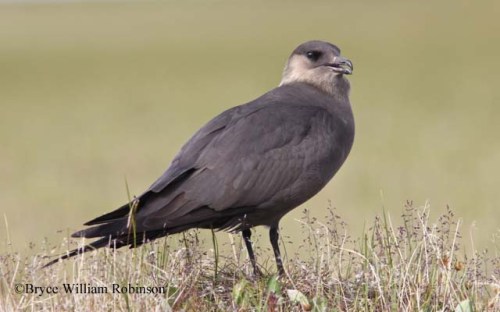
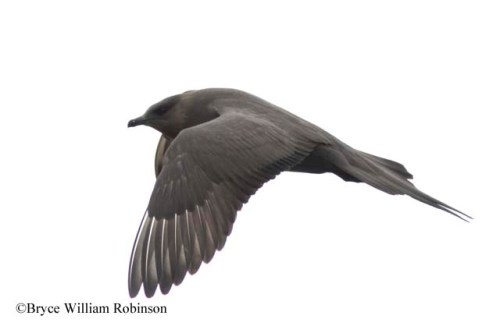
For the first few weeks, every time I walked through the jaeger’s territory, the birds would simply circle, vocalizing occasionally. This mild and cooperative behavior would soon change. In the meantime, it was enjoyable to photograph the birds, and contemplate their different plumages. The bird of which I believe is the male, sexed by behavior, is a solid dark morph. The female, is a very light and unmarked bird, quite unlike her mate.

IMG_3855 copy

When the birds actually initiated their nest, they became highly interactive creatures. The closer I came to the nest location, the more aggressive the jaegers became. Vocalizing constantly, the birds dove at my head. It was amusing to watch the birds heading straight for my face, and drop their cute little webbed feet. If it were a raptor with serious talons, the game would have been different, but webbed feet were ultimately non-threatening, and only made me giggle.

IMG_6403

Above is a photo of me, giggling. I’m glad my girlfriend Caitlin was there with the camera to capture my elation. I think the photo shows how much this bird nerd enjoys bothering nesting Jaegers, and how much jaegers dislike bird nerds bothering their nest. In this instance, I was trying to record the experience of having birds swipe at your head. I took videos on multiple occasions, almost every time we walked through the territory, but only once was I smart enough to turn my phone and get a video formatted correctly. Below you can watch the jaegers attack me on a foggy day, and experience one of the many reasons I loved working on the arctic tundra.

Red-tailed Hawk- Buteo jamaicensis Consuming Prey

by Bryce W. Robinson


I took this video the other day. At the beginning, you can see the bird reject the intestines of the rodent. Everything else is consumed. It is a bit long, but worth a watch. The hawk gets very animated towards the end. It is quite the treat to view, as a great deal of detail is visible.

I wonder about this bird. In the winter, it is difficult to distinguish visitors from residents. This is a unique looking bird. White on the lores, crown, and supercilium is not common amongst Utah’s western Red-tailed Hawks. Perhaps this is a bird from the north country. One cannot be sure, but it is fun to wonder.

Loggerhead Shrike- A Video Short

by Bryce W. Robinson


I have had extensive exposure to the Loggerhead Shrike, and I never grow tired of it. Last spring, I was exposed to numerous nesting shrikes in southern California, gaining insight into their breeding ecology and nesting behaviors. I am very excited to experience these things again this season, and plan to make a strident effort to document all peculiarities through photography and film.

I wanted to share this video short as an introduction to the bird. My friend Melissa posted some great photos of Loggerhead Shrikes as a highlighted species on her Birding Thursday project. I suggest checking them out here. One of the photos is of a bird and its prey, a horned lizard. I hope this video along with these photos create excitement and anticipation towards seeing some of the fruits of my nest work this spring.