A studio for bird study

Tag: wild

Orange-breasted Falcon Plucking Prey

by Bryce W. Robinson


For the Orange-breasted Falcon whose diet consists primarily of avian prey, to eat requires a great deal of work. First, the birds must capture a food item. They specialize in above canopy surprise and pursuit capture, a technique that blends a bit of skill and luck. When the two align and the bird finally captures a meal, they then must prepare it. Falcons prefer to ingest little amounts of feather from their prey items, and thus need to efficiently remove the extraneous feathers to access the muscle. To remove these feathers, they pluck their prey nearly clean. Plucking can be beautiful, as I found with the Orange-breasted Falcon in the video above as it prepared a Great-tailed Grackle. Perched on a limb high overlooking a deep river valley, the bird plucks. The observer can easily recognize the bird’s technique of rip and flick, as it efficiently carries out its daily ritual and feathers calmly drift away in the hot Central American air.

American Kestrel Painting – Male and Female

by Bryce W. Robinson

AMKE_Pair

I’ve painted the American Kestrel multiple times, and each is an improvement. But, all I see are the mistakes here. I struggle with being overly critical with myself, but I try to remember that the process and the growth are most important in my work. I learn a lot from each painting, about the birds structure, etc., but also about the process of painting. As I struggle with focusing on my faults, I’m working to stay focused on my growth, while recognizing the mistakes constructively. Hell, this exercise probably translates to everything in life, not just painting birds.

I’m going to make limited prints of this American Kestrel pair, so if you’re a kestrel lover click on the image and purchase a print.

Charadrius Plate

by Bryce W. Robinson

2L3A7578-2-01

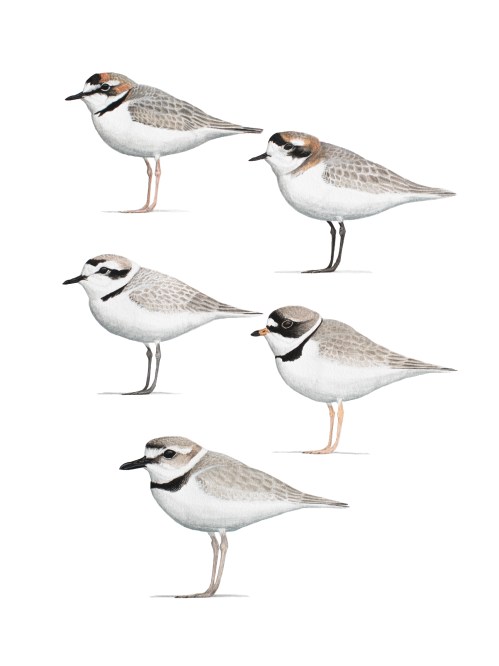
My friend Dan asked me to paint a shorebird plate for an auction at a conference that he will be attending in Peru in November. I chose to highlight the genus Charadrius for the plate, choosing five species from the new world. From the top, I’ve illustrated the Collared Plover (Charadrius collaris), Puna Plover (C. alticola), Snowy Plover (C. nivosus), Semipalmated Plover (C. semipalmatus), and Wilson’s Plover (C. wilsonia).

I learned a great deal from this painting. I am seeing a bit of growth in my painting over the past year, and this piece in particular represents a move forward. I’ll be painting many more plates that highlight species or subspecies groups.

Published in Western Birds: First Record of Breeding Eurasian Barn Swallows (ssp. gutturalis) in North America

by Bryce W. Robinson

Fig.3.jpg

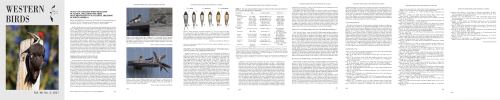
My friend Luke DeCicco and I published a paper in the Western Field Ornithologists journal Western Birds that details an observation I made during my last hours of the 2016 field season in Nome, Alaska. I happened upon four recently fledged Barn Swallows being provisioned by two adults, that were obviously white-bellied Eurasian birds. I couldn’t spend much time with them due to my departing flight, but I did my best to document everything in haste. The flight back to Anchorage was fun, as I sat there with my mind buzzing thinking of how to report this observation in the literature.

I asked my friend Luke be on the manuscript for a few reasons. First, Luke had identified a white-bellied bird in the same location (Nome DOT utility yard) a few days prior while we were loading our storage container. As such, I had my eyes open while traveling through the area when I spotted the birds being provisioned. Without his initial observation, I may have been effectively asleep at the wheel and may have missed the birds entirely. Birding was not the reason I was in the utility yard. Second, Luke has an impressive handle of the birdlife of Alaska, along with the connections necessary to expeditiously investigate the historical status of the species in the state, and to assess the potential that this record was indeed a first. In the end, he brought forward and engineered the aspect of the paper that is perhaps the most useful, an update on the status of Eurasian subspecies in AK, along with a summary of records of vagrant subspecies. The result is an article that will be very useful for folks in the future as they put their own observation into context. I feel really fortunate to have Luke’s contribution to this publication.

This publication represents a few firsts for me. Primarily it represents crossing a threshold in my career, as it is the first publication of mine where I have incorporated my passion for ornithological illustration. I painted a rendering of the differences between the subspecies discussed in text in the form of museum specimens. I’m very pleased with the figure, and I’m excited to continue to make illustration integral in my work.

The paper is worth a read for anyone interested in Alaska’s birdlife, and bird distributions in North America.

Click the image below and give it a read!
Untitled-1-01.jpg