A studio for bird study

Tag: wild

Gyrfalcons in Flight Print: A Gift for the Falcon Enthusiast

by Bryce W. Robinson

GYRF_Plate.jpg

Gyrfalcons in Flight. From left to right, juvenile gray morph, adult gray morph, and adult white morph. 10×20″ Giclee print comprising three Gouache paintings by Bryce W. Robinson. Purchase this print in the store. $40 + shipping and handling.

If you’re looking for a gift for a falcon or raptor lover, or even for the general bird lover, consider this print available in the ornithologi shop. This print details three Gyrfalcons that I painted while working in Alaska in the summer and fall of 2016.

A Green Heron GIF to illustrate Tail Flicking Behavior

by Bryce W. Robinson

GRHE.gif

While photographing a vagrant juvenile Green Heron (Butorides virescens anthonyi) along the Boise River in early November, I noticed a behavior I wasn’t aware of for this species. When I would get a bit too close the heron would notice me, stop foraging, and flick it’s tail while it slowly walked away, as if it had a nervous tick.

Tail flicking is a behavior that many species exhibit. A recent study with the Black Phoebe found support for the explanation that tail flicking was a sign of vigilance to predators, a topic I’ve written about here. When the bird flicked its tail, the predator got the cue that the bird was aware of its presence and the predator had lost the advantage of surprise. This seemed to make sense in explaining the behavior of the Green Heron I stalked on the Boise River. Each time it began flicking its tail, I’d let off until it relaxed and continued to forage.

Swallow-tailed Kite Movements

by Bryce W. Robinson

Swallow-Tailed Kite - Elanoides forficatus. 11 x 17

Swallow-Tailed Kite – Elanoides forficatus. 11 x 17″ prismacolor on bristol.

I illustrated this Swallow-tailed Kite for my friend Russ. He found Arizona’s first state record back in 2012, so understandably the Swallow-tailed is a special bird to him. You can see the accepted record here:

http://abc.azfo.org/ABCVote/_ABCReports_Public_View_list.aspx

It would be so exciting to see an unexpected X soaring high above the desert. Lately, Swallow-tailed Kites have been showing up in some odd places. For whatever reason a few birds have strayed farther north than their normal range. In this past weeks Rare Bird Alert on the ABA Blog, four separate sightings of the species were made in three different states: Illinois, Indiana, and Kansas. Sometimes birds make strange movements in great distances. You never know, you might be at a hawk watch this fall somewhere in the west and see a large X soaring in the sky. Better start scanning…

Plumage in Transition: Red Phalarope Pre-Basic Molt

by Bryce W. Robinson

REPH_1505

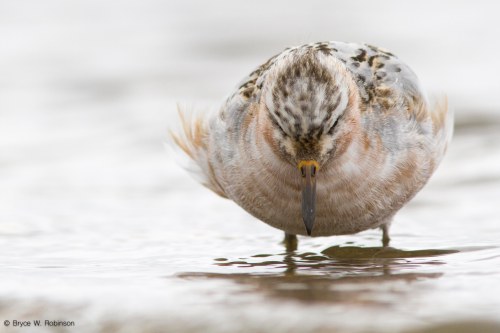
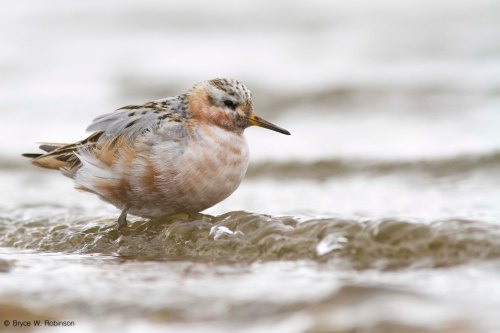
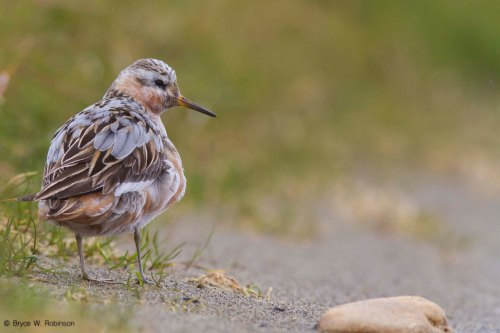
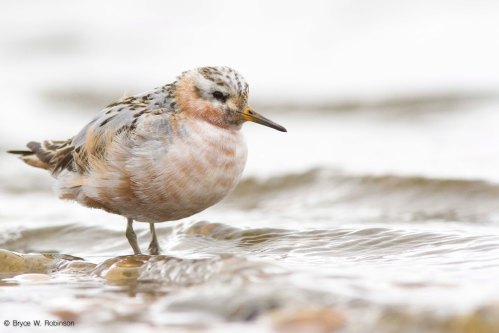
I don’t often post a large amount of photos from one subject, but I think this bird deserves the coverage. I was birding the western Alaskan coastline with my friends Neil and Ellen the other day when we found this male Red Phalarope – Phalaropus fulicarius. Even better, the bird was mid-way through its pre-basic molt, giving it a unique look. This was the first time I’d ever seen this transitional plumage. REPH_1501
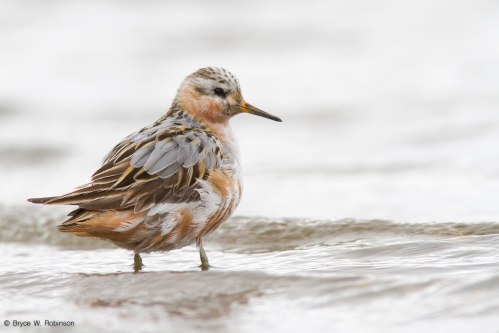
The new feathers of the basic plumage are blue-grey. The old feathers of the alternate plumage are gold and black. It’s a striking difference. Also note the orange body feathers of the alternate plumage, and the white feathers of the basic plumage. These birds are so colorful during their breeding periods on the pools of the Arctic tundra, but after this short period ends they molt into a cool plumage reminiscent of their winter haunts, the open ocean and coastlines. These color changes mean something, or better put, they have context. What a satisfying process, to see a bird in a state like this male and recall that the appearance has a story (begs the question, why the difference in appearance between seasons?).
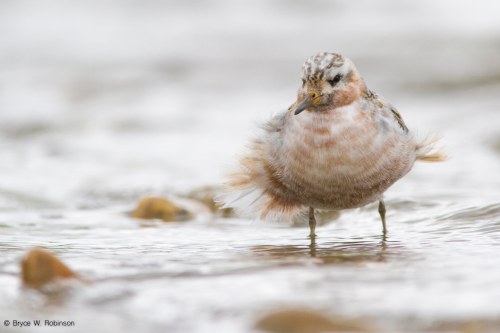
REPH_1502

Although the bird was midway through its molt, it is still identifiable as a male. You can see in the crown that the retained feathers are brown and gold. If it were a female, these retained feathers would be wholly black, and bold. The gold and brown around the face and on the nape also tell its sex.
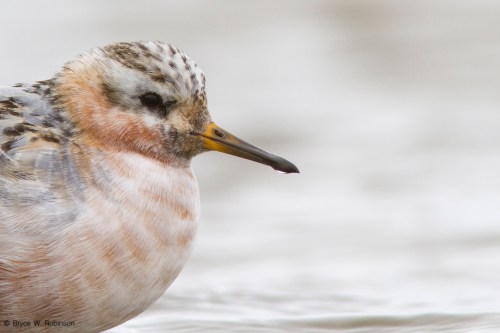
REPH_1503

This bird was so cooperative that I was able to take my fill of photos. It’s rare to see this species in a plumage such as this, so I’m happy that I was able to capture many different angles and views, truly document the bird, and even put the camera down and simply watch. I feel spoiled with the way the birding has been lately here in western Alaska. Too many great things to see, too may things to shoot with the camera, too many experiences to write about. Just the way life should be.REPH_1505REPH_1504 REPH_1507 REPH_1509