Gyrfalcons in Flight. From left to right, juvenile gray morph, adult gray morph, and adult white morph. 10×20″ Giclee print comprising three Gouache paintings by Bryce W. Robinson. Purchase this print in the store. $40 + shipping and handling.
If you’re looking for a gift for a falcon or raptor lover, or even for the general bird lover, consider this print available in the ornithologi shop. This print details three Gyrfalcons that I painted while working in Alaska in the summer and fall of 2016.
I had a great weekend. A few friends and I made the short road trip from Boise to the Oregon coast to see the ABA areas second record of Common Scoter (Melanitta nigra). The Common Scoter breeds across Europe and Asia, and most closely resembles the Black Scoter (Melanitta americana). The first record for this species was surprisingly only last year in Northern California.
We had no trouble finding the bird when we arrived, because there were already many birders on location. We were lucky though, it was high tide and the bird had come up river to preen and feed. I stood on a bridge with the bird nearly directly below me and took photos and video.
Male Common Scoter (Melanitta nigra). Second ABA record, Lincoln City, Oregon. November 2016.
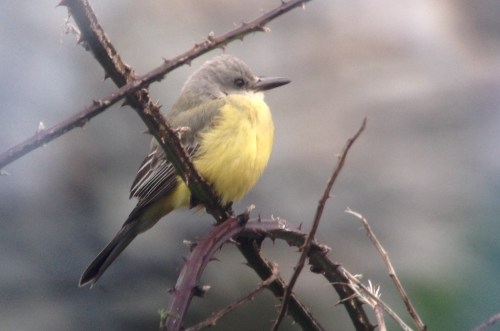
We birded the area after getting our fill, including sea watching which never disappoints folks from inland. We also bagged another lost bird, a Tropical Kingbird a few miles down the road from the scoter stake-out. Overall it was an excellent trip with good friends.
Digiscoped photo of a Tropical Kingbird (Tyrannus melancholicus) in Lincoln City, Oregon.
While photographing a vagrant juvenile Green Heron (Butorides virescens anthonyi) along the Boise River in early November, I noticed a behavior I wasn’t aware of for this species. When I would get a bit too close the heron would notice me, stop foraging, and flick it’s tail while it slowly walked away, as if it had a nervous tick.
Tail flicking is a behavior that many species exhibit. A recent study with the Black Phoebe found support for the explanation that tail flicking was a sign of vigilance to predators, a topic I’ve written about here. When the bird flicked its tail, the predator got the cue that the bird was aware of its presence and the predator had lost the advantage of surprise. This seemed to make sense in explaining the behavior of the Green Heron I stalked on the Boise River. Each time it began flicking its tail, I’d let off until it relaxed and continued to forage.
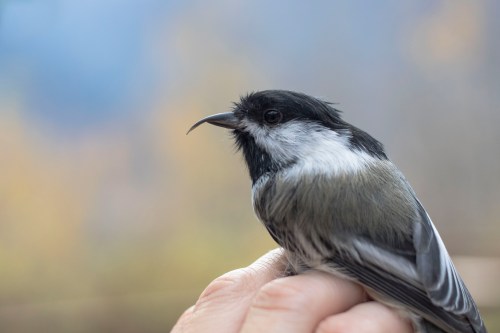
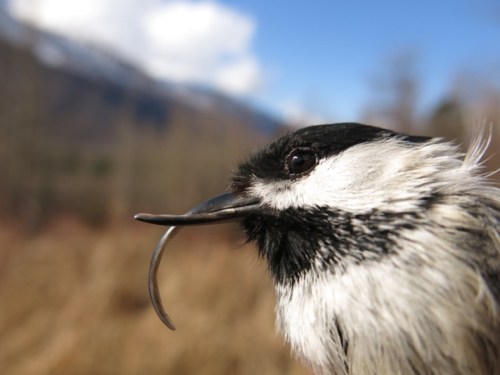
Photo 1. Female Black-capped Chickadee (Poecile atricapilla) with bill deformity.
I recently had the pleasure of spending a few days with my friend Rachel Richardson of USGS trapping birds in the Eagle River Valley of south-central Alaska. We captured a few species such as Black-capped and Boreal Chickadees (Poecile atricapilla and P. hudsonicus, respectively), and Red-breasted Nuthatch (Sitta canadensis). USGS has been trapping in these areas for years with the main focus of monitoring bill deformities, the prevalence of Avian Keratin Disorder, and the prevailing causes of a new found virus, Poecivirus.
The Alaska Science Center of USGS in Anchorage is part of a team of researchers, including the California Academy of Sciences, and the University of California San Francisco that have been investigating the causes of Avian Keratin Disorder for over ten years. Avian Keratin Disorder was first documented in Alaska in the 1990’s by Colleen Handel of USGS who leads the research team at the Alaska Science Center. In an article in Molecular Biology that came out in July 2016 (Zylberberg 2016), the team reports on the discovery of a new virus they termed Poecivirus, which may be responsible for the bill deformities.
Appropriately, the discovery is receiving a good deal of press. Below are a few links to national and international articles that detail the work and the discovery. All are worth a read (or a watch):
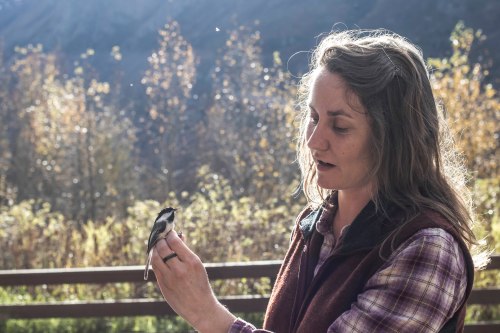
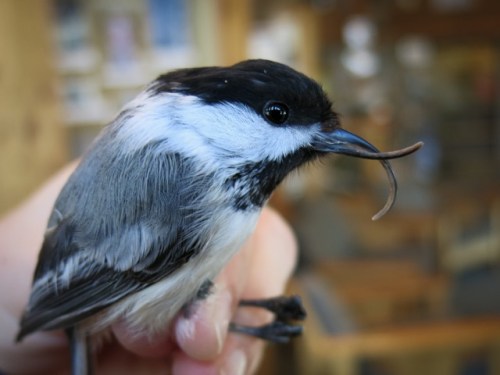
Photo 2. Rachel Richardson of the USGS Alaska Science Center holding a female Black-capped Chickadee (Poecile atricapilla) with a bill deformity.
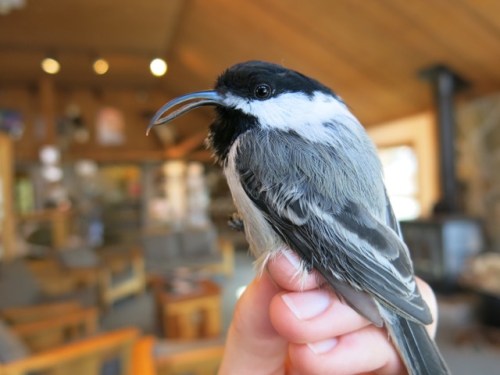
On the day I spent with Rachel in the field trapping birds, we only had one Black-capped Chickadee show up with a deformity. However, the one bird had an interesting story. This female (Photo 1) was first captured in 2015 and had no signs of any deformity. This year she obviously has a developing deformity. Her bill grew 5.1 mm in one year, a 70% increase in length. Whether or not this developing deformity will impact her ability to forage, preen, or even breed and provision young is yet to be determined. There are reports of deformed birds successfully rearing offspring, however it is without question that the deformities present a handicap that will ultimately reduce the individuals fitness.
It is important to track the rates and severity of deformities across the world. Because of this, the Alaska Science Center has developed a submission form for anyone to report their sightings of deformities. Please contribute to this effort and submit details of any sightings of elongated bills, including photos and location along with any other evidence for Avian Keratin Disorder at the following website:
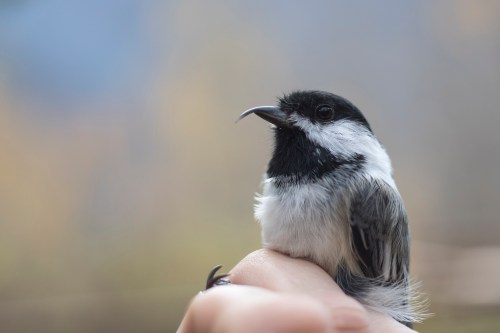
Photo 3. Female Black-capped Chickadee (Poecile atricapilla) with bill deformity.
Below are additional examples of AKD in Chickadees that have been captured as part of the Alaska Science Center’s efforts near Anchorage. These individuals unfortunately have more developed deformities than the chickadee we caught while I was tagging along.
Photo 4. Black-capped Chickadee (Poecile atricapillus) with bill deformity. Photo copyright Rachel M. Richardson.
Photo 5. Black-capped Chickadee (Poecile atricapillus) with bill deformity. Photo copyright Rachel M. Richardson.
Photo 6. Black-capped Chickadee (Poecile atricapilla) with bill deformity. Photo copyright Rachel M. Richardson.
It’s excellent to have a breakthrough and a step forward. However, the problem still remains as well as the daunting task of discovering the correlation between Poecivirus and bill deformities, the causes of both, and what role humanity plays in the prevalence and transmission of either. I’d like to tip my hat to those who have done so much great work on this issue thus far. Keep up the good work.
Referenced Literature
Maxine Zylberberg, Caroline Van Hemert, John P. Dumbacher, Colleen M. Handel, Tarik Tihan and Joseph L. DeRisi. Novel Picornavirus Associated with Avian Keratin Disorder in Alaskan Birds. mBio, July 2016 DOI: 10.1128/mBio.00874-16




 ornithologi.com