A studio for bird study

Tag: wildlife

Learning New Skills – Preparing Study Skins

by Bryce W. Robinson

From left to right: Sora - Porzana carolina, 2 male Brown-headed Cowbirds - Molothrus ater, 2 female Brown-headed Cowbirds - Molothrus ater

From left to right: Sora – Porzana carolina, 2 male Brown-headed Cowbirds – Molothrus ater, 2 female Brown-headed Cowbirds – Molothrus ater, all drying after preparation.

I’ve embarked on a new adventure in my ornithological education. I am now learning how to prepare study skins for museum collections with the help of my advisor Dr. David Anderson. My personal catalogue number 001 is a female Brown-headed Cowbird – Molothrus ater (farthest right specimen in the photo).

This is a new experience for me, and one that I’ve been looking forward to for a very long time. I’ll be sharing what I learn along the way.
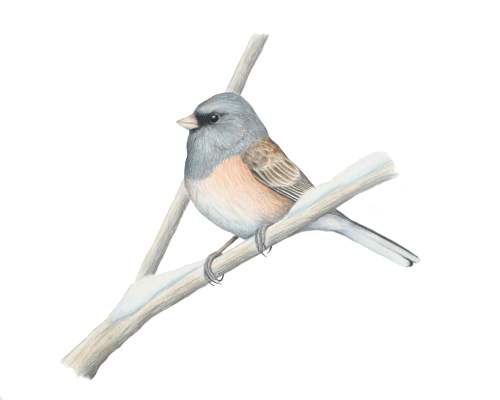
The Christmas Bird 2014 – “Pink-sided” Dark-eyed Junco

by Bryce W. Robinson

junco_copy

This year I chose a more common and well known winter bird for my annual year-end illustration The Christmas Bird. I chose a Dark-eyed Junco – Junco hyemalis, more colloquially known as a snowbird. The bird is fitting to represent the season, but I thought I’d make a bit of a twist to satisfy the nerds among us. I illustrated the subspecies mearnsi, the Pink-sided Junco. Those in the Rocky Mountain west are familiar with this bird, as it frequents feeders in mixed flocks with other Junco subspecies. It’s always a treat to see the distinctive pale blue-grey hood with a dark mask. I make sure to pay attention to the subspecies composition of Junco flocks here in western Idaho. We have flocks consisting mainly of “Oregon” Juncos, but occasionally we have “Slate-colored”, “Cassiar”, and the “Pink-sided”.

It is a bit strange to think that we are all at that point in the year once again. I certainly had a great year full of many birding adventures (3.5 months in western Alaska), plenty of satisfying illustrations, and loads of study and learning. I hope that others had an equally satisfying year. Here’s to another year of study and learning. Happy Holidays, and Happy New Year.

Black Turnstone Feeding Behavior

by Bryce W. Robinson


It is a great experience to see behaviors that obviously gave rise to a creature’s name. The Black Turnstone – Arenaria melanocephala is black, and feeds in the most interesting way as its name implies. It frequents rocky shorelines and turns stones to find food. I was lucky enough to find two birds staging along a tidal pool in western Alaska. The birds were living up to their namesake, turning stones vigorously in search of food.

Another aspect of observation that gives me satisfaction is recognizing a behaviors role in shaping morphology. The turnstone has a unique bill shape, adapted to gain leverage and flip stones in an effortless manner. What I’d like to investigate is the difference in muscle morphology in the neck and back between other close relatives that do not engage in this behavior.

“Behavior birding” holds a treasure trove of opportunities to ask questions and learn great lessons that further understanding of the bird world.


Juvenile Gyrfalcon – Falco rusticolus

by Bryce W. Robinson

Juvenile Gyrfalcon - Falco rusticolus. Image taken 7 July, 2014 at an eyrie in Western Alaska.

Juvenile Gyrfalcon – Falco rusticolus. Image taken 7 July, 2014 at an eyrie in Western Alaska.

I’m working on research that is meant to highlight the key parts of what Gyrfalcons eat while they are raising their young, and how any changes may impact their ability to thrive. I’ve gained an appreciation for the amount of effort and energy that is required to transform an egg into a Gyrfalcon capable of flight. The entire lives of the parents during this period revolves around the need for food and the care of the young. It is an impressive spectacle, and a wonder that they are able to put out young so successfully.

Additionally, I’ve come to an appreciation of the fact that the existence of these creatures depends solely on the destruction of other life. They destroy to thrive. This fact seems almost antithetical, but it touches upon an absolute in nature. That absolute is that both the burgeon and termination of life is all part of the natural flow of energy. This absolute keeps me on my path to explore birdlife and ensure that this flow continues for as long as I am responsible.