Blythe, California is not a destination for most. The small town is a bit run down and simple, not necessarily what anyone would have in mind when thinking of southern California. Still I have found beauty here. Surrounding the small town are green fields of alfalfa and other agricultural developments. I find myself here for work, living from a motel, and birding the surrounding farmlands for leisure. Possibly my favorite part of being in Blythe is the proximity of one of the west’s greatest river, and undoubtedly my favorite, the Colorado. As you can imagine, the unnatural clear waters of the southern Colorado draw in a number of birdlife and create a wonderful scene for birding adventures. Truly the river is the only reason numerous green fields scatter the desert countryside.
While out birding the agriculture fields Yesterday, a co-worker spotted a treasure just outside of town. Along the roadside, atop an irrigation sluice gate, sat a docile Burrowing Owl. We watched the bird as it dozed, occasionally glancing around but otherwise disinterested in going-ons. I couldn’t stop myself from snapping shots, but due to the size of the bird, and our distance, I was dissatisfied with any of the photos I came away with.
Today I took hope in the chance that the bird would be in the same place, and sure enough the bird sat vigil to the same scene. This time around I resolved to decrease the distance between the owl and myself. I succeeded and the bird payed no mind. Still, the photos I have leave me wanting, but with the excitement of the experience and my desire to share, I have decided to include the bird in my report.

Burrowing Owl- Athene cuniculeria
Burrowing Owls are one of the most charismatic members of the avian community. Their mannerisms can be extremely amusing at times. I will surely be visiting this bird often, and documenting our time together.
I haven’t spent much time birding outside of Utah, and as a result, I am seeing many new birds. Among these include a few flycatchers that are not present or numerous back home. Apparently someone spotted a Vermillion Flycatcher the other day by the river, so I will certainly be after that till I see it. I did have a little related luck today in finding a tyrant, the Black Phoebe. This bird is wonderful, and I believe it has entered my mind as a candidate for future illustrations. Soon, very soon. Until then, a photo will suffice.

Black Phoebe- Sayornis nigricans
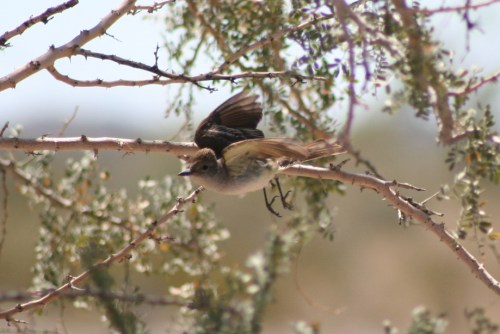
Another Tyrant that I have not known well till now is the Say’s Phoebe. Here in the Mojave, the Say’s are numerous, but I do not complain. They are a treat to and a wonder to watch, drawing me into their world.

Say's Phoebe- Sayornis saya
Of course with flooded green fields come insects and food for numbers of birds. I was delighted and surprised when I found a flock of white birds in an alfalfa field. It has been years since I have seen the Cattle Egret. These small birds belong to a group that are special to me. Watching them brings me back to my younger years of birding, and reminds me what I am searching for when watching birds. As with most of the birds of the day, the egrets I found were tolerant and cooperative.

Cattle Egret- Bubulcus ibis
The shores of the river housed a great deal of birds. As always, waterfowl were scattered across the mellow current. The American Coot was numerous, but intermixed and occasionally, I found some interesting birds. The other waterfowl that floated along included the Ring-necked Duck, the Canvasback, the Mallard, and a few Common Goldeneye. While watching a small group of Goldeneye, I noticed a Barrow’s Goldeneye grouped with a Common. This is probably a normal occurrence, but it was new to me.

Female Common, Male Barrow's, and Male Common Goldeneye, respectively.
Our raptor total of the day was incredible. Within a five minute interval, we saw three species of Falconidae, ending with a circling Prairie Falcon. I was unable to get any acceptable photos of any of the birds. This will be a task for the time to come, but for now I would like to share a photo that is a first of mine. I have never photographed the Turkey Vulture in flight, yet I felt the need and took the time and I believe it paid off. It is indeed a task of mine to maintain a comprehensive photo library, and the Turkey Vulture is certainly and integral part of a complete list.

Turkey Vulture- Cathartes aura
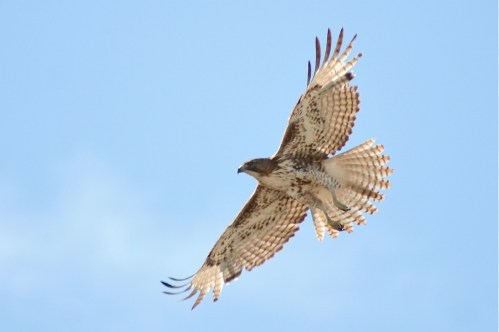
While working, I have been monitoring a few nesting Red-tailed Hawks. Of course the bird is a favorite and even a fascination of mine. I must admit I was surprised to see the difference in the birds this far south from those present back home.. The birds I have seen so far only add to my desire to learn more about plumage variations in this incredible buteo. I have been chasing some birds in hopes of photographing the them in good posture from below, illustrating in whole their plumage, to cross reference with the photos I have from the birds back in Utah. So far I have been unlucky, but I will continue to try.

Adult Light-morph Western Red-tailed Hawk- Buteo jamaicensis calurus
I wouldn’t recommend Blythe as a destination for most, but for birders, I would suggest spending the time, as you pass through on I-10, to exit and visit the river and the adjacent farmlands. If you have never birded the desert of southern California then I certainly suggest. I will continue to bird the area, and report what I find. Soon, I hope to convey the unrecognized ecological treasures that the town of Blythe presents.



 ornithologi.com