A studio for bird study

The Possibility of a Ladder-backedXNuttall’s Woodpecker Hybrids in Southern California

by Bryce W. Robinson
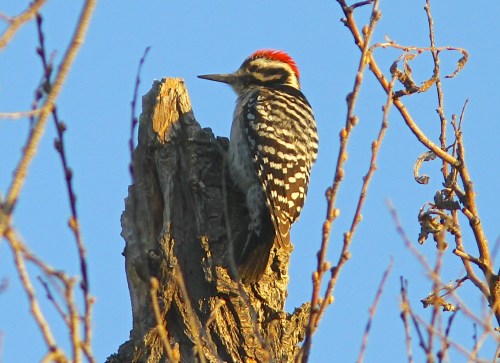
A possible male Nuttall'sXLadder-backed cross.

A possible male Nuttall’sXLadder-backed cross at Big Morongo Canyon Preserve.

Recently I went birding with some friends at the Whitewater Preserve on the edge of the desert in southern California. My friend Dan Williams is more experienced with the birds in the area, and has a great ear. He picked up on something that I’ve been paying attention to since.

The Whitewater Preserve is located in an area that is the meeting point for the ranges of two very similar woodpeckers, the Ladder-backed and Nuttall’s. The Ladder-backed Woodpecker is a species of the southwest that frequents semi-arid landscapes. The Nuttall’s is a California coastal species, preferring riparian areas. Very similar in appearance and habits, it is easy to confuse the two when in an area where it is unclear which is expected, such as the transition zone between the two.

We heard a woodpecker fly overhead calling. Dan recognized the call as a Nuttall’s, but when it landed it resembled a Ladder-backed in appearance. This began my inquiry into the occurrence of hybridization in the region. I found many discussions on the topic, with no clear or definitive conclusion of how, if, or where this really occurs.

I returned later to the Whitewater preserve in hopes of recording and photographing as many woodpeckers as I was able. I failed, but I did get to know the woodpeckers of the region a bit better. I found many birds, and one female that supported the idea that these birds are hybridizing in the area.

Last night I went birding in the Big Morongo Preserve. It was great birding. The Summer Tanagers have returned in good numbers. I kept tuned to finding woodpeckers in this area, as it is not far from the Whitewater preserve. I finally found a male woodpecker, and sure enough, it showed characteristics of both species.

First, I heard the woodpecker. In my mind, it sounded just as the Ladder-backed Woodpeckers sound across the southwest, but when it landed, I noticed a few things that were unlike the Ladder-backed.
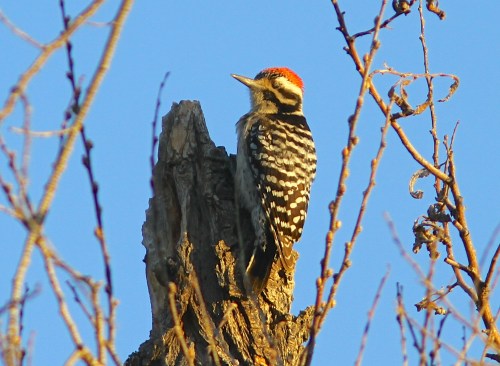
Possible Nuttall'sXLadder-backed Woodpecker. Note the dark black patch on the upper back, and extensive red of the crown, two contradictory features.

Possible Nuttall’sXLadder-backed Woodpecker. Note the dark black patch on the upper back, and extensive red of the crown, two contradictory features.

1. The Ladder-backed Woodpecker has striping that extends to its neck. The Nuttall’s has a patch of black on the top of its back. This bird resemble the Nuttall’s in this regard.

2. The male Ladder-backed has red on his crown that extends forward above the eye. The Nuttall’s red is less extensive, and sits on the back of the head. This bird resembles the Ladder-backed in this regards.

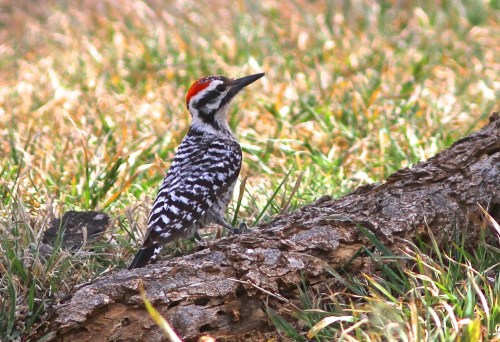
3. The Facial pattern of the Ladder-backed is dominated by white. The black markings are rather thin. The Nuttall’s facial pattern is dominated by black. Thick black lines swallow up the face. This bird is tricky, it looks much like a Nuttall’s, but the white above the eye and to the back of the head is rather prominent. I included an image of a Ladder-backed I photographed in Texas last month with a facial pattern much like the bird from Morongo.
IMG_7592


There are other nuances separating the two species such as the pattern of the outer retrices, spotting or streaking on the flanks, cream color or white of the pale parts, bill shape, etc. All of these aspects are learned through exposure, in my mind. The more you see both species, the more you will recognize the minutia that separates the two.

If anyone stumbles on this post that has any information on the subject, knowledge, or experience with both birds, I would love to hear your ideas. In my mind, the evidence is fairly clear indicating that this bird is likely a hybrid, or cross back. That makes the possibility or regularity of this occurrence rather high in my mind. You just have to be in the right place. Or maybe I just got lucky.


Beatnik Birding: The Southern California Desert

by Bryce W. Robinson

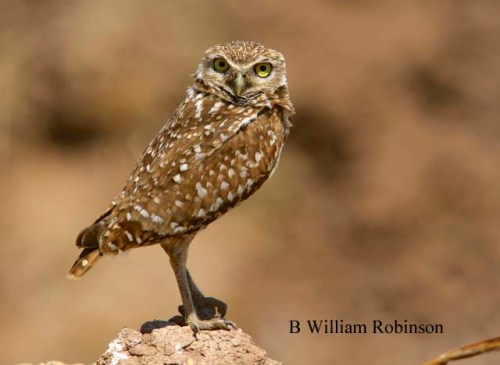
Burrowing Owl- Athene cunicularia

Burrowing Owl- Athene cunicularia

I’ve made a stop in the California Sonoran to conduct nesting bird surveys for a bit. This will be the end to the southwest tour of the beatnik birder. The roads I have travelled and the places I have seen… These times will be remembered.

My time here is brief, but long enough to once again experience the nesting season of the Sonoran. I’ve already had some amazing experiences with nesting birds, and found some of the most delicate lifeforms I’ll ever encounter.

The photo I share today is of a dedicated Burrowing Owl on the south end of the Salton Sea, standing watch over his tiny kingdom. He was so serious, I’ll have you understand. He took no notice of my vehicle as I encroached on his business. He was about a higher task, to ensure his legacy. He did not bother with me, for which I was fortunate. Soon I was too close for my lens to focus, so I stopped with my intrusion. It was a blessing to encounter such a stubborn owl, so I did not take anything for granted. After taking my fill of photographs, I simply watched.

I could have watched, and filmed, and taken notes, and drawn, and continued to pore into the world of this owl. But I left him to his task. There he remained, watching his land, diligent and dedicated. It is my hope that there he will forever be.

Beatnik Birding: Finding Ardeids; the Tricolored Heron

by Bryce W. Robinson

IMG_8649 copyAs a child, I poured over bird books, spending a substantial amount of time looking at the worlds herons. When looking through North America’s herons, I began developing favorites of the birds I dreamed to see. The Tricolored Heron was very near the top of the list. The bird has an aesthetic seemingly otherworldly. The colors and textures dazzle the eye. I was fascinated by illustrations and photos of this bird as a child.

Finally I have seen this bird, in its element, conducting its business, in all its glory. Every Tricolored Heron I have encountered since my first a few weeks back has afforded me first hand looks at characteristics that enlighten my understanding of this bird and the family to which it belongs. My time with this bird has been insightful and delightful. It conducts its business in its own style, with movements and techniques all its own. These techniques and behaviors are subject of a discussion which is to come. Oh the Ardeids; For whatever the reason, I find myself enraptured in their world.


Beatnik Birding: Sabel Palms

by Bryce W. Robinson

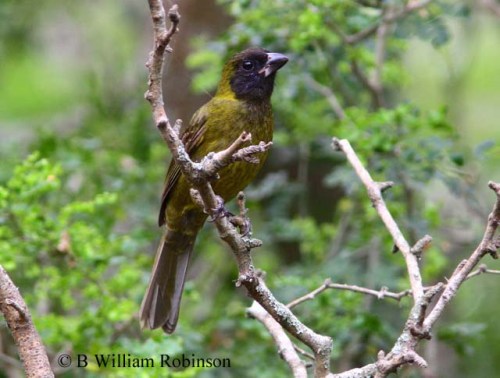
Female Crimson-collared Grosbeak-  Rhodothraupis celaeno.

Female Crimson-collared Grosbeak- Rhodothraupis celaeno.

South of Brownsville, along the Rio Grande, sits an Audubon sanctuary named Sabel Palms. It is one of my favorite places thus far. The trails feel very tropical, the birds are spectacular, and the other visitors are characters. I am odd in the world of birding, especially in the special places such as Sabel Palms. I am odd because I am young.

I came to Sabel Palms with one bird on my mind, the Crimson-collared Grosbeak. To see this bird would be a personal first, a treat to expound upon the bounty of fortunate birding experienced thus far. Asking around, I discovered that a female had been hanging about that day, so I posted up to patiently wait. And sure enough, the beauty revealed herself. Only birders understand the thrill of a life bird, of an exotic life bird, of a quest fulfilled. I’ll tell you as much as this, and let you the reader understand that this bird was special. I felt the purity and love of birding in the moment while experiencing this bird. A highlight, to be understated.

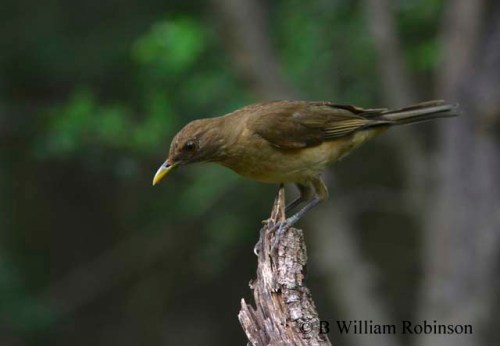
Clay-colored Thrush- Turdis grayi

Clay-colored Thrush- Turdis grayi

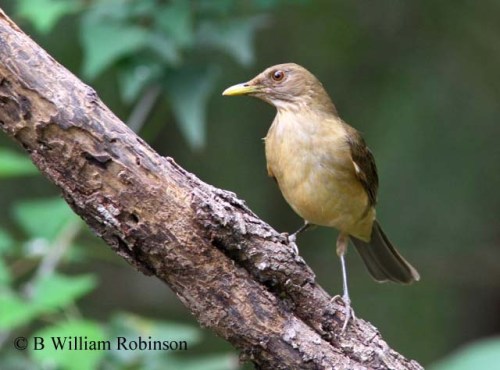
Another bird that was busy about the forest that morning was the Clay-colored Thrush. This bird is a new favorite. They are a very large Turdis, much larger than the American Robin of the north. I was fascinated by their habits, and fell in love with their song. They, along with a host of others, provided some music that helped build the experience of traveling about Sabel Palms. I council the birder, the reader, the adventurer, the inquisitive, I council you, to travel to the valley of the Rio Grande, and visit the Sabel Palm Audubon Sanctuary. A place for birds, aged birders, and beatniks indeed.

Clay-colored Thrush- Turdis grayi

Clay-colored Thrush- Turdis grayi