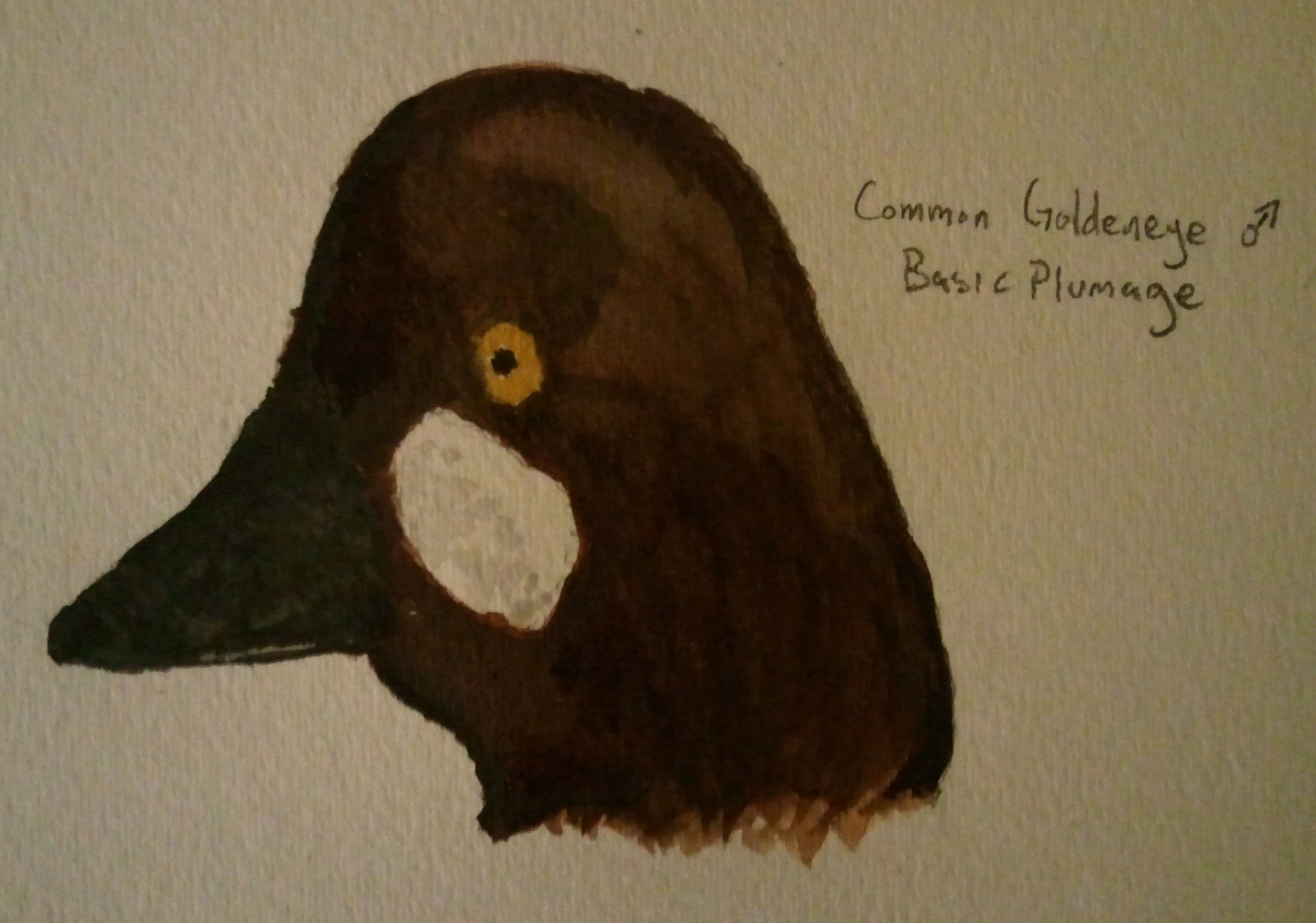
A studio for bird study

A Painting Returned from the Wild, Perhaps

by Bryce W. Robinson

This morning was cold and crisp as I travelled west towards the Wah-Wah Valley for day two of my second stint of winter raptor surveys. En route my eyes caught a familiar form in a stream system running tandem to the road. Highlighted by the first light of a clear but cool December day was the Great Blue Heron. The sight of the “Sentinel” promised a good day with plenty of birds. I drove on with a settled spirit and a refreshed mind.

The day went well. I saw many more birds than I had even hoped for. Time passed easy and I felt grateful for solitude and my time with the birds. After the survey ended, I found myself rolling along the open roads with the glow of the falling sun highlighting the mountain giants of the high desert. The scene was breathtaking, as it so often is in the west.

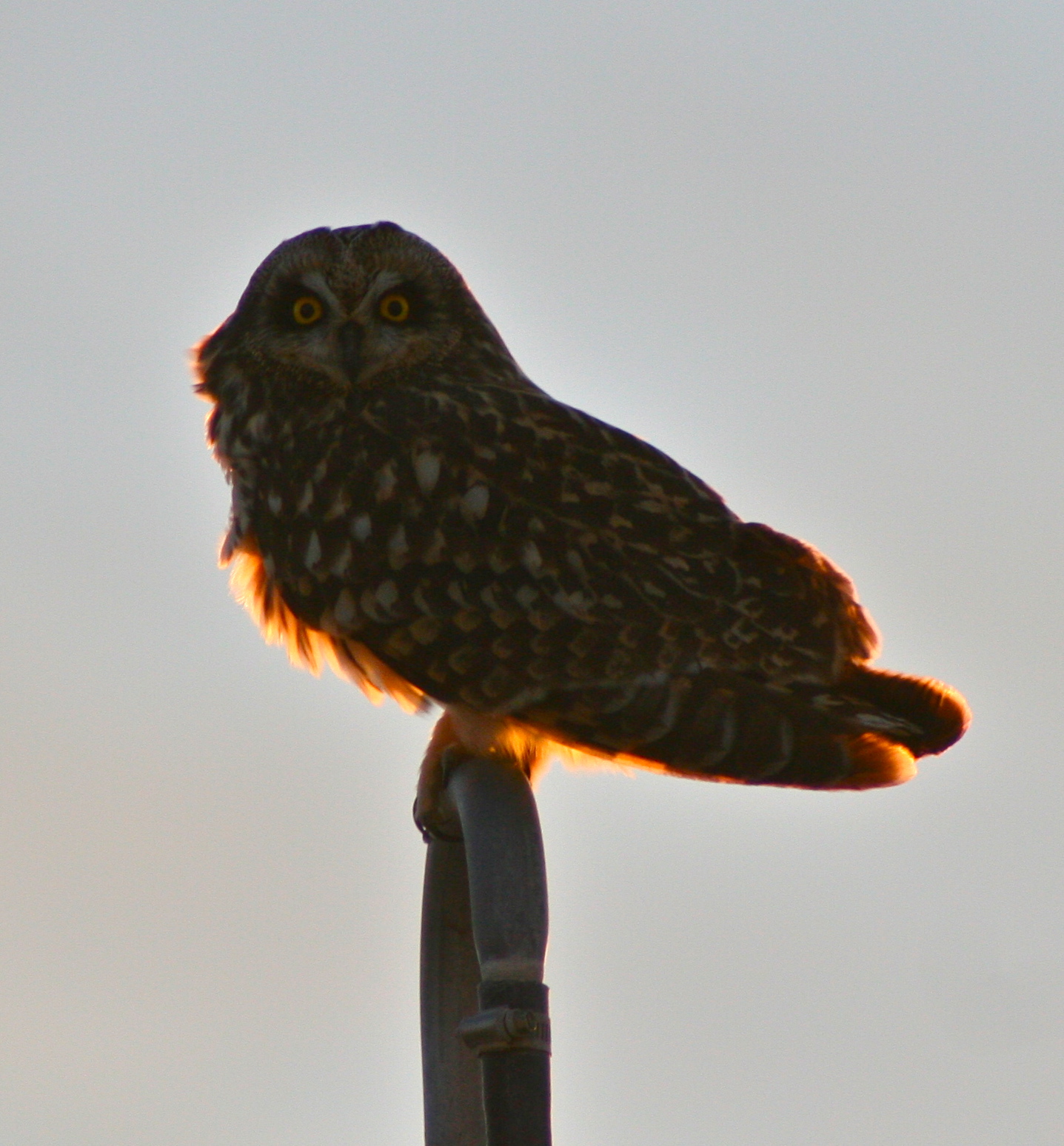
I made my way through the farmlands toward Beaver, with a keen eye on the wheel lines and skeleton trees that run alongside the road. Many birds occupy these areas in winter, and even with a day full of sightings, I was open and ready for more. My eyes soon caught the familiar odd shape breaking the pattern of the wheel line. As I neared I knew that the bird watching the glowing fields in the long light of dusk was different from the usual Buteo. With a round head and long wings was the very bird I had so recently finished painting. With the realization of the Short-eared Owl alongside the road, excitement leaked from my body as I prepared to meet for the first time in years, Asio flammeus.

Short-eared Owl on wheel line

Normally, raptors are rather wily and do not let you very near, but this owl tolerated me till I was within twenty meters of his eyes. I sat for ten minutes firing my camera and observing the striking creature. His head turned and turned as it surveyed for prey. I felt frustrated that the sun sat behind the bird, but I took nothing for granted and photographed the bird nonetheless. Unable to contain myself, I slowly opened my car door to step toward the bird and perhaps get around for a shot in better lighting. My careful actions became too much for the owl, and he retreated into the glowing landscape of the falling sun.

Asio flammeus, the Short-eared Owl

I am stricken by the coincidence of finding the bird in such an unlikely place only days after finishing my painting. Nevertheless and no matter the reason, I am grateful to have met Asio flammeus, the Short-eared Owl.

The Short-eared Owl- Asio Flammeus

by Bryce W. Robinson

Short-eared Owl- Asio flammeus. 14x18" acrylic on stretched canvas. $300

Perhaps the reason I am so enthralled with the Short-eared Owl is that it gives the birder a glimpse into the world of the owls otherwise cloaked under the darkness of night. Aesthetically, to say this species is striking fails to describe the image that the bird holds. Asio flammeus adequately conveys the fierce image that owls are known for. This bird has character, with its dark encircled eyes and piercing yellow gaze. When found in farmlands atop fence posts surveying the fields for prey, take the time to observe the bird, for its actions are sure to awe, impress, and tickle the onlooker. One photographer, of which I am a big fan, has taken many Short-eared pictures. Among these are the best photographs of the Short-eared Owl I have ever lain eyes upon. The man’s name is Ron Dudley, and you can check out his blog here, or simply look for the Feathered Photography link on my blog roll at the bottom of the page. After painting this bird, I have resolved to find and photograph this active diurnal owl. Till then enjoy the image I have created, and make an effort to get to know this incredible creature.

A Problem With Merlins and an Answer to the Red-Tailed Hawk

by Bryce W. Robinson

Identifying birds becomes more complex as you learn. This is mainly caused by a lack of content with knowing a bird to species alone. I remember the day when I found satisfaction in telling a hawk apart from a crow. Today I find myself dissatisfied with only knowing that I see a Golden Eagle. I want to know more about the bird. If I could, I would want to know age, gender, and its overall life experiences. Perhaps there is no end. Perhaps I will not be satisfied until I know the birds likes and dislikes, what makes it tick, what makes it laugh. These are all anthropocentric tags, but I use them to illustrate a point. There is no end to an obsession, and perhaps I will never stop. Learning is that way though, and there never is an end. That is why I learn, that I know there will never be an end, until mine. If you can follow my rant, let me lead into this discussion on two birds I recently found in the farmlands of northern Sanpete County.

1. Merlin (Falco columbarius), prairie subspecies. Gender and age unknown.

Prairie Merlin- Falco columbarius

On Thanksgiving day, before I settled in at my parents for an afternoon of excitement, food, and family, I drove along a dirt road looking at fence posts and power poles for raptors. I found a Prairie Merlin atop a pole, looking rather content, as if it had just finished its thanksgiving feast. I took many pictures before the bird flew to rest on a perch farther down the road. After some contemplation, I realized my initial thought of the bird’s gender may be wrong. I actually did not know the difference between a female prairie merlin and a juvenile.

Prairie Merlin taking flight

After some research I was left without any answers to the bird. In my recent correspondence with Jerry Liguori, I decided to send him a picture of the bird and ask him his thoughts. His response settled the matter but not the question. He answered back saying that there really is no definitive way to tell the difference from a female and a juvenile in the field, unless you have the bird in hand. I accepted the dead end and moved on.

2. Red-tailed Hawk (Buteo jamaicensis calurus), western subspecies. Age- Juvenile

Red-tailed Hawk (Buteo jamaicensis), juvenile

Differentiating adult Red-tailed Hawks from juveniles is not a difficult task given some exposure and little learning. I do seem to still gain a great deal of satisfaction at watching these common birds, and finding out what age the bird may be. Buteo jamaicensis is an incredible bird. The amount of plumage variation in this one species is astounding. Along with other buteos, the dark, rufous or intermediate, and light morphs make the bird exciting for the birder. The Red-tailed also has some other subspecies that mix up the identification possibilities. The Krider’s and Harlan’s hawks are my favorite possibility for the Red-tailed, and with so many choices, it becomes important to know the signs to look for when you make a correct ID of the Red-tailed Hawk.

This is not a discussion of what makes a Harlan’s a Harlan’s. That will come when I can get an acceptable photograph of the bird. The topic I would like to illustrate and discuss is how to tell an immature bird apart from an adult. The bird pictured is a proper and perhaps perfect example illustrating what to look for in ageing Red-tailed Hawks.

Red-Tailed Hawk juvenile showing what to look for in ageing

True, ageing Red-Tailed Hawks can get more complicated and precise, however I want to simply focus on how to tell if the bird is an adult or not. Notice on the bird that the primaries are paler than the secondaries. This can be seen from topside and below, and is a quick indicator of a juvenile or immature bird. In flight, the pale feathers create a light window like panel that is clearly visible in good lighting. Also not the heavy banding of the tail, and the lack of red. Western Red-tailed Hawks generally lack heavily banded tails, so the lack of red and banding tell of a juvenile or immature bird. This point should never be used alone to age a bird, as adults can have many possible tail patterns and color variations. Another helpful tip is the white mottling on the scapulars and upper wing coverts. Generally, adult westerns do not have this feature. Again, never use this point alone to age a bird. Finally, as not illustrated in the photo above, but seen clearly in the preceding photo of the bird, a pale or light eye indicates a young bird. This has its pitfalls, as I found a juvenile bird a few weeks ago with a dark eye, but is a general tip that proves helpful. As this bird posed and I took advantage, I noticed the potential for a discussion on feather anatomy and wing folding. Due to the multiple topics that may come out of this picture, I have decided to rest on ID and find another bird for a later discussion on feather anatomy. I encourage any interested to look at this picture and truly think about how helpful photography or field sketching can be for understanding and learning the intricacies in the world of birds.


Painting Pochards and Mergansers- An Aesthetic Approach to Listing

by Bryce W. Robinson

After a recent trip to the Lee Kay Ponds for an afternoon of birding, I resolved to take to painting to pick up where photography fails. I will soon begin taking a watercolor field kit with me when birding, to sit and record crude paintings of what birds flit and fly before me. This approach, I believe, will help my identification skills grow.

At the ponds, I soon realized that photographing waterfowl was nowhere near worthwhile at the time. The majority of the pictures I took were not only too far from the birds, but were also confounded by the sunlight reflecting from the water. Afternoon is probably not the best time to take pictures. My novice skills with a camera left me without any quality images from a few hours of birding.

I do not bird for the photographs. I had a wonderful time with the birds I was able to see. Still, I love using pictures to share the things I find. After reviewing my photographs at home, I resolved to record what I had seen in picture by painting, not just listing. I am not a lister, and I hardly spend the energy to carry a journal with me while I bird. I understand this is not a good behavior for a birder, but I simply do not have the drive to note the number of birds I find. I feel that the experience is the reward, not a list of english words after the fact. Still, I suppose my listing is done through photographs, but I have resolved to begin a new technique for recording my sightings.

After seeing a number of birds in eclipse plumage, I wanted to share the difficulties that this may present. Waterfowl are fun, due to the various plumages of the males and the difficulty of identifying females. In winter, males transition into what is termed an eclipse plumage, which is their basic plumage, looking a deal more bland than their alternate plumage that most are known by.

Watercolor trip report for Lee Kay Ponds, Nov. 29th, 2011

As I looked through the photos I started painting crude watercolor images of the various but similar birds I saw. One genus that was well represented was Athya, or the Pochards. These are a type of diving ducks that hold some fun identification challenges. They are also simply stunning creatures that bring a load of excitement for geeky birders such as myself.  Along with the Pochards, I was able to see some Mergansers, a bird group of which I rarely see. I never take seeing these birds for granted.

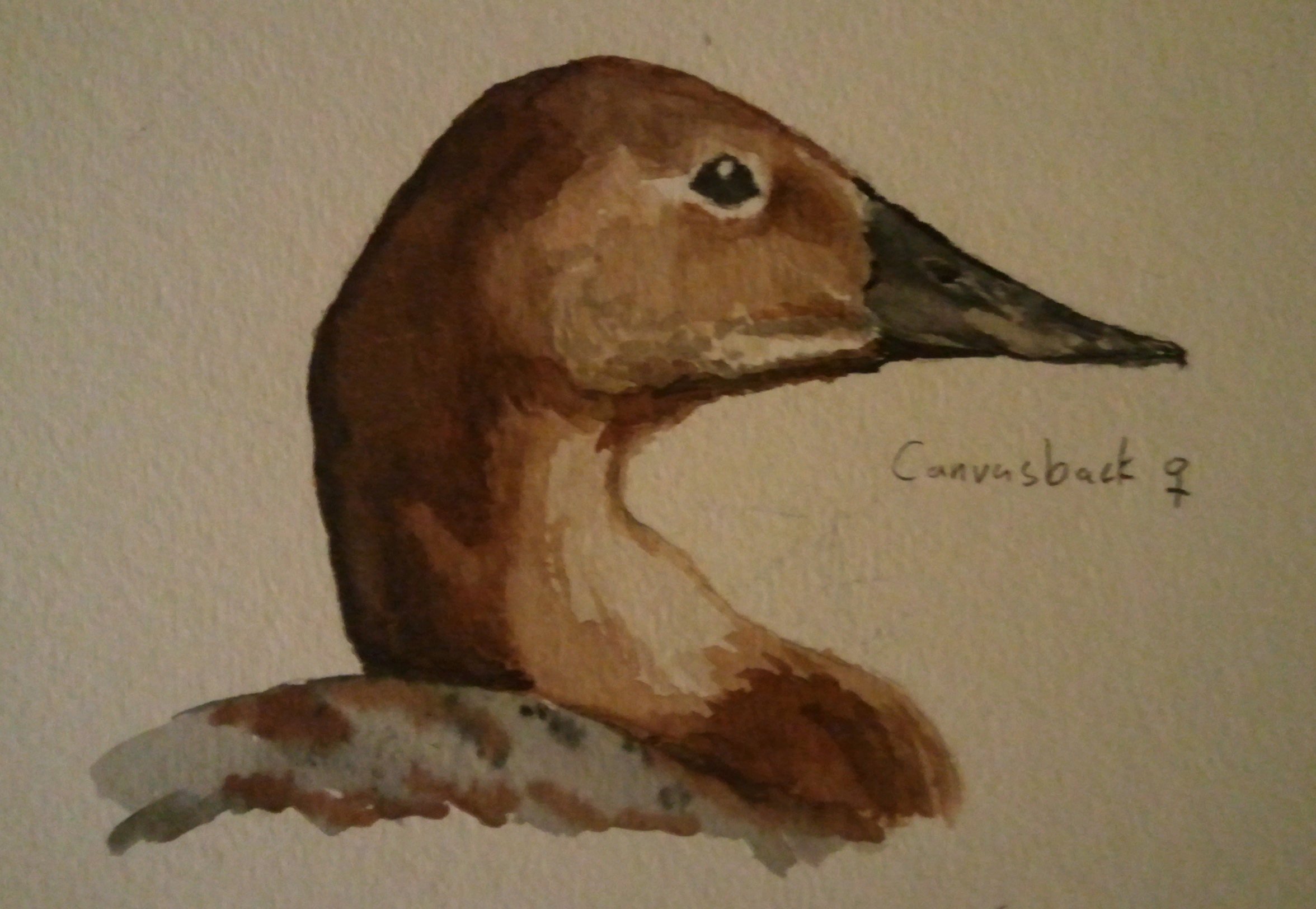
Female Canvasback (Aythya valisineria)

I stopped a number of times to rescan groups of birds, making sure I didn’t miss anything. This exercise proved worthwhile a number of times. Most birds sat in small groups, however there were the occasional loners . One such loner was a striking female canvasback (Aythya valisineria). With the possibility of confusing the adult male in eclipse or basic plumage with the female, beginning birders may find lone birds such as this a bit of a challenge. To quickly resolve whether the bird is male or female, look to the eye. Males have a red eye, the females is dark. Eye color may not be the best indicator when viewing a bird from afar, so there are other patterns to look for. Generally eclipse plumage looks just like a dull form of the alternate, so look for the dark breast and pale body. With exposure and effort, or simple exercises such as painting or sketching, identifying male eclipse from female with a lone bird will become effortless and automated.

Female Common Merganser (Mergus merganser)

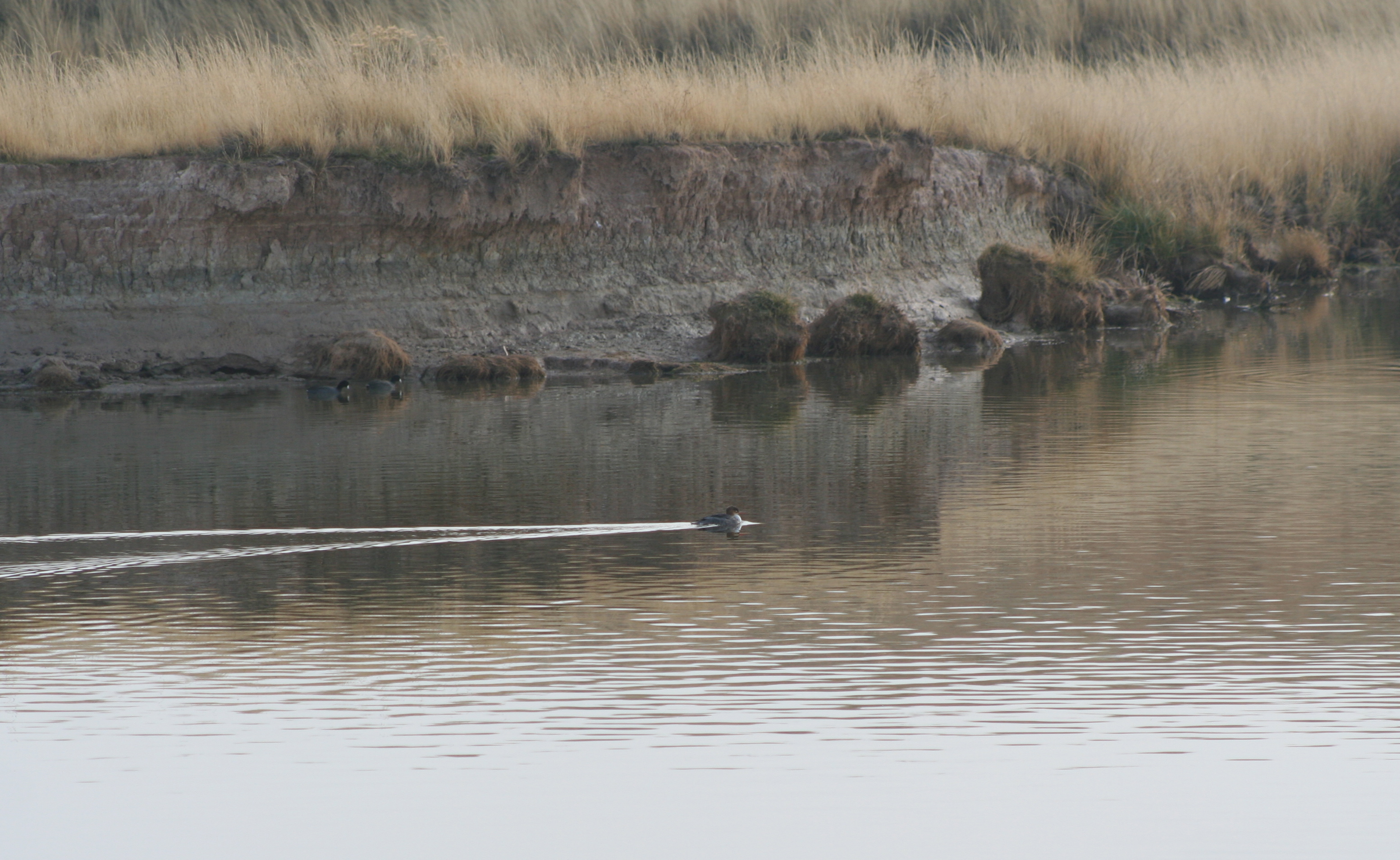
Another lone bird gliding through the water was a large bird of similar color to the canvasback. From afar, one would not know the difference, but when I took a close look through my binoculars, I could tell the bird was not anything of a duck. The long thin dinosaur like bill told me merganser, and in fact I certainly was looking at a female Common Merganser (Mergus merganser). The last time I saw this species was deep in the Grand Canyon, on the shores of the Colorado River. As I watched the water pass in rough and steady motion, I beheld a rapid rider wearing white with a green head and striking red bill. The Male is captivating in appearance, but seeing this female on the peaceful waters of the ponds gave me that same impression of beauty.
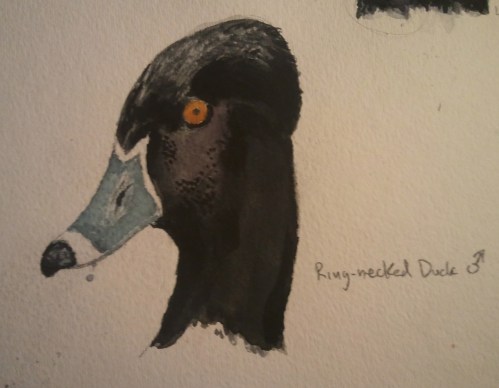
Male Ring-necked Duck (Aythya collaris)

A bird I often see on the calm waters in winter is the Ring-necked Duck (Aythya collaris). This duck is not a challenge to identify as it is not similar to any other Pochard save the Scaups. One would more regularly confuse a Scaup with the Ring-necked, because of the telling bill markings that stand out even at a distance. The Lesser Scaup (Aythya affinis) may trick the beginning birder. As I scanned the pond I saw a group of dark headed ducks sleeping on the waters. There was a time when I would have moved on thinking I was looking at another group of Ring-necked Ducks, however this time my mind picked up on the differences that separate the two. I watched until one of the sleepers raised its head, giving me a definitive view of a Lesser Scaup.
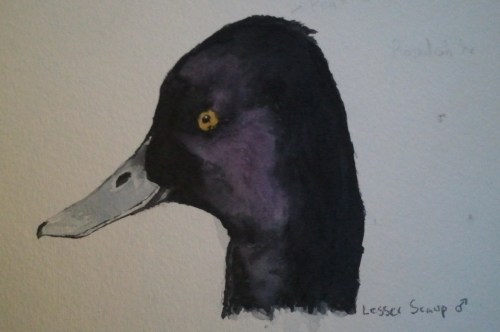
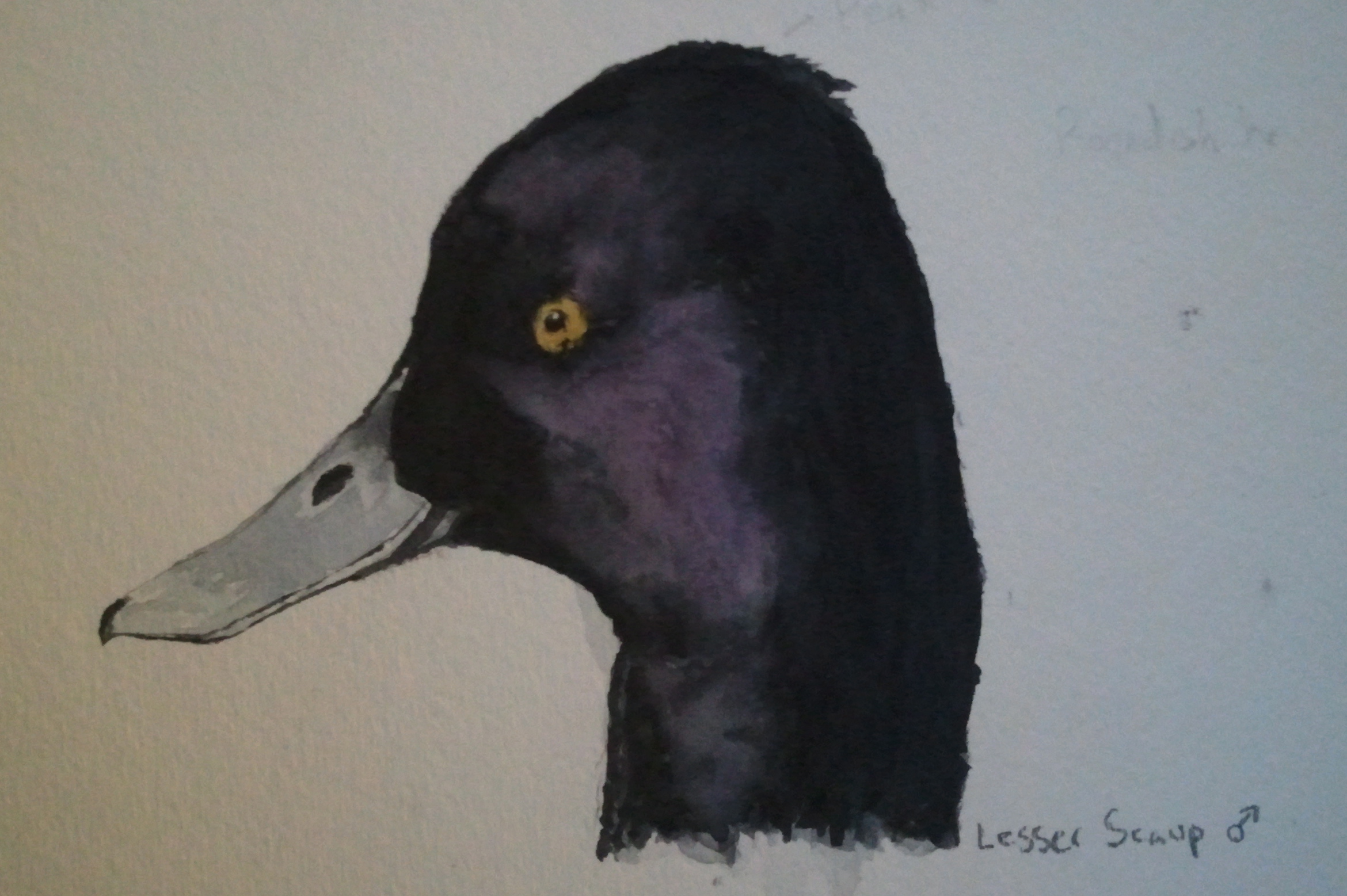
Male Lesser Scaup (Aythya affinis)

As I learn more of the ins and outs of bird identification, I find more and more difficult seemingly identical species that confound the birder. The Scaups are an extreme. At first glance they look like the same bird, but if you take the time to learn the subtle differences between the Lesser and Greater Scaup, you will soon find that they are easily distinguishable. A Greater Scaup in Utah would be uncommon, not impossible by any means, but uncommon. Still in order to pick up on the rare vagrant, one must be familiar with the differences. Head shape is the most common tip to telling to two apart. I seem to see eye placement as a great help as well, but this has some possibility for failure because the head shape can be manipulated by feathers. Still, a more rounded head with a front central eye placement indicates a Lesser, as opposed to a rectangular shape with high eye placement of the Greater. Also, the iridescence of the lesser is purple, the greater green.
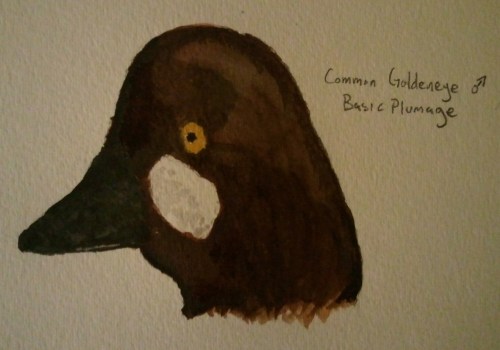
Male "eclipse" Common Goldeneye (Bucephala clangula)

The most common bird on the ponds that day, besides the Mallard of course, was the Common Goldeneye (Bucephala clangula). Their eclipse plumage is still striking, and they are easily picked out from a crowd due to their white bodies. The females are easily distinguishable too, however there is a confusing aspect to this bird. A few winters back I found a lone Goldeneye in a canal near Utah Lake. It lacked a white loral patch which through me for a loop. After some research, I discovered that first winter birds have this distinctive look. An identification difficulty quickly resolved.

Female Bufflehead (Bucephala albeola), and Female Hooded Merganser (Lophodytes cucullatus), respectively

While I was leaving I stopped to look at a small group of Hooded Merganser (Lophodytes cucullatus). The group consisted of one male and five females, or so I thought. After snapping a few photos knowing that the quality would be poor, I travelled home. When reviewing the photos at home, I took a closer look at the merganser group. It was not until then that I realized the fifth female merganser was in fact a female Bufflehead (Bucephala albeola). How I had failed to see this in the field is still a mystery in my mind, yet it points to an important tip. There will always be things that are looked over, so it is important to spend the time and watch. Really watch and search for things. This lone female Bufflehead was the only Bufflehead I saw all day. What it was doing flocking with the merganser group is a mystery I do not know the answer to. I included a watercolor of the female Hooded Merganser with the female Bufflehead to illustrate how silly this oversight was.

Overall the few hours I spent at the pond were wonderful. To close, here is my list for the day:

Song Sparrow

White-crowned Sparrow

Brewer’s Blackbird

Starling

Red-winged Blackbird

American White Pelican

Red-tailed Hawk

Rough-legged Hawk

Bald Eagle

Canvasback

Redhead

Lesser Scaup

Mallard

Gadwall

Canada Goose

Ring-necked Duck

Common Goldeneye

Bufflehead

Common Merganser

Hooded Merganser

California Gull

Great Blue Heron