A studio for bird study

Category: Uncategorized

Beatnik Birding: Central Texas

by Bryce W. Robinson

Scissor-tail Flycatcher- Tyrannus forficatus

Scissor-tail Flycatcher- Tyrannus forficatus

Out of Arizona, I streamed through dust storm upon dust storm. After the road ran the dust out, I knew I was in the great and free state of Texas. I had my heading pointed to a small nowhere town in west central Texas, to meet with Caitlin Davis. She was working on a Northern Bobwhite project in the area, and I was to lend a hand for a week and prepare to take the behemoth GRE in Abilene.

It was a great reunion, but I was in shock with where I had landed myself. Trucks trucks and trucks. It was the land of trucks. But, there were some redeeming qualities of the land, and they were all birds. While heading to the lab to band a covey of Bobwhite, I saw my first Scissor-tailed Flycatcher. I’ll remember that bird for time and all eternity. They sail through the Texas desert, grossly beautiful and calling for all attention; the bird certainly catches mine.

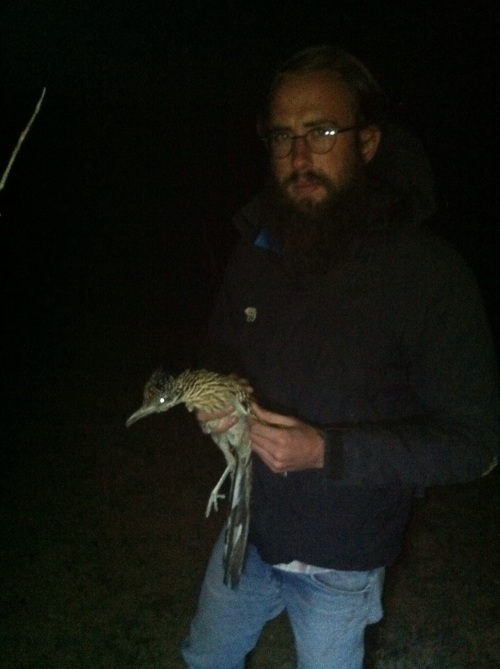
The project that Caitlin was working for used funnel traps to capture the Bobwhite. This provided a fun task of checking the traps twice a day for birds. There was always the excitement of the unknown that we might catch in the traps. My favorite was the Roadrunner. I had always wanted to experience this bird in hand.

The Beatnik Birder and the Roadrunner- Geococcyx californianus

The Beatnik Birder and the Greater Roadrunner- Geococcyx californianus

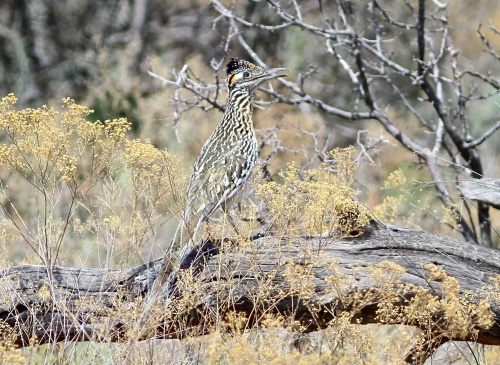
There were a great deal of Roadrunners bee-boppin around the Texas desert. I love watching the runners as they negotiate the desert terrain at top speed. Often, they stop atop a perch, and look about.

IMG_7677

Greater Roadrunner- Geococcyx californianus

All in all, it was a strange time in the rural country of the cowpoke state. I saw some great birds, met some strange folk, and took the GRE. Afterwards, the road continued south, and I settled into the hill country.


Beatnik Birding: Arizona Endings

by Bryce W. Robinson

Elegant Trogon- Trogon elegans

Elegant Trogon- Trogon elegans

Success is super sweet. I left Patagonia feeling disappointment from missing my target, the Trogon. My heading was the Huachuca Mountains, where I was unsure if the Trogon was a realistic expectation. I arrived in the valley east of Huachuca’s at the house of my new friend, Christie Van Cleve. I met Christie while watching the Black Hawk migration the prior week in Tubac. She insisted I come see her house, and the nearby canyons.

Her insistence proved fruitful for my birding. When I arrived, I sat in her dining room, watching the birds in her yard. She has created the most incredible feeder set up that I have ever seen. She boasts an impressive yard list, somewhere in the 180’s. It was easy to see how such a number could be possible.

After minutes of watching, I saw one of the most incredible birds I was to see in Arizona. The Magnificent Hummingbird came to the feeders time and again, to flash its brilliant green gorget. I was in awe, and excited. For the next few hours, I watched the birds about their business, and enjoyed Christie’s company.

Later that afternoon, Christie took me to Huachuca Canyon. The canyon is only accessible by entering a military base. This may seem a deterrent, and perhaps is the reason I was unaware of the canyon, but entering and traveling about the base was easy. We went up the canyon, where Christie showed me two spots where Elegant Trogon’s had nested in years past. She told me stories about her times in the canyon, watching these birds. What a treat it would be to see these birds raising their young, hunting for insects, and conducting themselves in accordance with their habits. As we did not see the birds in either location, I resolved to return the next morning and try one last time for the Elegant Trogon.

I ventured back through the base in early morning, and travelled up the canyon towards the two nest sights. Birds were about this morning, and I listened to many species both new and familiar. Still, both nest sights were without the Trogon, and my spirit fell. But, as I am a birder, and love other experiences besides the chase, or hunt, I venture farther up the canyon to find others.

With my senses keen, and tuned to any peculiar movement, or sound, I was sure to pick up the Trogon if it made itself known in any way. And I did!

The moment the trogon barked, I knew what I had hear. I did a silent jump for joy and listened for a second call. Soon enough, multiple calls came and I narrowed in on the Trogon. Within a minute, I had found the brilliant male Trogon, sitting in the branches, calling. It was wary of my presence, and retreated when I came to close.

The bird continued to call, but as I observed its behaviors, I picked up the presence of a second bird. Hearing a second call pulled my attention to another fleeing male Trogon. Blessed by the sight of two males, in all their glory, I took in my fill of the birds, and left them to their business of establishing territories and continuing their business of procreation.
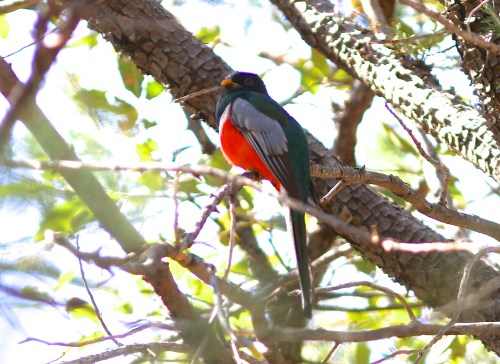
Elegant Trogon- Trogon elegans

Before I left, I spent some more time talking with Christie. On the morning before I hit the road, she informed me of a pair of Mexican Spotted Owls in the canyon near her house. I decided that the Spotted Owl would be a great bird to see before my journey continued elsewhere. It was not difficult to find the birds in the canyon. Directed to a reliable roost, I located two owls deep in sleep. I was careful not to disturb their slumber, and give them added stress. I watched the pair for minutes, taking a few photos before returning back to the road, and onward to Texas. On a high from the Trogons, I decided it was time to make my Arizona exit. I had missed some birds that I wanted to see, but I had other priorities, and felt that I needed to put my wheels back on the road, and move eastward with my eyes on the Texas coast.


IMG_7435 copy

Beatnik Birding: Patagonia Lake State Park, and the Patton’s

by Bryce W. Robinson

Neotropic Cormorant- Phalacrocorax brasilianus, at Patagonia Lake

Neotropic Cormorant- Phalacrocorax brasilianus, at Patagonia Lake

I arrived at Patagonia State Park on a nice evening a few days ago. I had travelled south from Tubac that afternoon after watching my last morning of migration up the Santa Cruz river. It was a bit hard to leave, I’ll admit. While passing through the border town Nogales in late afternoon, I saw a spectacle new to my eyes. Countless vultures filled the sky, from near eye level to stratospheric heights. I could not believe my eyes. The numbers were well above a thousand, and covered the sky as far as I could see. I cursed in awe, and continued on my way.

The state park was filled to capacity. I drove in without checking at the booth. Luckily the attendant had left for the evening, so I was not turned away from the camping grounds. I drove about searching for a place to park my home, finally settling on the day use parking lot. I was a bit nervous that I would draw attention from the rangers, and be chased from the park. Still, I settled in and went to sleep.

Luckily, when I awoke, I had not drawn any unwanted attention. The park was to be had, and so I set off. One bird was on my mind of course. That which was missed in Madera, the Elegant Trogon, had been seen in the riparian system east of the lake, only the day before. So I went for it. Along the way I birded the lake and found many things. Neotropic Cormorant was a first for me, so I stopped for a look and enjoyed their peculiar gutteral noises.

Another bird I found was the “Mexican” Mallard. I actually found a pair. They began some peculiar behaviors, which I intuitively read and readied my camera. Courtship behaviors ensued, and then copulation. Two superficially female Mallard ducks had done the deed, and I was privy. My discussion on the status of the Mexican Duck will be left for another post, as will the photos of the copulation event. The male being obviously not like a drake Mallard, one could imagine how much discussion is behind the decision to keep theses “subspecies” lumped with the typical Mallard.

Male Great-tailed Grackle- Quiscalus mexicanus showing a leucistic primary.

Male Great-tailed Grackle- Quiscalus mexicanus showing a leucistic primary.

The above photo is of a Great-tailed Grackle, a very common and conspicuous bird of the southwest. I included it because it illustrates an aspect of the bird world which fascinates me to the highest degree; leucism. One primary feather on this bird is white as snow, and for what reason can only be left to speculation. Well, on my part. I actually am not sure if it is know why this occurs. Anyway, I wanted to include the photo, as I thought it to be quite interesting. It is neat what you can see when you really pay attention.

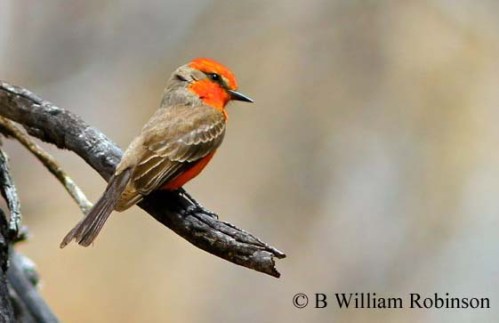
Vermilion Flycatcher- Pyrocephalus rubinus

Vermilion Flycatcher- Pyrocephalus rubinus

I ventured on my trogon quest, finding many treasures along the way. I spent around three hours coursing the river system with a keen eye out for the Elegant Trogon. Of course, my ear was tuned as well. As I searched, I realized how quickly I was learning the sounds of the southwest. I’m very excited to know many of the species by ear now.

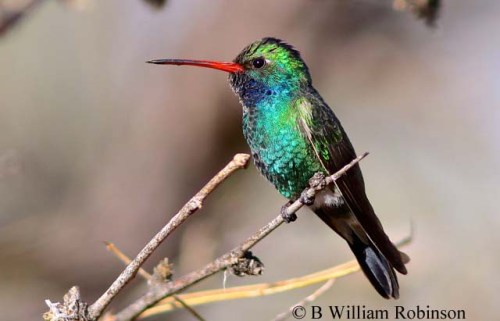
The place was birdy, and I picked up a few new species to me. Photography is difficult in heavily wooded areas, but I came away with a few goodies. One prized photo is the Broad-billed Hummingbird shown below. The BBHU is a fairly common species in these parts, but I’m always delighted at the chance for a close look. Hummingbirds fascinate me, and their delicate features are likely the reason.

Broad-billed Hummingbird- Cynanthus latirostris

Broad-billed Hummingbird- Cynanthus latirostris

I walked out of the forest mid afternoon, without seeing this mystical tropical Trogon. I really tried to put it out of my mind. I had time to search elsewhere. Later that evening, after some relaxation, I left the park. I headed towards Patagonia, to park my car in the middle of town and awake the next morning for some hummingbird viewing at the famed Patton’s.

The Patton’s proved to be remarkable. Among the highlights were White-throated Sparrow, Scott’s Oriole, Rufous Hummingbird, and of course, the Violet-crowned Hummingbird. Never mind the large amounts of people that stopped by with tails of the amazing sighting of the Elegant Trogon at Patagonia Lake that morning. I was in heaven with the birds in this backyard. Still, I was a bit disappointed at my unluck, but little did I realize, the cards were still in my had. I hit the road that afternoon towards Sierra Vista, to meet up with my new friend Christie Van Cleve, and check out Huachuca Canyon.

Beatnik Birding: Madera Canyon, AZ

by Bryce W. Robinson

IMG_0012It’s no secret that Madera Canyon, AZ is one hell of a spot. What I didn’t expect was to climb out of the desolation of the desert into a cool and lush sky island, full of wildlife. After becoming a bit desert dreary, I felt refreshed entering the high woodlands in search of some new birds. I decided I’d go as high as I could, and start hiking from there.

I’ve become quite entranced by the myths of Trogons that can be seen in this part of the country. I held high hopes for this journey up the canyon, but I came away empty handed. What I did find were a good number of birds that I were firsts for me. Long story short, it was a really great morning in Madera Canyon. The place didn’t disappoint bird-wise.

Yellow-eyed Junco- Junco phaeonotus

Yellow-eyed Junco- Junco phaeonotus

Of the throngs of birds I was able to find, I only photographed a few. One of my favorite new birds was the Yellow-eyed Junco. I found a few small flocks, acting just as any junco species does, picking around the ground through the understory. They would notice me, flit to a nearby perch, and look around nervously. These juncos sound quite different than their dark eyed relatives, so when I initially heard them, I knew I was in for something new and good.

Arizona Woodpecker- Picoides arizonae

Arizona Woodpecker- Picoides arizonae

I was really focused on one bird in particular. I love woodpeckers, and the Arizona Woodpecker is a specialty of these parts that I couldn’t wait to find. I heard the bird first, tippy tapping its way around a small Ponderosa Pine grove. It didn’t take long to locate the brown bird. I think the hikers that passed me wondered why I was elated by this brown woodpecker. I’m sure some understood, but others gave me quizzical glances. I giggled a bit, there’s nothing wrong with that.

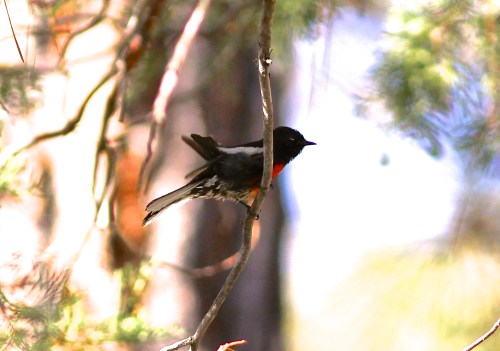
Painted Redstart- Myioborus pictus

Painted Redstart- Myioborus pictus

Another bird to delight both my eyes and my ears was the fire chested Painted Redstart. These birds were all over the riparian areas of the canyon. I really paid attention to their song, and I think I may have it down. Maybe the next time I hear this bird, I will be able to know what I am listening to.

I can say that Madera Canyon was more than I hoped for. On my way out, I stopped by some feeders and saw a brilliant crimson bird that I immediately knew, although I had never seen. Hepatic Tanager! That is what I said aloud, again receiving concerned looks from the general tourists.

I have yet to have any truly in depth and interesting human interactions. I am hoping I meet a like minded birdnerd soon. I’m headed over to the Patagonia-Sonoita Creek area next, where I’m sure I will run into some other nut jobs. I’ll be keeping an eye out for the Elegant Trogon in that area. Hope I find it!