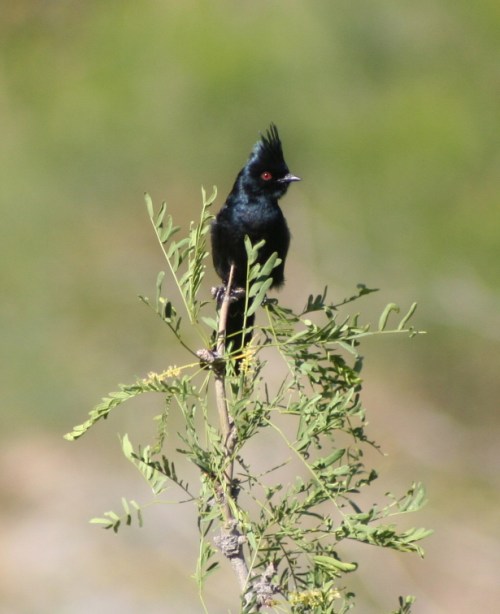
Male Phainopepla- Phainopepla litens
This afternoon I took a trip to a place called Indian Canyon. I never expected to find such a place. In the midst of aridity and rock strewn mountainsides, a Palm covered drainage of flowing water empties into the Coachella Valley. With the amount of time I’ve spent in the water-less desert lately, this place was paradise. I had heard it was a great place to bird, and since the spring migration is in full swing, I expected to see some special species.
I was happy to find myself with new birds, particularly warblers and flycatchers. I must admit my knowledge in these two groups is lacking, and it has become an area of focus for my current study. Identifying Empidonax flycatchers are one of the biggest difficulties that the birder faces. There are a few species that are indistinguishable from one another. In many cases, the call alone is the only way to gain a positive identification. With this said, I found two different “empids” today that I feel fairly confident I was able to ID properly.
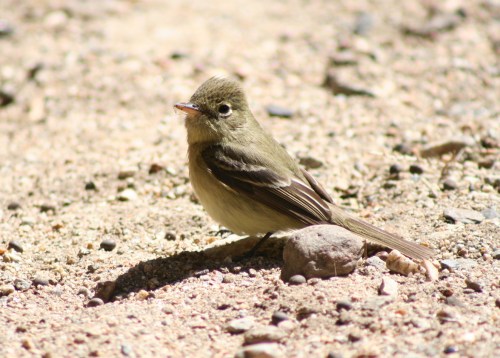
Pacific-slope Flycatcher- Empidonax dificilis
This Pacific-slope Flycatcher was a character. It sat on the ground, occasionally lifting to the air to swoop after and insect, returning to the ground to watch for more. It paid little mind to my intrigue. It was great to watch this bird and get to know its look and behavior.
I included the photo below to show a helpful ID tip when watching empids. The color of the lower mandible can help eliminate particular species. I was fortunate to capture this image as the bird looked my way, exposing a light colored lower mandible.
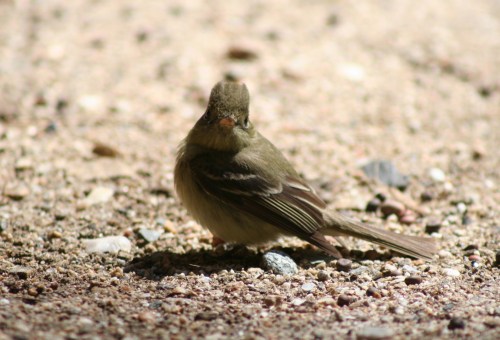
Pacific-slope Flycatcher- Empidonax dificilis
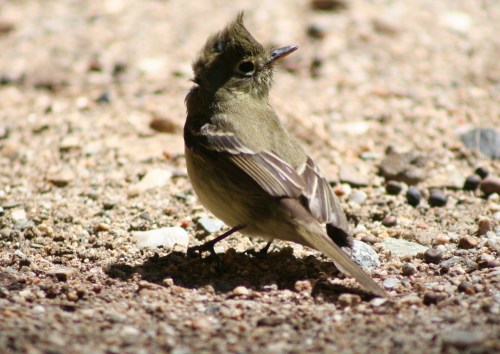
Pacific-slope Flycatcher- Empidonax dificilis
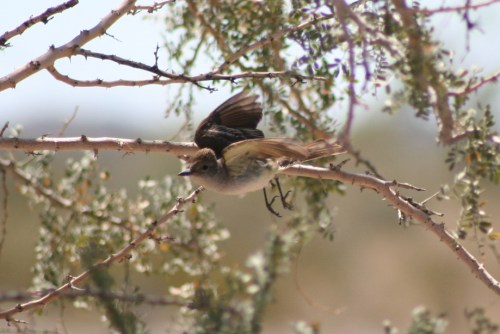
Another empid was flitting around the stream. Not assuming it was the same species, I took the time to watch and note features that might separate it from the previous bird. I never heard either empid call, so perhaps I should admit that I can not be absolutely certain in my ID. I will be bold, and say that I believe the second bird to be a Hammond’s Flycatcher.

Hammond's Flycatcher- Empidonax hammondii
Hammond’s do not breed, nor winter in the area, so this would be a migrant. That fact makes my time watching the bird ever more meaningful.
I’m beginning to find myself extremely fascinated with the warblers. They are a diverse group, and contain some of the most visually stimulating birds in North America. As a birder, they are a challenge. They hardly stay still, constantly jumping from limb to limb, deep in foliage. In old growth forests, multiple species coexist in close proximity as they occupy different zones of the canopy layer. This is a helpful fact in identifying birds as the birder sees fleeting glimpses of uncooperative warblers. In a palm dominated riparian zone, I had it easy. With relatively little understory and one canopy layer, I was able to spot multiple warblers and gain sufficient views to aid in my identifications.
The first warbler was a bird I had never seen, but knew nonetheless.
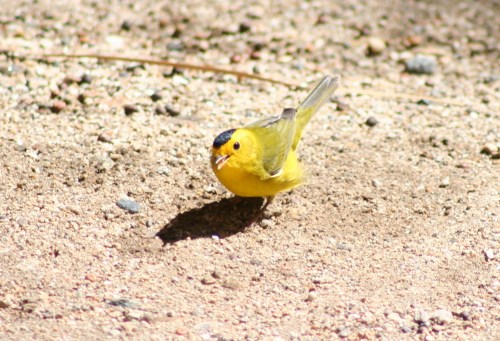
Wilson's Warbler- Wilsonia pusila
This Wilson’s Warbler was loads of fun. I watched it for a while as it travelled around, low to the ground, foraging for whatever it could find.
Another Warbler that was very present along the stream was an Audubon’s Yellow-rumped Warbler. These birds are very common, but always fun. In the desert the past week, I have been seeing a few migrating warblers. One particular difficulty I have faced is differentiating between what might be a MacGillivray’s Warbler and a Nashville’s Warbler. To the experienced birder, this might seem silly. I have no problem admitting that I am still learning some simple problems. Today, however, I finally saw a bird to solidify the knowledge to distinguish the two.
Eye-rings can be problematic. So can crown markings. After all, the Orange-crowned Warbler rarely shows the orange feathers on its crown that give it the name. The Nashville warbler is very similar to the MacGillivray’s, save some subtle differences. The broken eye-ring of the MacGillivray’s is certainly distinctive, but I daresay this is not the marking that should be focused on. The throat of the birds differ; the MacGillivray’s being gray, the Nashville’s being yellow. I was troubled at not being able to confidently ID the birds I saw this week. Today, I saw a few Nashville Warblers. I include a poor photo not for quality, but to show that in some lucky instances, the bird looks just as the guides depict.
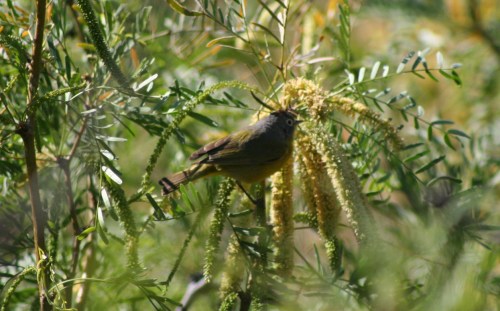
Nashville Warbler- Oreothlypis ruficapilla
The throat isn’t visible, but everything else looks great. Note the complete eye ring and rufous cap. I even saw this bird well enough at times to pick out the whitish vent. Today, I learned what makes the Nashville, the Nashville.
I saw a few Black-throated Gray Warblers today. They were all very friendly. I was so close to one bird that I had a hard time fitting him into the frame. I was unable to get any photos that I really like. Most are obscured by foliage, or butt shots. Too bad, but I did get a few for the reference library.

Black-throated Gray Warbler- Setophaga nigrescens
I haven’t seen many thrushes in my life, so it was great to see a Hermit Thrush wandering through the brush. I followed the bird into a thicket, where it sat still, allowing me to capture a few images.

Hermit Thrush- Catharus guttatus
The day was a great day of growth for me. I make attempts to take advantage of the opportunity to learn even a little each day. I love feeling like my knowledge is growing. I wouldn’t be happy if it were any other way.




 ornithologi.com