A studio for bird study

Category: Uncategorized

Western Grebe vs. Clark’s Grebe- An Easy Tip for Distinguishing the Two

by Bryce W. Robinson

The past fall, I travelled the roads of the Bear River Migratory Bird Refuge in search of wayward migrants and peculiar passersby. I found the waters full of many birds, but the most prevalent was the black and white Grebe. Thousands upon thousands of these birds littered the waters, feeding and resting, preparing for the next leg south to their wintering waters. I have seen many grebes in my day, and I admit that something about the birds intrigues me more than usual. Perhaps it is the way they carry their young upon their back, and dive into the water at the first sign of danger, only to resurface with the chick still riding steady. I have followed grebe in my kayak many times, and observed in depth their defense technique as they dive and resurface farther from me.

The grebe is designed to swim and dive for food. Their hind legs are positioned farther back on their body than normal, making them awkward and clumsy on land. As lame as they appear on land, they make up for in the water. Their mating display is famous. Pairing up, two grebes run synchronously along the water until diving. Such a bonding display leaves the birder in awe.

While I watched the grebe populations this fall, I realized the identification difficulty that is present between two species of north american grebe. I would like to illustrate a technique I use for study, in hope of communicating not only an easy answer to an overwhelming question for new birders, but also a way to quickly solve any difficult learning problem in bird ID.

The Western Grebe and the Clark’s Grebe look identical at first glance. As the two distinct species occupy the same range and habitat, it becomes a challenge for the beginning birder to differentiate the two. I have illustrated the difference, which not only solidifies the fact in my own mind, but may better communicate the ideas that I write for the reader.

The Western Grebe has a black hood that is pulled over the red eye, while the Clark’s has a hood that sits like a cap. With white above the eye on the Clark’s, and black surrounding the eye on the Western, the two become easily distinguishable, even at quick glance.

Truly, the Clark’s can show some darkness around the top of the eye, but this fact illustrates an easy way to distinguish the two. One factor I failed to include was bill color. The Clark’s Grebe will have a more yellow bill than the Western. More uncommon than the Western, the Clark’s will join into flocks creating a large group of both species much like I observed in the marshlands last fall.

Common birds are too often overlooked. I encourage you to stop at the next flock of grebe and watch. Watch the silly habits of the birds, and see if you can tell the difference between the two species. Getting to know these two birds will undoubtedly bring you as much pleasure as it has brought me.

Learning from the Best- A Day in the Field with Jerry Liguori

by Bryce W. Robinson

Yesterday was spent photographing birds with Jerry Liguori. It was such a full day that I forgot to wish my mom happy birthday. I accept the label of a terrible son. Sorry mom, Happy Birthday.

I find that surrounding myself with those that are more skilled and knowledgable than myself helps me learn quite a bit more than I might alone. Birding with a man like Jerry Liguori should have been highly intimidating, but I felt very comfortable being myself and exposing my identification weaknesses. He is a very humble person, willing to teach and share his passion.

Jerry has some incredible photography equipment. You can look through the guides on raptor identification that he has published and see that he knows his stuff regarding bird photography. I was excited to see him in action, and perhaps pick up on some of his techniques. Seeing my camera and lens against his, Jerry kindly offered me the opportunity to use one of his set ups for the day. Taken aback, I accepted the offer. What followed was the best day of bird photography I have ever had.

As we continued, Jerry took the time to teach me some general techniques of using the camera on manual. I really learned a lot about the hows and whys of photographing raptors. I was so grateful that he was willing to take the time and energy to show me how to share in the experience. From my experience with Jerry, he teaches those who share his passion not from an ego, but from a true love of the birds. I personally feel that with true passion comes a desire to share and infect others with that same passion, and I see that in the way Jerry interacted with me.

From the start, Kestrel’s were every where to be seen. I have never been able to get as close to birds as I did with Jerry. He says he has the best luck, for whatever reason. I would be skeptical, however, we had some great experiences with tolerant birds. Here are two Kestrels, the first a docile male atop a sign, and the second, a hungry female feasting on an unlucky Marsh Wren.

Male American Kestrel- Falco sparverius

Female American Kestrel- Falco sparverius eating a Marsh Wren- Cistothorus palustris

Although common, I never pass up the opportunity to observe a Kestrel. They are a lot of fun to watch. The female munching on the Marsh Wren was very tolerant of our intrusion. As we watched her eat, we could see feathers fly as she ripped them from the bird. Admittedly, both Jerry and I assumed the Kestrel was feasting on a vole or field mouse. It wasn’t until I reviewed my photos at home that I discovered what the bird’s meal actually was.

Another species that seemed to cover the marshlands in large numbers was the Northern Harrier. Again, as common as the bird is, it is always enjoyable to watch it wander low above the marsh, occasionally making acrobatic moves at unsuspecting prey. We spent some time driving alongside many Harriers, photographing as we drove.

Northern Harrier-Circus cyaneus. Juvenile.

Northern Harrier- Circus cyaneus. Juvenile.

Another bird that was fairly numerous was the Rough-legged Hawk. According to Jerry, we didn’t see as many as usual, but to me the numbers were acceptable. All of the RL’s that I photographed are juveniles, which I found interesting. One particular individual was missing p7, a bird that Jerry had photographed a few weeks prior when the feather was dangling but not fallen. I did my best at getting a decent photo of the distant bird.

Juvenile Rough-legged Hawk-Buteo lagopus missing p7

The sun was in and out as the day went on. We found a RL on the wing taking advantage of a sunny spell and good thermals. Directly underneath the circling bird, I shot to my hearts content. I came away with some great photos as the bird rose on thermal updrafts, observing the strange behavior of the two mad humans below.

Juvenile Rough-legged Hawk- Buteo lagopus

Although the day was definitely dedicated to photographing raptors, I had the opportunity to take the time to capture images of a number of species outside of the raptors. While I was photographing some waterfowl, I saw a friend Debra, and she informed  that I had missed the opportunity at seeing two Great-horned Owls roosting. That was disappointing, but I was glad to come away with the birds that I did.

As we drove along a winding road, we spotted a Loggerhead Shrike only meters off the road. Surprisingly, the bird did not fly when we stopped directly beside it. I fired a number of shots, then took the time to simply watch. As I watched, Jerry stopped photographing to check the quality of his images. At that moment we both missed the opportunity to catch the shrike expelling a pellet in a dramatic fashion. We continued with a win some lose some mentality. I believe that when photographing birds, if you do not preemptively adopt this mind set, you will certainly go mad with missed opportunities.

Loggerhead Shrike-Lanius ludovicianus

American Wigeon- Anas americana

Song Sparrow- Melospiza melodia

Cistothorus palustris

Ring-billed Gull- Larus delawarensis

Great Blue Heron- Ardea herodias

It was an exceptional day of birding. I am very grateful for Jerry Liguori’s willingness to share his time and equipment with me, and teach me some things about a world we both find fascinating. I hope to join Jerry in the field again very soon. It must be in the very near future, because in a few weeks I will be moving to southern California to work as a biologist conducting nest surveys for a consulting firm. I want to get in as much Utah birding as I can before I leave, but I will certainly continue my study after I relocate. Soon the species that are featured will change as I travel. The ebb and flow of life is truly something to embrace, and embrace it I shall.

Ardea alba- The Great Egret

by Bryce W. Robinson

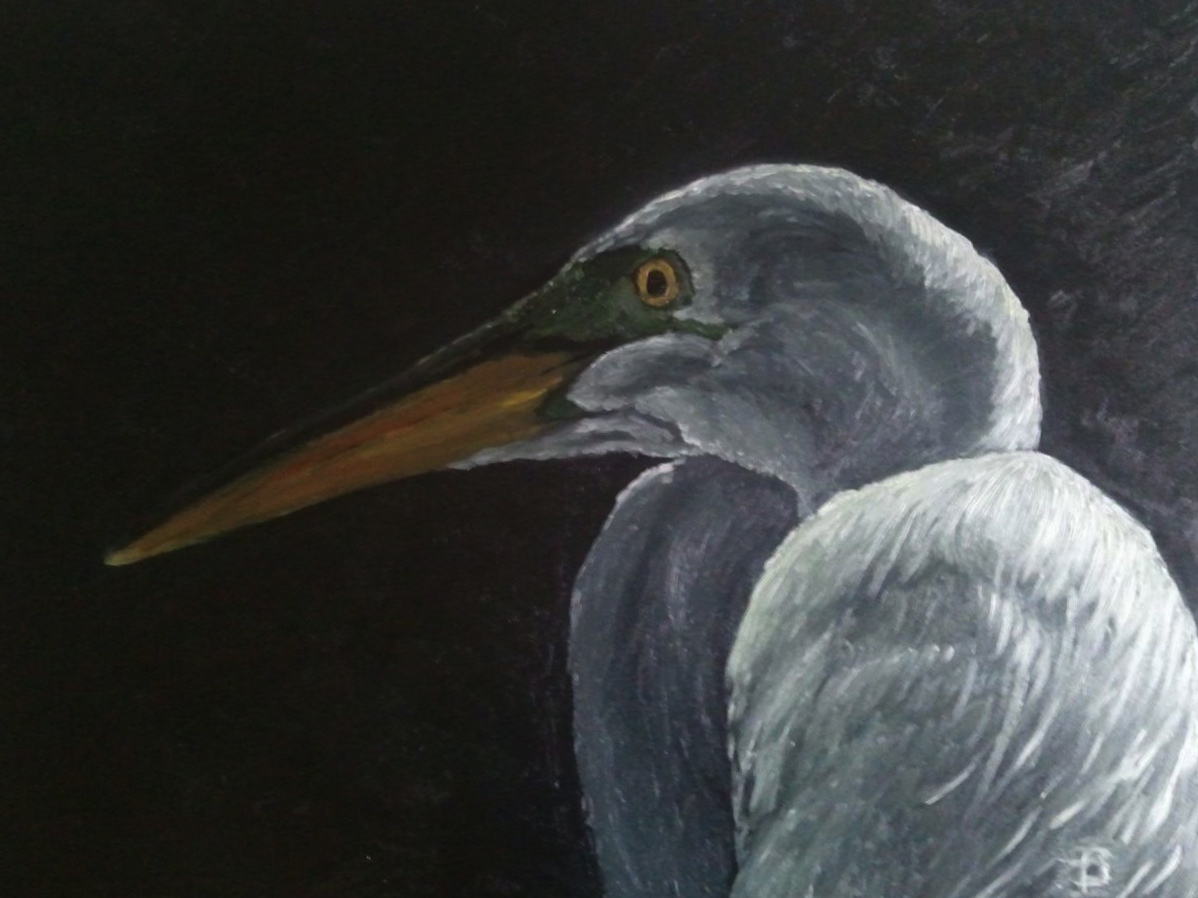
The world is saturated with paintings of the Great Egret, and for good reason. I myself have always made plans to paint the bird, but I never made the effort for fear of falling short of producing an image that truly captures the beauty and grace of the fine creature. Finally, I felt comfortable with giving a go at painting my first Great Egret.

The all white egret juxtaposed against any landscape is stunning. Evolutionarily speaking, it makes little sense why any animal would want to wear plumage of piercing white, unless perhaps their habitat was a snow covered ice land. Thriving in tropical climates, the Great Egret defies any sensible survival strategy and boldly stands out as a symbol of the grace and allure of the avian world.

Deep in the mangroves, a bird studies the shallows. Calm and steady, with long flowing plumes, the beauty of the Great Egret stabs through the shadows. Densely covered forests filter the light, creating a dark world of wonder. Sunlight filters through the shrubbery, and the bright white plumage of Ardea alba shines with vitality. An image of elegance preserved in time, preserved through time.

The Great Egret, Ardea alba. 18x24" oil on stretched canvas. Original not for sale.

Preserved is precisely the word. Saved from the lustful commodification of the new America, the Great Egret now stands as a symbol of what is that might have been lost. Plume hunters at the turn of the 19th century sought after the long white decorative feathers that the egrets wear in breeding season. The stunning feathers adorned the hats of many wealthy women, who served as eyesores against the beautiful white decorations worn upon their heads.

How such a creature could be disrespected leaves me grasping. I have never been able to pass an egret without stopping, stepping back, and paying homage to its exquisite nature. I now see the Great Egret as the powerful symbol that through sacrifice and near extinction, awoke humanity to their destructive nature, resulting in the birth of the conservation movement. No wonder the bird is chosen to accent the National Audubon Society’s logo. Their name reflects their human heritage, and their symbol reflects their avian awakener.

It is nearly the first of January, and multiple reports have come of these birds in the marshlands of the Great Salt Lake. If you have never seen a live egret, make a diligent effort to do so. Perhaps when it is found, it will awaken you much like it awakened America. Perhaps you will see the elegance, the beauty, the allure, and the importance of the natural world.

Common Raven- Corvus corax

by Bryce W. Robinson

Often I find myself frustrated with the sight of the Common Raven. Searching for raptors becomes a game of disregarding Ravens from afar to avoid spending needless energy focusing on a bird that is not only common, but prevalent. Birders understand the lack luster feeling of seeing common birds. Although common and at times a nuisance for the birder, the Common Raven is remarkable and deserves respect and admiration as one of the most intelligent creatures of the wild.

Corvids are cunning, to say the least. Particular species have been documented using tools, and it is easy to see their wit when you meet a Corvid in the wild. The way the birds caw and crow makes you wonder whether their communication system is at a level equal to our own. Only a few species of birds have been symbolized and present throughout the cultures of humanities history, and the Raven is among these.

When friends discover my ability to paint and illustrate, I often offer them their choice of bird for a painting. Many times I am asked to paint the Raven. People still hold this creature as a symbol of the intelligence and cunningness of the wild. For those that love the desert landscapes of the southwest, the bird also captures the spirit of the place. I will always love the opportunity to paint Corvus corax, and I am sure that from now until my end, I will create the Raven on canvas time and time again.

Common Raven, Corvus corax. 16x20" oil on canvas.

My first Raven is in portrait style, much like my other birds. I painted it with a dark background in hopes of capturing the personality and depth of one of the avian worlds most intelligent creatures. Mischievous, playful, even mournful are documented behaviors of the Raven. What a wonder we so often overlook. Sincerely watch the Raven, and your mood may soon shift from disregard towards an appreciation for a very common, but truly amazing bird.