
A studio for bird study

The New Raptor ID App

by Bryce W. Robinson

IMG_0042

The newly released Raptor ID app, a collaborative production from Hawkwatch International and the Cornell Lab of Ornithology is, plainly put, unprecedented. Author’s Jerry Liguori and Brian Sullivan have accomplished something incredible.

The app is a first of its kind for raptor identification, but perhaps more impressive is the informative video of each North American raptor species that is included with each account. Jerry Liguori’s voice over for each video is instructive and informative. How priceless to have the nation’s leading raptor ID expert in your pocket to talk you through an ID.

Of course, the app is full of species account information and many excellent photographs detailing each species in all plumages. Captions supplement photos and describe important identification features. The “similar species” tab details confusing similarities, making observers aware of problematic or potential pitfalls and providing simple descriptions for avoiding identification mistakes.

The app strays from the classic american field guide, because it lacks annotated identification pointers to bird imagery (see The Sibley Guide to Birds, The National Geographic’s Birds of North America, or the guide that started it all the Peterson Field Guide to Birds, to name a few). Some will undoubtedly voice their complaints about this feature, but as many involved in raptor ID know and understand, the most important aspect of learning to identify raptors is understanding how to look at birds rather than memorizing single identification features. This app provides identification information in such a way, fully fitting the Liguori style guidebooks that have advanced raptor ID in North America much further than before.

Other features include vocalizations, range maps, and information for contacting Jerry and Brian with raptor ID questions. Truly, this app is an essential addition to the raptor ID enthusiasts toolkit. At $9.99, it is a bargain and should be purchased by all interested in raptor ID, and truly bird ID alike.


I’m honored to have contributed a small handful of images to this excellent app. I’m truly appreciative of that opportunity. Above are photos of mine featured in the app, including the species header for Gray Hawk.

You can find the app online on the App Store or Google Play for Android. Purchase the app, support two excellent non-profit organizations, Hawkwatch International and the Cornell Lab of Ornithology, and reap the rewards.

California Gnatcatcher – Polioptila californica

by Bryce W. Robinson

FullSizeRender-1

This month I found myself fortunate to have the opportunity of illustrating a “Coastal” California Gnatcatcher (Polioptila californica californica). I was asked to do an illustration for Sea and Sage Audubon in southern California, and I decided to illustrate the California Gnatcatcher because it is perhaps the most pressing avian conservation issue facing southern California.

A few decades of rapid urban development in southern California’s coastal sage scrub habitat has left California Gnatcatcher’s with shrinking suitable habitat and a fragmented range. These pressures have taken their toll on the United State’s only California Gnatcatcher populations, to a point that in 1993 the gnatcatcher received threatened status.

Today it seems that the California Gnatcatcher’s presence and future in the coastal sage scrub is that of small fragmented populations. In essence, the damage has been done, and efforts now focus on preserving what quality habitat is left and ensuring that the small populations remain.

My choice to illustrate this bird was founded on 1. maintaining awareness for the plight of this incredible bird, 2. supporting a feeling of identity for those that live in the area and invoking the California Gnatcatcher as an important part of that identity, and 3. a reminder that these birds act as a symbol for the broad impacts human development has to the ecosystem, a symbol that goes well beyond single species conservation.

For more information on the history of the conservation effort for this species, and to stay updated on current action visit:

The USFWS’s Environmental Conservation Online System page for the Coastal California Gnatcatcher.


Western Grebe with Young

by Bryce W. Robinson

IMG_0006.JPG

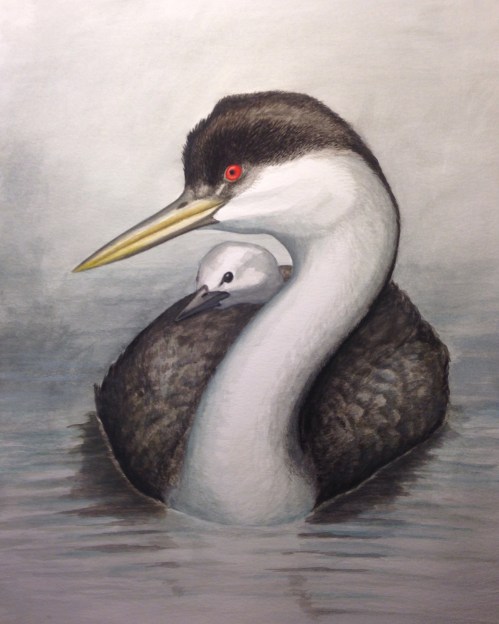
Western Grebe (Aechmophorous occidentalis) with young. 11 x 15″ Gouache painting. Copyright Bryce W. Robinson

I really enjoy the strange behaviors found in the bird world. The Western Grebe (Aechmophorous occidentalis) is then naturally a favorite, due to a few behaviors that are on the surface quite strange.

The first is the rushing, or the synchronous courtship dance where a pair runs in contorted posture across the water. I’ve never painted, photographed, or filmed this behavior but I hope to this coming spring.

The second is the behavior pictured above. Young grebes ride on their parents back, situated between the wings. The parent dives for fish with young in tow, then surfaces with a catch and feeds it to the young.

The third is perhaps the strangest of the behaviors. Grebes eat their own feathers, and parents feed their feathers to their young. There are many hypotheses of what they may do this, but perhaps the most plausible is to line their stomachs. Grebes of course eat fish, yet their gizzards may not fully crush the bone. To protect the soft tissue of their proventriculus and perhaps parts of the intestines, grebes then eat a large amount of feathers that line their insides.

Rather incredible….

Banded Golden-crowned Kinglet

by Bryce W. Robinson

_MG_4949.jpg

This past fall I helped the Intermountain Bird Observatory band birds on a number of occasions at a site along the Boise River. I’ve returned to the location on occasion throughout the winter to bird, and every time I find a small mixed flock with banded individuals throughout.

The other day I made attempts to photograph banded birds to capture band numbers and identify individuals. Easier said than done when the flocks are busy foraging. I came away with some good photos, but nothing that put together a full sequence or even the last few digits.

It can be said, however, that these birds are most likely the same birds that were banded here in October. The other most plausible explanation is that some were banded at IBO’s other site, only a few miles away on the top of Boise Peak. I’m unfamiliar with the literature on winter movements of the Golden-crowned Kinglet, so I don’t have an idea if holding a small range throughout winter is common for this species. Still, the birds I photograph seem to be staying put which surprises me in some way. Perhaps the inclination of the flock to stay within a small range speaks to the quality and perhaps importance of the habitat provided by this relatively wild portion of Boise’s section of the river.

Time to read, and think some more.