
A studio for bird study

Northern Shrike Nest in Western Alaska

by Bryce W. Robinson

IMG_7056-2

I’ve been on the ground in Alaska with my friend Neil for a week now, and the hunt for Gyrfalcon nests has been all consuming. We haven’t had much luck on the Gyrfalcon front, most nest sites are occupied by Rough-legged Hawk, Golden Eagle, and Common Raven.

Although we’ve had little success with finding Gyrfalcon nests, we have found many other natural treasures. We’ve already seen our fill of Grizzly Bears, and even caught a brief but close look at a Gray Wolf. It seems that every day in the Alaska bush turns up a number of great experiences. One that tops the list for this past week was when I found a Northern Shrike nest in a small tree along a creekside.
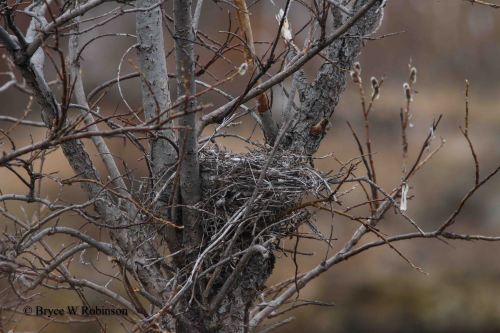
NSHR Nest

The mother held tight in the nest until we were within twenty feet. She then fled, and as we were checking the nest and counting eggs, she came back to her nest. Her responsible behavior and fidelity to her clutch provided me with some great opportunities to photograph her. I appreciate the tenacity of these small passerines. They are truly a vicious song bird. You can see she has some blood on her beak. NSHR

I’ve spent some time at Loggerhead Shrike nests in the desert southwest while doing nesting bird surveys, but I’ve never seen a Northern Shrike nest until now. I’ll tell you, the nests of excubitor are not at all unlike ludovicianus. This nest, like the Loggerhead, was in the middle of the small tree, cones shaped and made of many twigs. The cup was rather deep, and lined with many feathers to insulate eggs and young from the severe weather of the Alaskan tundra. This was a great moment in my first hand education in ornithology, so I had to share.

NSHR Nest wm-0900s


The Gyrfalcon Project is on the Ground in Alaska

by Bryce W. Robinson

Adult female Gyrfalcon- Falco rusticolus

I’m in Alaska to start the first field season of The Peregrine Fund’s Gyrfalcon Project. I landed only three days ago, and hit the search for nests right away. At this point, the earliest nesting Gyrfalcons will have hatching eggs any day. For my research, I need to find them before they hatch.

Gyrfalcon Eyrie

Already I’ve located two occupied territories, with one nest well into incubation. With the help of my friend and field assistant Neil, I made my first entry into an eyrie yesterday to assess nest age, and gather other important data. While I was in the nest, Neil took advantage of the disturbance and documented two very responsible adult Gyrfalcons as they circled and watched my intrusion.

Adult Female Gyrfalcon- Falco rusticolus

After we finished our tasks of data collection, we left the nest. When we reached a distance of approximately 500 meters from the nest cliff, we turned around and took a look at the nest. We were happy to see the female had already returned to the nest to resume incubation. While I was in the nest, I was able to see that one egg had pipped, meaning that in a couple of days there will be some newly hatched Gyrfalcons.

Stay tuned as the summer progresses. There will be numerous reports over the course of the season. Soon there will be nestlings, and I’ll be there to photograph them. You can find out more about this work on ornithologi’s Gyrfalcon Project page, and be sure to check out the Peregrine Fund’s website and consider supporting my work, and raptor conservation as a whole. Here’s to a successful summer, with loads of Gyrfalcon’s!


Intermountain Bird Observatory’s Long-billed Curlew Study

by Bryce W. Robinson

photo-22

I was fortunate to tag along with Jay Carlisle and the IBO crew yesterday afternoon to trap and outfit a female Long-billed Curlew- Numenius americana, with a GPS transmitter. IBO has been tracking Curlews for a little over a year now, with the focus of understanding their movements and why there has been a general population decline.

This is a great project, headed by a great institution. I encourage everyone to take a moment to learn about the effort and consider supporting the work of IBO.

The Long-billed Curlew is an exceptional bird. Let’s do our part to make sure it has a future in the changing west.

LEARN MORE, and CONTRIBUTE! Do so on IBO’s Curlew Homepage  

Long-billed Curlew nest

Long-billed Curlew nest

Sharp-tailed Grouse Lek

by Bryce W. Robinson


Yesterday, I had the privilege of getting up at 4 AM to join Jay Carlisle and Heidi Ware on a trip to visit a Sharp-tailed Grouse lek in western Idaho. We arrived on the lek before sunrise, just in time to hear the beginning dances of the lekking grouse. As the sun rose the grouse surrounded us, chucking in unison and stamping their feet.

If you’ve never been to a Sharp-tailed Grouse lek, you must. It is a bizarre performance as the birds face off with a nemesis to exhibit their fitness and attract the attention of a lady.

The peculiarity of this display is reason enough to ensure that open natural landscapes, such as the sagebrush steppe in western Idaho is preserved. Spread the word and the images of natural wonders such as these grouse, so that even those not so interested in wildlife will recognize the benefit of conserving the wild world.