A studio for bird study

Tag: art

Charadrius Plate

by Bryce W. Robinson

2L3A7578-2-01

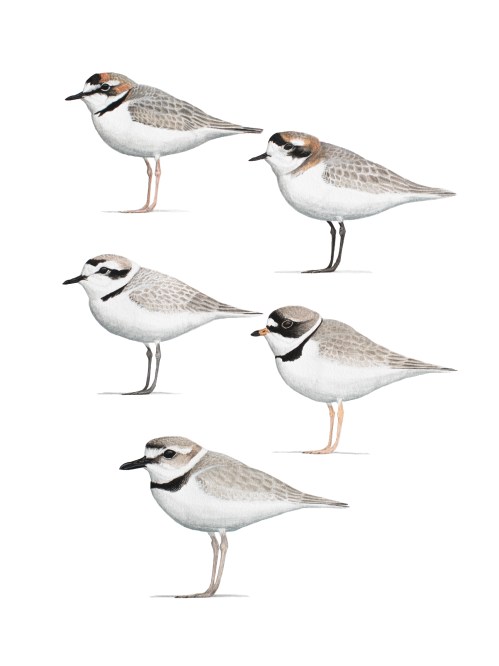
My friend Dan asked me to paint a shorebird plate for an auction at a conference that he will be attending in Peru in November. I chose to highlight the genus Charadrius for the plate, choosing five species from the new world. From the top, I’ve illustrated the Collared Plover (Charadrius collaris), Puna Plover (C. alticola), Snowy Plover (C. nivosus), Semipalmated Plover (C. semipalmatus), and Wilson’s Plover (C. wilsonia).

I learned a great deal from this painting. I am seeing a bit of growth in my painting over the past year, and this piece in particular represents a move forward. I’ll be painting many more plates that highlight species or subspecies groups.

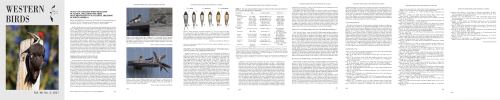
Published in Western Birds: First Record of Breeding Eurasian Barn Swallows (ssp. gutturalis) in North America

by Bryce W. Robinson

Fig.3.jpg

My friend Luke DeCicco and I published a paper in the Western Field Ornithologists journal Western Birds that details an observation I made during my last hours of the 2016 field season in Nome, Alaska. I happened upon four recently fledged Barn Swallows being provisioned by two adults, that were obviously white-bellied Eurasian birds. I couldn’t spend much time with them due to my departing flight, but I did my best to document everything in haste. The flight back to Anchorage was fun, as I sat there with my mind buzzing thinking of how to report this observation in the literature.

I asked my friend Luke be on the manuscript for a few reasons. First, Luke had identified a white-bellied bird in the same location (Nome DOT utility yard) a few days prior while we were loading our storage container. As such, I had my eyes open while traveling through the area when I spotted the birds being provisioned. Without his initial observation, I may have been effectively asleep at the wheel and may have missed the birds entirely. Birding was not the reason I was in the utility yard. Second, Luke has an impressive handle of the birdlife of Alaska, along with the connections necessary to expeditiously investigate the historical status of the species in the state, and to assess the potential that this record was indeed a first. In the end, he brought forward and engineered the aspect of the paper that is perhaps the most useful, an update on the status of Eurasian subspecies in AK, along with a summary of records of vagrant subspecies. The result is an article that will be very useful for folks in the future as they put their own observation into context. I feel really fortunate to have Luke’s contribution to this publication.

This publication represents a few firsts for me. Primarily it represents crossing a threshold in my career, as it is the first publication of mine where I have incorporated my passion for ornithological illustration. I painted a rendering of the differences between the subspecies discussed in text in the form of museum specimens. I’m very pleased with the figure, and I’m excited to continue to make illustration integral in my work.

The paper is worth a read for anyone interested in Alaska’s birdlife, and bird distributions in North America.

Click the image below and give it a read!
Untitled-1-01.jpg

Orange-breasted Falcon (Falco deiroleucus) Painting: A Mile Marker

by Bryce W. Robinson

Untitled-2-01

I feel really fortunate for the opportunity to illustrate and paint during the six months I’ve spent in Central America. My time here has really expanded my understanding of birdlife, and strengthened all of my skills with which I employ to communicate this understanding to others. I’ve been a bit more familiar with the Orange-breasted Falcon each time I’ve painted it, and on reflection I think it shows in each painting. This has taught me the value of studying structure, plumage, posture, effects of light, and personality in each species I illustrate. Being familiar with your subject (from field study) is integral to rendering it correctly, which means I’ll need to spend more time in the field looking at birds.

Singing Brewer’s Sparrow (Spizella breweri) on Sagebrush

by Bryce W. Robinson

brsp

Singing Brewer’s Sparrow (Spizella brewer) on sagebrush. Gouache on watercolor paper.

One of the best parts of spring in the Sagebrush landscape of western North America are it’s singing inhabitants. The Brewer’s Sparrow may be my favorite, because of its subdued but beautiful plumage and distinct trill song. On a spring morning at sunrise, one can walk through a healthy stand of sagebrush, songs erupting all around, as multiple males sing atop their sagebrush posts.

Brewer’s Sparrows have a distinct buzzing song, that sounds superficially simple and distinct. But, their songs can be variable and have multiple types as described in Rich (2002). See the figure below to gain a familiarity with the variability.

25025301.gif

Song types of the Brewer’s Sparrow, long (A) and short (B). Figure taken from Birds of North America Online, adapted from Rich (2002). 

Rich (2002) found that the variability seen above seems to follow no geographic trend or isolation, nor does there seem to be any song sharing among neighbors. High turnover among territories and potential for natal dispersal could limit the development of local dialects, etc. Interesting stuff…

If you’re unfamiliar with the sound of a singing Brewer’s Sparrow, be sure to visit Xeno-Canto and explore.

My friend Eli is wrapping up some research investigating the impacts of anthropogenic noise on sagebrush inhabitants in southwest Idaho. Breeding Brewer’s Sparrows were among a few focal species of her study. She’s currently working through the publication process, and when her work comes to surface in print, I’ll be sure to share. I expect that anthropogenic noise has some masking impacts on a Brewer’s Sparrow song, and in turn could potentially change the dynamics of song structure under anthropogenic noise blankets, etc. More research and time will tell.

Here is a short clip of a singing Brewer’s Sparrow in Idaho that I took through my Zeiss scope. The song is barely audible because of how distant I was from the singing bird:

Referenced Literature:

Rich, T. D. 2002. The short song of Brewer’s Sparrow: individual and geographic variation in southern Idaho. Western North American Naturalist 62(3): 288-299.