A studio for bird study

Tag: art

The Christmas Bird 2013: American Tree Sparrow- Spizella arborea

by Bryce W. Robinson

treesparrowetsy

Every year I illustrate a bird for the holiday season. This year, I’m a bit early, but only because I wanted to open the Christmas Bird for purchase as a print. You can visit the ornithologiart store, and purchase a print. Available are 4×6″ for $8.00, 5×7″ for $12.00, and 5×7″ matted for $15.00. Click the photo to purchase, or simply follow the link: ornithologiart.

The American Tree Sparrow is a breeder of the high north Taiga lands. It migrates to the lower parts of North America during winter, and is a favorite feeder bird of many. I chose the American Tree Sparrow because I feel it captures the spirit of the season, and is emblematic of the winter solstice. This is a great holiday gift for any birder.

From both Caitlin and I, Happy Holidays, Merry Christmas, Happy Hanukkah, or Happy Solstice. However you choose to celebrate the season, we hope you have a great time with family, friends, and of course, birds.

Support Gyrfalcon Conservation Efforts of The Peregrine Fund Through Year End Donations, or By Purchasing Artwork

by Bryce W. Robinson

Click image to purchase

Click image to purchase **PRINT ONLY** *Original available

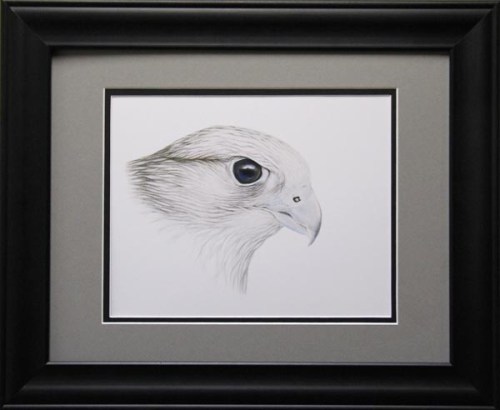
The Gyrfalcon, the Polar Bear of the bird world, is truly an iconic symbol of the frozen north.

It is undeniable, the earth is undergoing rapid change. To properly predict and prepare for the impacts this change will have on the Gyrfalcon, The Peregrine Fund has started a program to study particular aspects of Gyrfalcon biology, and form a conservation program.

I am part of The Peregrine Fund team, charged with developing a long term project to monitor Gyrfalcon populations, and conduct necessary research that will inform conservation biologists, to ensure the future of this powerful bird.

Please consider contributing to the efforts of The Peregrine Fund for a year end donation, and be part of a conservation effort aimed at ensuring the future of the Polar Bear of the birds, the Gyrfalcon. Doing so will not only help in the effort to understand and ensure the future of an arctic animal, but will inevitably help in understanding climate change and its real time implications on the earth as a whole, and in turn, on ourselves.

You can become part of this effort by visiting The Peregrine Fund website, and clicking on the DONATE NOW button on the top right of the page. The Peregrine Fund is a registered non-profit 501-C3, so all donations are tax deductible. In the comments section of the donation form, please specify that you wish your gift to contribute to the Gyrfalcon Project.

In an effort to diversify my funding sources, I have started THE GYRFALCON PROJECT, here on ORNITHOLOGI.COM. I will illustrate and paint, to capture the Gyrfalcon in its emblematic form. All illustrations will be featured on the blog and will be available as originals, along with prints. 50% of proceeds from all sales will be donated to The Peregrine Fund to support the Gyrfalcon Project.

Your action will help, no matter how small, in empowering the research and understanding of our rapidly changing world.

If you are interested in commissioning an original of any medium, please contact me at ofbirdsandbATgmail.com.

Prairie Falcon- Falco mexicanus

by Bryce W. Robinson

Prairie Falcon- Falco mexicanus. 18x24" prismacolor on bristol

Prairie Falcon- Falco mexicanus. 18×24″ prismacolor on bristol

Of all the raptors I illustrate, it seems falcons give me the most trouble. I’m not entirely sure why, but the fact that I struggle with the family is a bit disheartening, as it is likely to be a group I spend a considerable amount of time studying for the rest of my life. Perhaps with time, I’ll work out the bugs in my inability to adequately illustrate the birds.

Falco mexicanus is a significant illustration for me. I’ve conducted a great deal of field work in the west, primarily in the flats of the great basin, and I’ve had many experiences with the sandy brown assassin. Get yourself lost on lonely dirt roads of the remote great basin in midst of winter, and you will undoubtedly come upon a Prairie Falcon perched on some high point, surveying for prey.

I remember last year, I was searching for eagles on the edge of the salt flats of north western Utah. I had pulled over to glass a mountain top, and found myself watching a perched Golden Eagle, some two kilometers away by my estimate. While I watched the bird, I notice a fast approaching figure headed straight for the large raptor. The figure was in fact the Prairie Falcon, come to conduct its business of bullying the large eagle. The tenacious bastard kept at it for nearly five minutes, until finally the eagle had enough of the dodging, and fled from the persistent falcon pest.

My success with illustrating this bird is fortunate, and gives me the courage to start a project that will be focused on gleaning some much needed extra funding for my work with the worlds largest falcon this summer. Stay tuned as this idea develops and materializes.

A “Meridionalis” Turkey Vulture

by Bryce W. Robinson

IMG_4268

I gave my Turkey Vulture warts, for a reason. As I’ve stated in previous posts, I’ve began pursuing a degree in Raptor Biology at Boise State University, under the direction of David Anderson at the Peregrine Fund, and Marc Bechard, who has been with BSU since the 1980’s. Dr. Anderson is a great man himself, and I’m sure I’ll have plenty to tell about him later, but for this post, I’d like to mention some things about Dr. Bechard.

Last week Dr. Bechard accompanied me and a few of my peers, along with Greg Kaltenecker of Idaho Bird Observatory to attempt to capture migrating Turkey Vultures. Ultimately we failed, but I feel like I learned some things about Dr. Bechard and his interest with Cathartes aura, commonly called the Turkey Vulture. While trapping hawks in the blind at Lucky Peak, I picked his brain for insights into the life histories of the Turkey Vulture. He told me many things, but one aspect that stuck was his discussion of the subspecies of the Turkey Vulture, their regional distribution, and their migratory habits.

We in the west see what is called subspecies meridionalis, which is the subspecies I’ve illustrated above. Those in the east see septentrionalis. In Arizona, you find the nominate aura at its northern extent. These three sub groups comprise the Turkey Vultures found in North America. Of course in S. America, there are others. It is not often that you find a man who specializes on vultures. I find myself lucky to be working under such a man. At the moment, he is in Gambia, trapping Hooded Vultures with Keith Bildstein of Hawk Mountain Sanctuary. Lucky him, as he is off chasing exotic vultures while I teach his classes. I’m perfectly fine filling in while he’s gone, so long as he teaches me all that he knows!

Juvenile "Western" Turkey Vulture- Cathartes aura meridionalis

Juvenile “Western” Turkey Vulture- Cathartes aura meridionalis