
A studio for bird study

Tag: avian

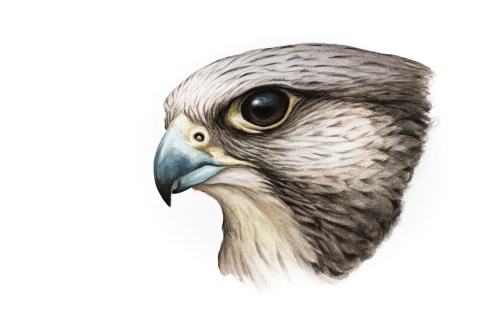
Gyrfalcon (Falco rusticolus) Painting

by Bryce W. Robinson
_MG_9407

Gyrfalcon (Falco rusticolus). 11 x 17″ Gouache on paper.

Over the past three years my study has revolved around the Gyrfalcon, as I’ve pursued my Master’s of Raptor Biology degree at Boise State University. In May I completed my degree and finished my thesis. At the moment, I’m doing field work in Alaska with the U.S. Fish and Wildlife Service on a few different bird projects across the state, but I’m also working on getting my Gyrfalcon work published. As my work gets published (hopefully) I’ll be sure to share links and a brief description of what each paper details.

While in school I did my best to be actively illustrating and painting birdlife. I’ve painted a number of different species over the past three years, but I’m left with the feeling that I did not paint my subject species enough. I suppose this feeling indicates that I’ll need to regularly return to painting the Gyrfalcon. I’d like to illustrate some of the concepts detailed in my research, but for now I decided to paint a simple head shot of the Gyrfalcon as a cessation of my “structured” work on the species. Now the page turns to a new chapter, the subject of which is unknown to me but I get the feeling it may be quite broad.
Lesser Yellowlegs Casts Pellet

by Bryce W. Robinson


I’m currently working in the Alaskan boreal forest outside of Anchorage. The focus of the work is on boreal wetland species such as Lesser and Greater Yellowlegs, Solitary Sandpiper, Short-billed Dowitcher, Olive-sided Flycatcher, and Rusty Blackbird to name a few. The time I’ve spent in the field has been rewarding on many levels, mostly because I’ve never worked in this system and I’m exposed to behaviors I’ve never seen.

Today I was in a canoe on my way to find some Rusty Blackbird nests. While slowly making my way, watching what I passed, I noticed a Lesser Yellowlegs perched on a log in the water. At the shoreline, I got out of the canoe and crept on the yellowlegs, laying down and turning on my camera. I’ve never had the chance to get great yellowlegs photos, so I took the opportunity. Meanwhile I recognized the opportunity to take some video, and as I switched over and began recording the yellowlegs expelled a pellet. This video alone, though it could be better quality, is worth an entire summer spent in the boreal. These seldom seen instances that speak to the life histories of birdlife are what I value.

Owls and raptors often get the attention when speaking about pellets in birds. In fact, many people don’t realize that most birds expel pellets. As recently as 1979, many species weren’t known to expel pellets (Below 1979). Now we understand that most species that consume insects and vertebrates cast pellets to reject indigestible material.

More description of the excellent boreal birdlife to come. I’m in heaven.

Referenced literature:

Below, T. H. 1979. First Reports of Pellet Ejection in 11 Species. Wilson Bulletin 91(4) pp. 626-628

Short-tailed Shearwater

by Bryce W. Robinson

I’ve seen a lot of North America’s birdlife, but there are certain bird groups where my exposure is lacking. One area is birds of the sea, or what we refer to as pelagic species. I haven’t seen many of these birds, particularly those that belong to the order Procellariiformes. In fact, I can count on one hand the number of species from this group that I’ve seen. So understandably I’d be interested in gaining more exposure in any way.

The other day I was birding the western Alaska coastline with my friends Neil Paprocki and Ellen Whittle. We were paying a lot of attention to the sea because we were looking to see puffins and a few loon species. I myself have spent a great deal of time watching the sea from the Alaskan coast, and I’ve never seen anything from the order Procellariiformes. On this day I had a first. We noticed a dark bird floating along the shoreline, maybe 100 m out. After scoping the bird, I knew that it was a Short-tailed Shearwater, a lifer for me and a long awaited bird. I was, to understate it entirely, excited.

The sight raised one thought in my mind, that the bird was obviously ill in some manner. It seemed to be sleepy, unconcerned by our presence, and very near shore (uncommon among these types of birds). So, something was likely wrong with the bird. Still, I took the proper satisfaction from studying the bird and enjoying its subdued behaviors.

I took some video (above) using my Zeiss Victory Diascope 65 F* TL that show the bird at a peak in its activity while we were watching. Notice the bird take a drink at the end of the video. If we drank seawater we’d in effect die of dehydration due to the high salt concentration. But, seabirds can drink saltwater. They excrete the excess salt through their nostrils. Observing this bird drinking the saltwater, and recalling their adaption for surviving life on the ocean was another moment where I saw something in real time that I had read about previously. Such an incredible experience, and behavior birding at its best.

Rough-legged Hawk Nestlings

by Bryce W. Robinson

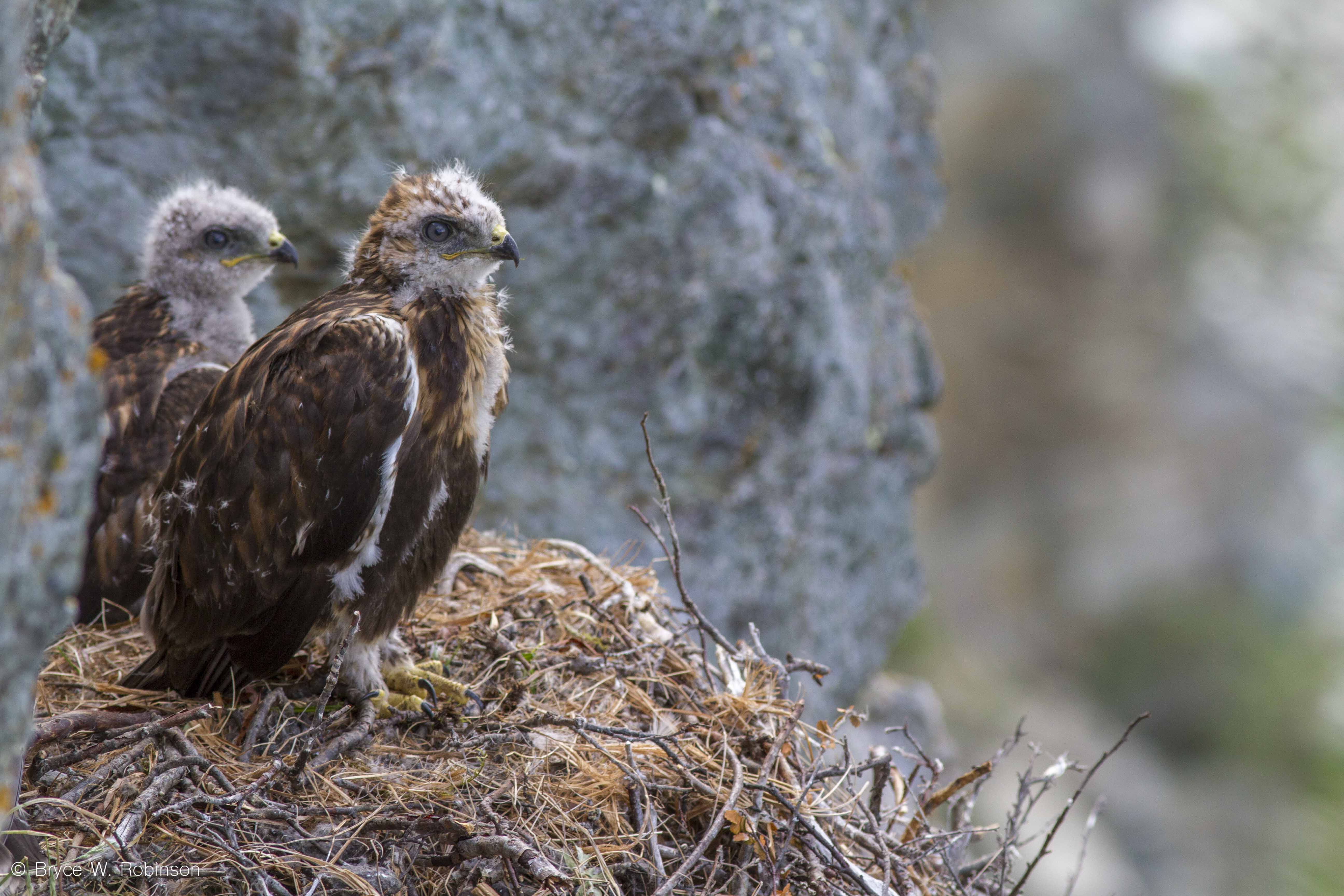
Rough-legged Hawk Nestlings

I was surprised the first time I saw the proximity of nesting Rough-legged Hawk and Gyrfalcon. It was my first summer in Alaska. I was along the Dalton Highway peering through a scope at an incubating white Gyrfalcon. Only 100 meters down the cliffside was an incubating Rough-legged Hawk. Now that I’ve gained an in depth experience with cliff nesting birds of the Arctic, I see why these birds tolerate one another. There simply aren’t enough locations to be choosy.

These eyes were watching me as I pulled out one of my Gyrfalcon nest cameras the other day. This is on the extreme end of Gyrfalcon – Rough-legged Hawk nest proximity. These nests are only about 10 meters apart, and given that these young Roughies are about to fledge, they will both be successful. Almost every cliff I’ve worked in this summer has had a nesting Rough-legged Hawk pair. Some cliffs have had two, along with nesting Raven and Cackling Goose (yes, they nest in cliff nests often). Real estate is limited, so all suitable sites are usually occupied given enough food in the area.

Rough-legged Hawks are a favorite. I gained a familiarity with them during past winters in Utah, and it was always a dream of mine to see them on their breeding grounds. Each time I’m around a nest, I remember my current place and business in life, something that is not to be taken for granted. I’m living a personal dream, and I’m happy.