
A studio for bird study

Tag: bird

The Power of Feathers in Determining Shape and Appearance

by Bryce W. Robinson
 

BANS_03

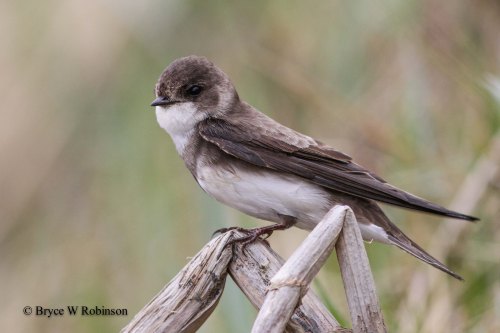
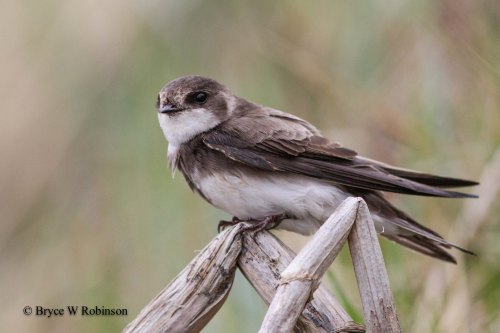
Consider the photo above and the photo below. The differences in shape are rather dramatic, as the photo above looks rather non-typical of a Swallow. These two photos are of the same Bank Swallow – Riparia riparia, taken seconds apart. 
BANS_02

Photographing swallows in flight itself is either a challenge or futile, I haven’t quite decided. But, if you sit long enough and forget about photography for a moment, you become aware of some incredible bird behavior. I sat alongside a tundra pond a few days ago, where two Bank Swallows and one Tree Swallow made rounds picking emerging insects from the water top. The interactions between the two species, and even between the two conspecifics were entertaining, but the real thriller was their interactions with me. Multiple times the birds flew within inches of my face, all the while giving me close looks at swallow feeding strategy and behavior.

Occasionally, the birds would perch to rest. A few times they choose perches only feet from me. When they landed, the would preen and chatter. One interesting observation during these resting periods was their change in appearance when they roused, or fluffed their feathers. The birds would lose the sleek swallow shape altogether, and in some postures appear more flycatcher-like than a swallow. This made me ponder the power of feathers, as they govern a birds appearance. It’s a bit bizarre, and a useful thing to consider when looking at a far bird, or a photograph that doesn’t quite make sense. Shape is one of the most useful factors in bird identification, but can at times be misleading without extended observation.

A minor complexity in the world of birds, but nonetheless fascinating.

Using Nest Cameras to Monitor Gyrfalcon Diet

by Bryce W. Robinson

Gyrfalcon Nest with Camera

While I’ve been sharing images and stories from Alaska concerning my work with Gyrfalcons, I’ve neglected to share any aspect of the work that has brought me here. I chose the image above to provide insight into the idea behind The Gyrfalcon Project. In the past month, Neil Paprocki and I have installed 6 motion sensor cameras in Gyrfalcon nests to monitor their diet during the nestling period. This information will give us a better idea of how changes in the system will impact the ability of these birds to reproduce. 6 cameras is a good start for the project, but I am capable of outfitting four more nests with cameras this season. The issue is access, and at the moment I’m scrambling to formulate a plan to put out the final four and round out the season with ten total cameras gathering valuable data of nesting Gyrfalcons. I’ll keep interested readers updated regarding our success. Please feel free to comment about questions, ideas, concerns, or general queries. I’ll do my best to respond when I’m able.  And the Gyrfalcon beat goes on!

Sharp-tailed Grouse Lek

by Bryce W. Robinson


Yesterday, I had the privilege of getting up at 4 AM to join Jay Carlisle and Heidi Ware on a trip to visit a Sharp-tailed Grouse lek in western Idaho. We arrived on the lek before sunrise, just in time to hear the beginning dances of the lekking grouse. As the sun rose the grouse surrounded us, chucking in unison and stamping their feet.

If you’ve never been to a Sharp-tailed Grouse lek, you must. It is a bizarre performance as the birds face off with a nemesis to exhibit their fitness and attract the attention of a lady.

The peculiarity of this display is reason enough to ensure that open natural landscapes, such as the sagebrush steppe in western Idaho is preserved. Spread the word and the images of natural wonders such as these grouse, so that even those not so interested in wildlife will recognize the benefit of conserving the wild world.

A Communal Roost of the Great Horned Owl

by Bryce W. Robinson


I’d like to share this video of a solitary roosting Great Horned Owl to introduce a story and celebrate a career goal accomplished for both Caitlin Davis, and myself.

In December 2012, Caitlin and I were conducting Golden Eagle surveys in the west desert of Utah. One evening on our survey route near the border of Nevada and Great Basin National Park, we came upon a roosting pair of Great Horned Owls. These owls sat in a small string of trees about 30 m in length. Soon after we discovered the roosting pair, we noticed an additional four owls in the same tree line. A total of six owls sat together in close proximity, and soon after we counted the birds, I knew the significance of what we had found.

Because I knew that Great Horned Owls are extremely territorial, I looked into the literature hoping to find any reports of similar roosting behavior. After what seemed to be an exhaustive search, I had found no reports of any communal roosting behavior for the Great Horned Owl, or any other Bubo species.

I discussed the idea of reporting the findings with Steve Slater, Shawn Hawks, and Markus Mika at HawkWatch International. They were supportive of the idea, so with little hesitation I wrote a short report of the roost and submitted it for publication to the Journal of Raptor Research.

The report was accepted, and has now been published in the latest issue of the JRR. Caitlin and I are extremely grateful to everyone who helped us get the word out in the proper fashion by talking out ideas, and revising the manuscript. It was a fun process, and I look forward to repeating it again in the future.

Read the article here:

Robinson, B.W. and C. M.  Davis. 2014. A communal roosting of the Great Horned Owl (Bubo virginianus). Journal of Raptor Research 48(1) 88-89