A studio for bird study

Tag: bird

Singing Brewer’s Sparrow (Spizella breweri) on Sagebrush

by Bryce W. Robinson

brsp

Singing Brewer’s Sparrow (Spizella brewer) on sagebrush. Gouache on watercolor paper.

One of the best parts of spring in the Sagebrush landscape of western North America are it’s singing inhabitants. The Brewer’s Sparrow may be my favorite, because of its subdued but beautiful plumage and distinct trill song. On a spring morning at sunrise, one can walk through a healthy stand of sagebrush, songs erupting all around, as multiple males sing atop their sagebrush posts.

Brewer’s Sparrows have a distinct buzzing song, that sounds superficially simple and distinct. But, their songs can be variable and have multiple types as described in Rich (2002). See the figure below to gain a familiarity with the variability.

25025301.gif

Song types of the Brewer’s Sparrow, long (A) and short (B). Figure taken from Birds of North America Online, adapted from Rich (2002). 

Rich (2002) found that the variability seen above seems to follow no geographic trend or isolation, nor does there seem to be any song sharing among neighbors. High turnover among territories and potential for natal dispersal could limit the development of local dialects, etc. Interesting stuff…

If you’re unfamiliar with the sound of a singing Brewer’s Sparrow, be sure to visit Xeno-Canto and explore.

My friend Eli is wrapping up some research investigating the impacts of anthropogenic noise on sagebrush inhabitants in southwest Idaho. Breeding Brewer’s Sparrows were among a few focal species of her study. She’s currently working through the publication process, and when her work comes to surface in print, I’ll be sure to share. I expect that anthropogenic noise has some masking impacts on a Brewer’s Sparrow song, and in turn could potentially change the dynamics of song structure under anthropogenic noise blankets, etc. More research and time will tell.

Here is a short clip of a singing Brewer’s Sparrow in Idaho that I took through my Zeiss scope. The song is barely audible because of how distant I was from the singing bird:

Referenced Literature:

Rich, T. D. 2002. The short song of Brewer’s Sparrow: individual and geographic variation in southern Idaho. Western North American Naturalist 62(3): 288-299.

Great Blue Heron (Ardea herodias) Watercolor Painting

by Bryce W. Robinson

gbhe

When I was a kid, I poured over the Great Blue Heron (Ardea herodias). I’d spend hours near my house in Ithaca, NY, stalking this bird to get a better look. I was studying the bird, its habits and its behaviors, though I didn’t quite realize what I was doing at the time. I’d also spend hours sketching the bird. It was the first bird I drew, and I drew tirelessly.

Since I was a kid I’ve done a few Great Blue Heron illustrations and started a few paintings, but due to my diversified passion for birdlife I haven’t finished a painting of this subject since I was a kid. Finally, I had the opportunity to do so.

I look at the painting and I see loads to improve upon, but it’s so satisfying to see my illustrations as a child against the painting above. As I do, I reflect on my journey thus far in life and look forward to many more paintings to come.

First Idaho Record of Red-flanked Bluetail – December 2016

by Bryce W. Robinson

_MG_5166.jpg

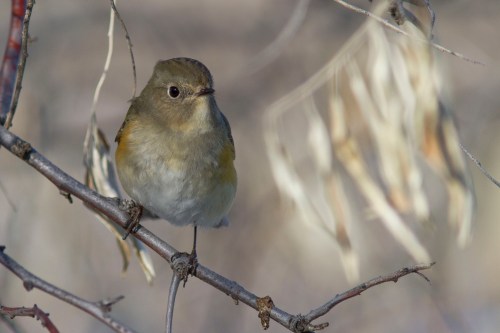
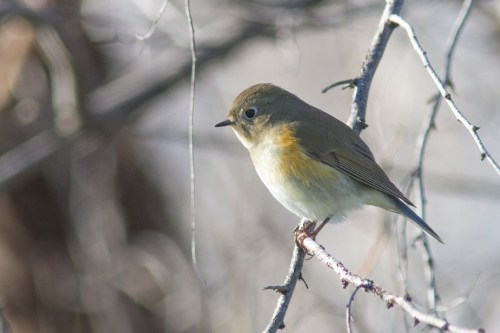
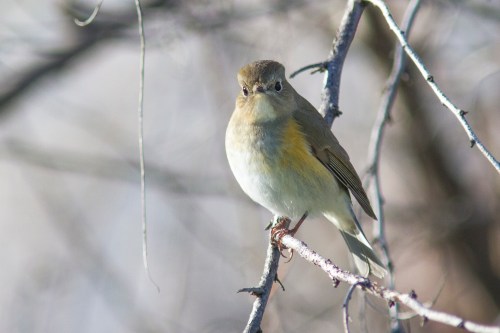
On 31 December 2016 I made the five hour trip from Boise to Lewiston to see Idaho’s first record of Red-flanked Bluetail (Tarsiger cyanurus). On arrival, the bird already had a crowd watching it forage along the Russian Olives that bordered the river.

_mg_5271

It was a sunny and relatively warm morning, and the bird was actively foraging. It would appear on the tree edge and making foraging sallies to the ground. It looked like the bird was eating the Russian Olive fruits, but one of my photos show it with an arthropod in its bill as well.

_MG_5140.jpg

It made its way foraging between four trees along the river, heading south to the last tree and then returning north. Occasionally it would disappear low in the trees along the rivers edge, and return to foraging within a few minutes.

My favorite aspects of this bird were its subtle hues in the plumage, particularly the blue throughout and the white throat patch. I also enjoyed its behaviors, such as the constant tail dabbing. The bird was extremely cooperative, providing all watching with excellent views. At times when it would come to the ground to forage, it would do so only feet from the birders. I’d say it was behaving about the best anyone could hope for concerning a high profile vagrant.

I spent some time attempting to capture video of the bird perched on a limb, tail dabbing. I mostly was unsuccessful, but did manage the following clip that is poor quality. It’s worth sharing just to show the birds behavior.


The Red-flanked Bluetail was a great end to 2016, which was a bummer of a year for so many reasons, but was incredible and profitable regarding birds. Hopefully 2017 will match or exceed. Happy New Year.

2nd ABA Record of Common Scoter (Melanitta nigra) in Oregon

by Bryce W. Robinson


I had a great weekend. A few friends and I made the short road trip from Boise to the Oregon coast to see the ABA areas second record of Common Scoter (Melanitta nigra). The Common Scoter breeds across Europe and Asia, and most closely resembles the Black Scoter (Melanitta americana). The first record for this species was surprisingly only last year in Northern California.

We had no trouble finding the bird when we arrived, because there were already many birders on location. We were lucky though, it was high tide and the bird had come up river to preen and feed. I stood on a bridge with the bird nearly directly below me and took photos and video.

_MG_4118.jpg

Male Common Scoter (Melanitta nigra). Second ABA record, Lincoln City, Oregon. November 2016.

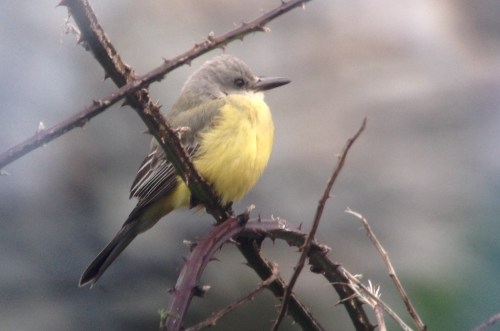
We birded the area after getting our fill, including sea watching which never disappoints folks from inland. We also bagged another lost bird, a Tropical Kingbird a few miles down the road from the scoter stake-out. Overall it was an excellent trip with good friends.

FullSizeRender-1.jpg

Digiscoped photo of a Tropical Kingbird (Tyrannus melancholicus) in Lincoln City, Oregon.