A studio for bird study

Tag: birding

Rock Sandpiper – Calidris ptilocnemis, From Curiosity Stems Study

by Bryce W. Robinson

ROSA

Here in western Alaska I’ve been able to spend a bit of time pausing from a focus on Gyrfalcons to watch the Rock Sandpiper – Calidris ptilocnemis on its breeding grounds. My fascination with its appearance, behavior, and vocalizations caused me to look into what is known about their populations and distribution, a factor of bird biology that I’m growing evermore interested in studying. My investigation led me to understand that there occur three separate subspecific populations in Alaska, the nominate ptilocnemis of the Pribilofs, the tschuktschorum of the western mainland, and couesi of the Aleutian archipelago. As I am currently conducting research on the Seward Peninsula, I have been experiencing Calidris ptilocnemis tschuktschorum. 

After some further reading, I learned that the nominate ptilocnemis has the most northern wintering region of any North American shorebird. Remarkably, these birds spend their winters in the Cook Inlet of coastal Alaska. How they manage to find enough food and weather the extreme temperatures and conditions is above my current comprehension, but I was able to find some literature on the subject. Apparently, their is no physiological characteristic or attribute that separates ptilocnemis from other Rock Sandpiper subspecies that would give it the edge to winter so much farther north. The other Rocks could physiologically manage a winter in the north as well, but for whatever reason ptilocnemis is the only ssp. to do so. This seems like a peculiarity, and that is precisely why I am so fascinated by their distribution.

There are other Calidris species that are polytypic, and have separate wintering grounds for each subspecific population. Learning about such cases is extremely enlightening and begs for some contemplation on the matter. Perhaps a polytypic species such as the Rock Sandpiper, or the Red Knot will have an edge on anthropogenic induced changes affecting key migratory sites and their ability to survive the great journey. Perhaps the ability to buffer such disruptions is already built into their distribution at the species level. They are certainly better off than a monotypic species that stops over or winters wholly in a small and localized area. If the lower Pacific Coast of North America becomes a dead zone, then perhaps the subspecies couesi and tschuktschorum will be hard hit, but the nominate ptilocnemis may fair well and maintain a presence for the Rock Sandpiper in North America. As we attempt to be aware of our ever increasing impact, it sure would be nice to know that some birds will be able to wear the disruption, even if it is to a minor degree, so we can then put more energy into those more sensitive.


Referenced information:

Gill, Robert E., Pavel S. Tomkovich and Brian J. Mccaffery. 2002. Rock Sandpiper (Calidrisptilocnemis), The Birds of North America Online (A. Poole, Ed.). Ithaca: Cornell Lab of Ornithology; Retrieved from the Birds of North America Online:http://bna.birds.cornell.edu/bna/species/686

Ruthrauff, D. R., A. Dekinga, R.E. Gill, and T. Piersma. 2013. Identical Metabolic Rate and Thermal Conductance in Rock Sandpiper (Calidris ptilocnemis) Subspecies with Contrasting Nonbreeding Life Histories. The Auk 130 (1) pp. 60-68

Happy International Guillemot Appreciation Day (IGAD)

by Bryce W. Robinson

BLGULast year my friend Frank, a great birder, asked me a simple question, “Did you celebrate International Guillemot Appreciation Day this year?” I told hime no, and that I had no idea what he was even talking about. He explained that July 27th, if I remember correctly, has been designated to recognize the Black Guillemot. Sounded great to me.

I researched the history a bit, and it seems there is some confusion of whether or not IGAD is July or June 27th. This year, I’ll be celebrating the existence of Guillemots on July 27th. I’ll get it sorted out next year and celebrate in line with what was originally designated as the day to recognize the small Alcids.

This year I illustrated the above Black Guillemot. I haven’t been illustrating much this summer on account of my focus on Gyrfalcon field work, but I made it a priority to put this image together in honor of the birds. I also plan to head to my favorite sea watch spot and watch for an hour or so. I should turn up a few Pigeon Guillemots, and who knows, perhaps a Black or two. The bird would be notable here in Western Alaska in summer, but with birding you never know!

Appreciate a Guillemot today. They sure are class act creatures!

BLGU

The Power of Feathers in Determining Shape and Appearance

by Bryce W. Robinson


BANS_03

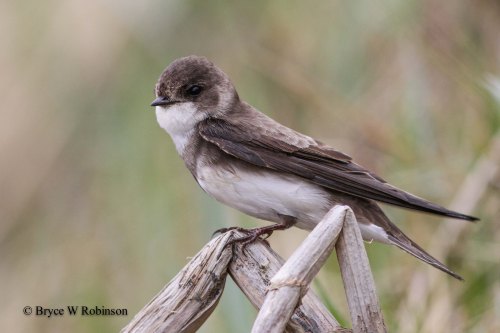
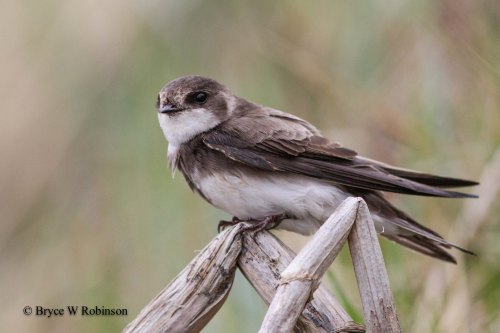
Consider the photo above and the photo below. The differences in shape are rather dramatic, as the photo above looks rather non-typical of a Swallow. These two photos are of the same Bank Swallow – Riparia riparia, taken seconds apart. 

BANS_02

Photographing swallows in flight itself is either a challenge or futile, I haven’t quite decided. But, if you sit long enough and forget about photography for a moment, you become aware of some incredible bird behavior. I sat alongside a tundra pond a few days ago, where two Bank Swallows and one Tree Swallow made rounds picking emerging insects from the water top. The interactions between the two species, and even between the two conspecifics were entertaining, but the real thriller was their interactions with me. Multiple times the birds flew within inches of my face, all the while giving me close looks at swallow feeding strategy and behavior.

Occasionally, the birds would perch to rest. A few times they choose perches only feet from me. When they landed, the would preen and chatter. One interesting observation during these resting periods was their change in appearance when they roused, or fluffed their feathers. The birds would lose the sleek swallow shape altogether, and in some postures appear more flycatcher-like than a swallow. This made me ponder the power of feathers, as they govern a birds appearance. It’s a bit bizarre, and a useful thing to consider when looking at a far bird, or a photograph that doesn’t quite make sense. Shape is one of the most useful factors in bird identification, but can at times be misleading without extended observation.

A minor complexity in the world of birds, but nonetheless fascinating.

Bar-tailed Godwit Observations – Learning in the Field

by Bryce W. Robinson

Female Bar-tailed Godwit

I really appreciate instances where I learn in the field, from first hand observations rather than reading in a book. It seems my bird related knowledge is skewed a bit to the latter, so that when I observe something for the first time in the field, I usually have an understanding of it from previous reading. I’d like to measure myself as a young ornithologist by what I recognize in the field, and later read in a book. I’d like to say, “hey, I saw that last week when I was watching that Arctic Warbler, just as so and so wrote here in this account”. To me, this skill means that I have the observation tools necessary for proper bird study, and I’m up to par with my contemporaries and those who have studied before me, or at least developing the skills needed to reach that point.

Male Bar-tailed Godwit

Well, I’m happy to report that one such instance occurred recently, as I was observing and photographing a pair of Bar-tailed Godwits – Limosa lapponica. I’ve had very little exposure to these birds, a fact of which I’m working to rectify at the moment. The two birds I found the other evening were recent arrivals, and very keen on replenishing the reserves they had just spent on the long flight from Australia, or thereabouts.

Bar-tailed Godwit - Male and Female

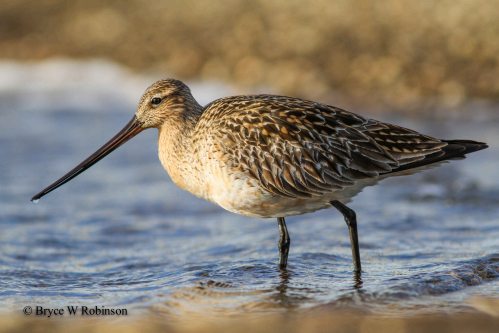
I sat with the birds for an hour, maybe more, and shot away with my camera. While doing so, I was struck by the dramatic size difference between the male and the female. The male, being an impressive cinnamon color, was much daintier than his female companion. The light bodied female was at least 1/3 larger than the male, by my estimation. Also, her bill was noticeably longer. So, my first observation learned from the experience was that this species exhibits “Reversed Sexual Dimorphism”, or that the female is larger than the male in size and attributes. Of course the birds are sexually dimorphic in alternate plumage, which makes identification easy during the breeding season, but my observation in size dimorphism was exciting nonetheless.

My second observation came later as the birds wandered closer and I was able to see their behaviors in greater detail. Both birds were feeding, sticking their bill fully into the soft sand and pulling out all sorts of wriggling worm-like animals, the classification of which is certainly unknown to me. When the worm critters were extracted, I noticed some flexing in the upper mandible of the bill. Later, as the birds became more full, they’d stop to preen and stretch. During one of these idle moments, I noticed some extreme flexing in the upper mandible. AHA! Rhynchokinesis! My first personal observation of this trait in birds.

Not the best photo, but look at that upper mandible flex!

Not the best photo, but look at that upper mandible flex!

Although these observations are not novel, nor are they difficult to observe, it was still an exciting moment in my field education. I noticed two traits belonging to Bar-tailed Godwit that were unknown to me beforehand. The fact that Rhynchokinesis exists in this long-billed species makes absolute sense, but observing the trait first hand was a moment that sums up exactly why I study birds. The satisfaction of recognizing these traits is rich, and causes one to push on and observe other species in greater detail. The more you look the more you see, and in the future I hope experiences like these become more frequent as I learn how to truly look at birds. I feel like my education is only beginning!