A studio for bird study

Tag: birding

Semipalmated Sandpiper- Calidris pusilla

by Bryce W. Robinson

IMG_4352 copy

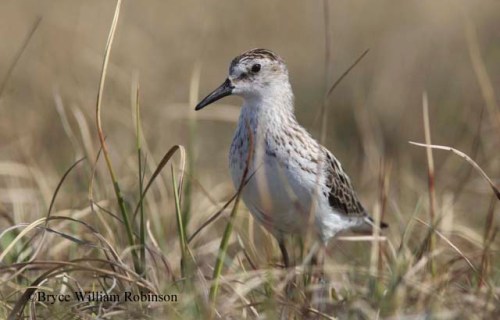
The most common shorebird I encounter lately is the Semipalmated Sandpiper. When displaying, the male flies about, even hovering with wings in rapid motion, calling consistently. The call is difficult to describe, but I’ll make an attempt. There is a sound from childhood, when we as imaginative children fastened a playing card to the spokes of our bicycles with a rubber band to simulate the sound of a motor. The sound of the playing card, while riding at moderate speeds, is much like the display call of the Semipalmated Sandpiper. I ought to simply record the audio…

This bird does not like to leave its nest. When it does, it makes adorable chatter and distressing sounds. As with other ground nesting birds, it has developed distraction techniques in attempts to lure an intruder from the nest. Often, as I process the contents of the nest, the bird wanders closely chatting at me. I find it adorable, but that is the human in me.

IMG_4482 copy

I’ve very much enjoyed experiencing this species on a daily basis. The schedule shows that of the nests I’ve recorded to this point, a few should be hatching in as little as two days. I plan to capture what these delicate birds look like as they first venture into the world. I’m sure it is “face melting”, as they say.

Pectoral Sandpiper- Calidris melanotos

by Bryce W. Robinson

IMG_3735 copy

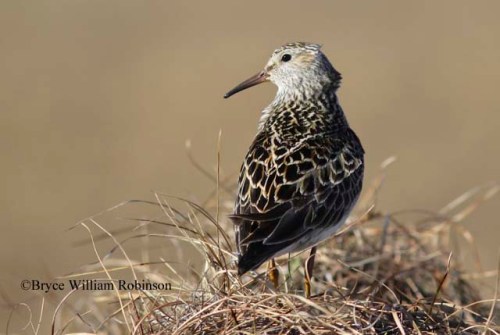
The Pectoral Sandpiper is one of the most common sandpipers in the areas I’ve been frequenting. These birds have one of my favorite flight displays. The male flies low over the tundra, filling his anterior air sacs with air to increase the resonance of his calls. Close your mouth, and in a low voice repeat goo goo goo goo, and you have produced the sound of the displaying male Pectoral Sandpiper. I’m making attempts to record this behavior, but all I have so far are some very poor photographs. I thought I’d share one just to help paint the picture of the bizarre behavior.

IMG_3491

The behaviors here are fascinating. This is only a taste of the smorgasbord of incredible bird life that is available here in the thawing tundra summer. I can’t wait to capture and share more.

Beatnik Birding: Sea Watching on the Pacific Coast

by Bryce W. Robinson

Surf Scoter- Melanitta perspicillata migrating north

Surf Scoter- Melanitta perspicillata migrating north

Well, it has happened once again, I’ve lapsed in my blogging. I’ve been through Utah, Nevada, and back to California again. There have been great birds along the way. I’d love to share some of the photos I’ve gathered along the way, but I want to share an experience I had yesterday. It was new and exciting for me, and carries potential for a whole new avenue of learning in my bird study.

I’ve yet to venture into the ocean to bird. I’ve only made it to the coast. Seabirds fascinate me, and I plan to make a pelagic tour soon enough. Until then I am standing on solid ground, watching what I can. I’m not seeing any true seabirds such as the Black-footed Albatross or Wilson’s Storm-petrel, but I am seeing unfamiliar birds passing over the ocean at a distance. My hawk watching instincts have kicked in on a whole new group of birds.

Pacific Loon- Gavia pacifica

Pacific Loon- Gavia pacifica

All the training I’ve had with raptors comes into play with passing sea migrants. There are particular field marks to pay attention to, but after enough exposure, I am sure I will be making my ID’s from shape, form, and flight style.

While watching for a few hours yesterday, I saw a massive loon migration. Every few minutes, a group averaging ten birds would come through, low over the ocean. It was a chore to check my field guides and learn what to look for with identifying passing loons. I started getting a handle on separating breeding plumage Pacific from Red-throated and Common, as there are some obvious in flight plumage differences. In the afternoon sun, however, I began to realize that lighting was confusing things.
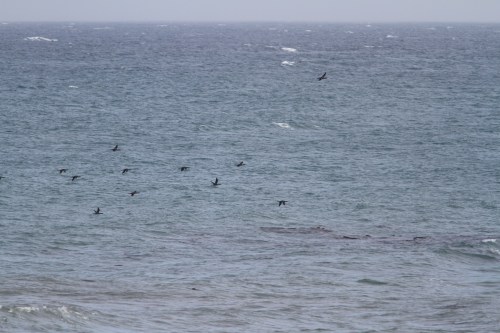
Pacific Loon- Gavia pacifica

Pacific Loon- Gavia pacifica

A field mark for identifying Pacific Loons in flight is two prominent white lines on their scapulars, coupled with a dark throat. It seemed to me that every passing group was a Pacific, even the birds that resembled Red-throated Loons in shape. After some thought, I realized that the harsh sun was likely giving a glare off of the other dark backed loons, making it appear to have the white scapular markings.
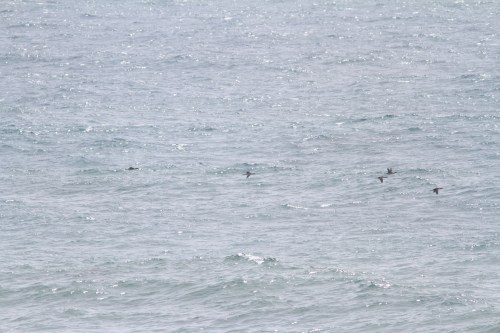
Red-throated Loon- Gavia stellata

Red-throated Loon- Gavia stellata

There were other passing migrants, and shore dwellers. I had two Whimbrel fly through, a good number of Pigeon Guillemot, and of course many many gulls. I admit, I have not spent the amount of time studying gulls as I should, but I am working on it. What a daunting task.
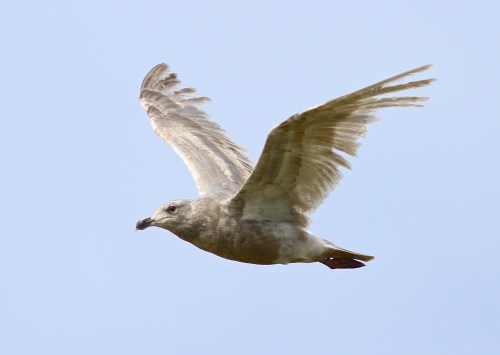
 

A first winer in its first pre basic molt Glaucous-winged Gull- Larus glaucescens

A first winer in its first pre-basic molt Glaucous-winged Gull- Larus glaucescens

I’ll be interacting with the ocean quite regularly for the next few months. I hope to find the time to share everything interesting and exciting that I come across. And the road continues ever onward.



Beatnik Birding: A True Desert Denizen, the Le Conte’s Thrasher

by Bryce W. Robinson

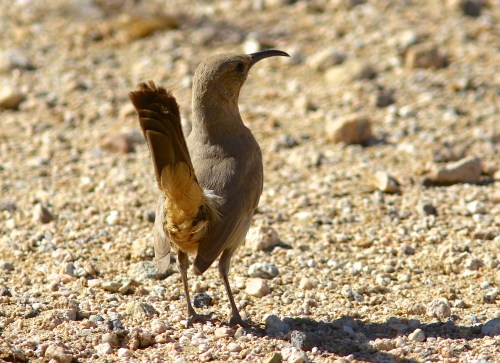
Le Conte's Thrasher- Toxostoma lecontei

Le Conte’s Thrasher- Toxostoma lecontei

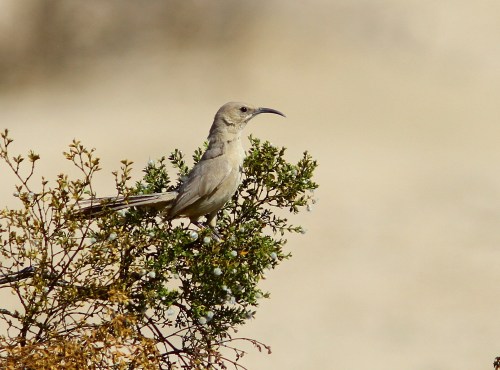
The genus Toxostoma is comprised of some of my favorite birds. At the top of these species is the Le Conte’s Thrasher. I love this bird in part because it is rather difficult to find. I’ve spent a great deal of time in the Sonoran Desert, frequenting the sandy creosote scrub that is this birds habitat. Still, I’ve only seen a handful of this desert specialist, and each time has been memorable.

Recently, I found two birds outside of Palm Springs, CA, one of which was singing atop a creosote. I had never heard the song of the Le Conte’s. It is the same wonderful wandering warble of other Toxostoma species, yet it seems a bit more delicate.

The Le Conte's Thrasher signature habit, running along the sand as if it were a Roadrunner.

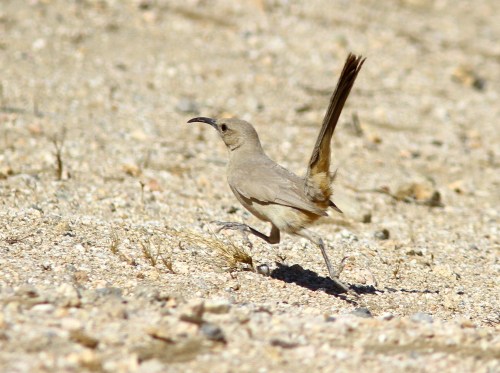
The Le Conte’s Thrasher signature habit, running along the sand as if it were a Roadrunner.

One of the reasons I am so fascinated by this bird is its habit to run across the sand between Creosote shrubs as it forages for food. It seems to prefer running rather than flying. I can’t help but think of the Greater Roadrunner every time I see this behavior.

Le Conte's Thrasher- Toxostoma lecontei

Le Conte’s Thrasher- Toxostoma lecontei

I find it incredible that this bird is only twenty miles from another southern California Toxostoma species. The California Thrasher is much like the Le Conte’s in appearance, but it frequents the chaparral hills of southern California. This pair of Le Conte’s Thrashers I found are on the western edge of the desert in the extremely arid white sand hills amidst Palm Springs iconic wind mill farms. Its proximity to the California Thrasher’s range is incredible, as the species is very different in habits and habitat. These two species are prime examples of evolution, adaptability, and the affects of environmental pressures.