A studio for bird study

Tag: birding

White Wagtail Breeding in Teller, Alaska

by Bryce W. Robinson


Working again in Nome this summer, although for a relatively short time, provided me with the opportunity to attempt to see some of the birds of the region that I had missed in previous years. One such bird was the White Wagtail (Motacilla alba). Before traveling to Nome, my friend Luke had informed me that he had already seen the species in a lagoon near the Red Knot camp, so my chances were promising.

Red Knot work was in full swing when I reached Nome, which limited the chance to try for the wagtails. In the meantime came a report of a White Wagtail AND a Common Ringed Plover (Charadrius hiaticula) in Teller some 40 miles from our camp. On 5 July, a day of rain and weather, we took advantage of the inability to work with Knots and headed to Teller to try for both birds.

2L3A0610

An alarm calling adult White Wagtail (Motacilla alba) in Teller, Alaska.

When we reached Teller we began the search, more focused on the plover than the wagtail as the bird was a lifer for most in the group and the wagtail was not. After 20 minutes of fruitless plover searching Luke spotted our other target, a wagtail at the north end of the village. Luke and I both set out to photograph and film the bird and soon realized it was carrying food. Another adult appeared, also with food, and our minds tipped to the possibility that these birds bred in the area. Jim (head of the Red Knot project) watched the food carrying adult and followed it back to an electricity box on the side of a nearby building. The bird entered the utility box, and exited without the food. We quickly backed the truck up below the box to gain access and check for nestlings. Sure enough a grass nest sat in the corner of the box containing small nestlings.

IMG_3945

Electricity box containing a White Wagtail (Motacilla alba) nest. Teller, Alaska.

IMG_2210

White Wagtail (Motacilla alba) nest. Teller, Alaska.

After quickly documenting the nesting situation we left and let the adults return to provisioning the young. At the end of the day we left Teller with an excellent experience with White Wagtail, but unfortunately no Common Ringed Plover. Such is birding.

A few weeks later on 22 July, Luke and I returned to Teller on another poor weather day to check on the success of the brood. We soon found multiple juvenile wagtails chasing the adults, begging for food. Luke mentioned that White Wagtail had bred in Teller in years past, but I was left feeling like I had just struck oil – My first White Wagtails, breeding at that!

2L3A8201

Juvenile White Wagtail (Motacilla alba). Teller, Alaska.

The experienced left me excited. I’ve found that the best way to deal with the hangover excitement of a great birding experience is to illustrate, so after the initial sighting of the adults in early July I took advantage of the next day of weather and painted a White Wagtail on the inset of my Nome 2016 sketch journal.

IMG_0441

White Wagtail (Motacilla alba) in the inset of a 2016 field season sketch book for birds of the Seward Peninsula, Alaska. 

Seeing a bird species for the first time, and one that is quite uncommon in North America at that, is the best of birding. Especially if it feels like its been a long time coming. To see the bird and gain a first hand account of its breeding habits, well that is something else. It has a context, and context is what makes my experiences fruitful. I love life histories of birds, especially regarding breeding. I consider this experience to be the example of the what I seek when I step out the door aimed at observing birdlife.

July 2016 in Nome, Alaska had some magic, or something. But it seems that it was a continuation of a theme that started in early May. I bet that if you were to ask anyone that traveled to Nome, AK in the summer of 2016 they would agree. It was special summer, and I can’t wait to hear reports of what the fall brings in the region.
Red Knot (Calidris canutus roselaari) Fieldwork in Western Alaska

by Bryce W. Robinson

IMG_7100

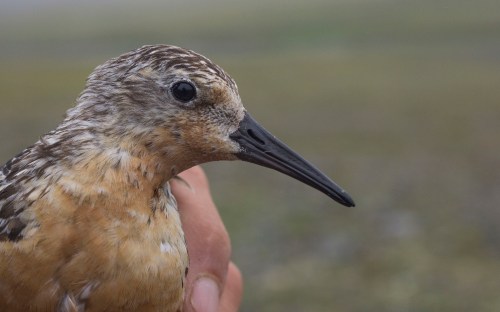
Adult Red Knot (Calidris canutus roselaari) captured on the breeding grounds in western Alaska.

On 1 July I travelled to Nome, Alaska to work on roselaari Red Knot research. I’ve spent the last month working on the project, and I’ve learned a great deal. The U.S. Fish & Wildlife Service has been conducting research on breeding Red Knots for the last seven years on ridge lines outside of Nome. They’ve focused on reproductive monitoring, marking and resighting birds, and determining the timing of arrival and departure on their breeding grounds. The effort has also provided collaboration with folks studying this population on their migratory and wintering grounds. You can read more about the connectivity study here.

IMG_7045

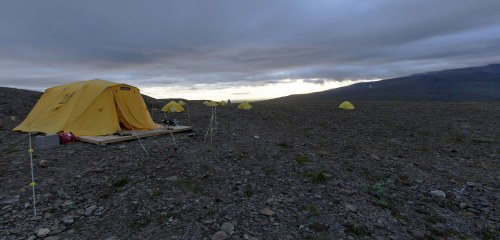
Red Knot research field station. Seward Peninsula, Alaska

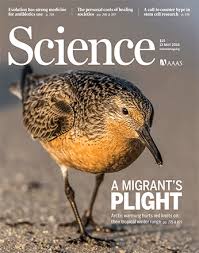
I feel fortunate to have joined the work, especially considering that the collaborative study effort on this circumpolar breeding species is growing. This year a researcher from the Royal Netherlands Institute for Sea Research (NIOZ) joined the USFWS study effort in Alaska. Jan van Gils Ph.D., whose work was recently featured as the cover article in Science Magazine, joined Jim Johnson and Lucas DeCicco and the USFWS crew to investigate the potential impacts that trophic mismatch may pose on the breeding roselaari Red Knot. It was excellent spending time with Jan, as we discussed many ideas concerning climate change impacts on Red Knots and Arctic life alike.

images

Jan van Gils et al. 2016 as featured on the cover of Science Magazine.

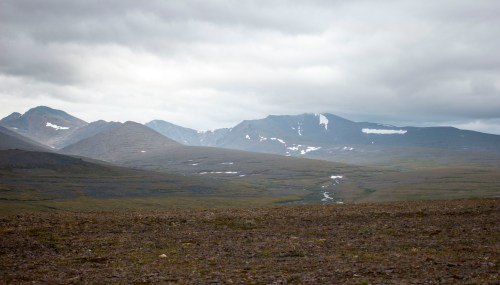
Alaska’s Red Knot population breeds on higher elevation rocky tundra. Many ridge lines on the Seward Peninsula are important breeding grounds for Red Knots. With climate change comes impacts to prey populations that the Red Knot needs for successful breeding.

IMG_7043

Red Knot breeding grounds in western Alaska. The low rocky ridge lines surrounding the river valleys are the preferred breeding habitat of the roselaari Red Knot.

There is then the potential that the tight timing of arrival and breeding of these birds may no longer coincide with the peak abundance of prey populations, something that has already been shown in many species that breed in the Arctic. Thus, understanding fully the timing of their breeding on the ridge is essential for understanding future climate change impacts.

IMG_7071

Pinpoint GPS unit attached to an adult Red Knot.

To better understand the latter portion of the timing of Red Knot breeding on the Alaskan ridges, Jim and Luke began deploying pinpoint GPS dataloggers on adults to determine when they depart the breeding grounds, the time they spend on migratory stop over sites, and the length of migration, . This year we deployed units that have already started returning data on migratory locations and duration. It will be exciting to see how the birds differ, or don’t.

IMG_7080

Luke checks out the placement of the pinpoint GPS unit on this adult roselaari Red Knot.

I had an excellent month on the peninsula. Apart from learning a great deal about these birds and their breeding ecology, I gained more exposure to excellent bird life in one of my favorite ecosystems. At the end of the season Luke and I shifted our focus to the coastal areas to attempt trapping of staging Juvenile Red Knots for more pinpoint deployment. I’ll highlight the rewards from the effort in my next post. In the end the Red Knot work was the cessation of an excellent summer of Alaskan bird study.

The season was successful thanks to a great field crew apart from Jim, Luke, and myself: Nick Hajdukovich who handled the lead for the first part of the season before Lucas joined in the field, Sarah Godin, Bethany, and Charlie and Linnaea Wright. 

Great Gray Owl Fledglings

by Bryce W. Robinson

_MG_9942.jpg

Another highlight from my recent time spent on the Innoko National Wildlife Refuge was happening upon three Great Gray Owl (Strix nebulosa) owlets that had “branched”.

In fact, these birds had hatched in a nest that was nothing more than the top of a birch snag, so far as I could tell. There were no nest structures in the area, only a plenty of broken tree snags about 5 meters tall. I believe that once they were too big to fit, the owlets fledged. Each bird was on a partly fallen truck leaning diagonally, a ramp for them to climb from the ground to relative safety from ground predators.

The first bird my friend Nick and I found sat staring at us, but with only one eye open. It appears from the photo that a Moose Fly (Tabanidae sp.) was biting its eyelid. I became very familiar with these flies during my time in the area, and felt for the poor young owlet.   The flies have pinchers on their mouth that they use to break skin, and from my experience with them it seems they do this to draw the blood and then feed. At least mosquitoes are mostly painless during their blood draws…

_MG_9928.jpg

We first heard the owlets begging calls while conducting a point count a few hundred meters away, but by the time we found them they had quieted down and stood extremely still, staring at us. Without a doubt we were the first humans these birds had seen. The Innoko is a very remote place, as we never saw a single person during our five-day stay in the area despite covering a distance of over 200 river miles round trip.

_MG_9968.jpg

I was enamored. I’ve seen very few Great Gray Owls in my life, and seeing birds at this age was a first. It has always been something I’ve wanted to see, so it was a dream realized. After getting our fill of the owlets, we began searching for an adult. We soon found a large ghost-like owl, the adult Strix nebulosa, 50 meters from the owlets. In my experience with Great Gray Owls, they’ve been extremely tame birds that tolerate your intrusion and lend themselves to photography. This birds was not tame, and unfortunately flew into the forest as we drew near. I wasn’t able to get any photos, but I managed to watch through my binoculars for a bit.

I captured a short clip of one of the nestlings (below). It’s a rather uneventful short clip, but it adequately describes the experience and the owlets tactful poise as it remained motionless as it kept eyes on Nick while I took video.


Here it is in full, the media from my first encounter of a Great Gray Owl family in the remote Alaskan wilderness.

Harlan’s Red-tailed Hawk on the Breeding Grounds in Alaska

by Bryce W. Robinson

This post details my encounters and notes of Harlan’s Red-tailed Hawks in Alaska during the early summer of 2016. The post is separated into two parts, individuals I encountered while conducting the Alaska Land Bird Monitoring Survey in the remote western interior, and individuals I’ve encountered in the Anchorage area.

From the Innoko National Wildlife Refuge:

_MG_0034.jpg

Photo 1. Adult male light morph “Harlan’s” Red-tailed Hawk (Buteo jamaicensis harlani). Innoko National Wildlife Refuge, Alaska. Photo copyright Bryce W. Robinson.

I just returned to Anchorage from two weeks of bird surveys in the interior of Alaska, conducting the Alaska Landlord Monitoring Survey for the Boreal Partners in Flight. These surveys entailed travel to three remote national wildlife refuges; Innoko NWR, Nowitna NWR, and Koyukuk NWR. The aim of myself and my friend Nick Hajdukovich was to conduct point counts on refuge land. Our travel consisted of float plane transport to each refuge. Once in the Innoko, we logged 200 miles of river travel on the Innoko River to and from our two survey plots, which provided me with great exposure to untouched Alaskan wilderness. Along the way I happened upon a few individuals of perhaps my favorite bird taxon, the harlani subspecies of the Red-tailed Hawk.

_MG_9925.jpg

Photo 2. Innoko River, Innoko NWR, Alaska. June 2016. Image copyright Bryce W. Robinson.

The first birds I encountered on the Innoko River happened to be a nesting pair. Their nest was situated on a partially fallen White Spruce that extended over the open river. As we approached the nest we cut the motor and drifted directly beneath the brooding female. At 200 m from the nest a light morph bird, the male, took flight from a nearby tree and began vocalizing and stooping on our boat (Photo 1, 3). As we floated by, I took the opportunity to document the situation.

_MG_0202.jpg

Photo 3. Adult male light morph “Harlan’s” Red-tailed Hawk (Buteo jamaicensis harlani). Innoko NWR, Alaska. June 2016. Photo copyright Bryce W. Robinson.

It was excellent to observe the defensive behavior. Equally excellent was the light morph plumage of the male, and his silver/white tail with hints of red near the tip (Photo 3). As we passed the dark morph female on the nest (Photo 4), we could see her heavily banded tail, dark and red throughout (Photo 5). The variability in tail pattern in these birds interests me greatly, and it was excellent to see this dark bird with a near wholly red tail.

_MG_0232.jpg

Photo 4. Adult female “Harlan’s” Red-tailed Hawk with nestling. Innoko NWR, Alaska. June 2016. Image copyright Bryce W. Robinson.

The female was sitting in the nest, along with one nestling which appeared to be around 15-20 days old. The nestling was panting in the intense Alaskan sun. The temperature was a balmy 70 degrees Fahrenheit, very warm for Alaska. We drifted on, got our fill of photos and satisfying looks, started up the 5 HP motor, and continued our trip.

RT.jpg

Photo 5. Female dark morph “Harlan’s” Red-tailed Hawk (Buteo jamaicensis harlani). Note the near wholly red tail. Innoko NWR, Alaska. June 2016. Photo copyright Bryce W. Robinson.

Throughout our trip we saw a few other adults, all dark morphs that one would consider “typical” harlan’s with whitish and silver tails, white streaked bibs, etc. The birds were uncooperative for photography, except for two individuals that happened to be my most sought after group of this taxon, second year birds midway through their pre-basic molt (Photo 6). I included a photo of one of the individuals, as they were quite similar in appearance and at the same stage in their molt.

_MG_0024.jpg

Photo 6. Second-year “Harlan’s” Red-tailed Hawk (Buteo jamaicensis harlani) midway through pre-basic molt. Innoko NWR, Alaska. June 2016. Photo copyright Bryce W. Robinson.

The degree of molt which these young birds undergoing is worth noting, as compared to all adults that I’ve seen. All adults, presumably breeding, are limited in the extent of their feather replacement. The two Second-year birds that I’ve photographed are molting heavily, as you can see in photo 6. This speaks to the energetic requirements of both molt and the reproductive effort, and the trade-off in allotment between both, something of which I’ve noted before in Gyrfalcons (find it HERE).

Overall the time spent in the western interior was grossly fruitful in my exposure to Harlan’s alone.

From the Anchorage area:

Something interesting is happening in Anchorage. Although I’ve seen plenty of birds in the region that fit what we call the “typical” Harlan’s (Dark morph, light bib, silver or white tail, mottled flight feathers, etc.), I’ve found two individuals, a pair, that are worth documenting. It’s important to note that I’ve been working in a fairly restricted area on the U.S. Air Force base at the north end of the city. I haven’t been able to cover much area throughout the valley, but much of my assumptions about other Red-tailed Hawk in this region come from observations at Gunsight Mountain Hawkwatch.

_MG_8855.jpg

Photo 7. Adult light morph “Harlan’s” Red-tailed Hawk (Buteo jamaicensis harlani), showing traits suggestive of B. j. abieticola. Anchorage, Alaska. June 2016. Image copyright Bryce W. Robinson.

The first bird is a light morph female that my friend Laura showed me (Photo 7.). Although it has qualities typical for Harlan’s such as a mottled tail with silver and white tones amidst red, and globular belly markings, it also possesses traits reminiscent of other subspecies such as B. j. abieticola (Northern). Most notable is the barring throughout the wing lining, and on the belly. Also notable is the regular and distinct barring in the flight feathers. The question arises whether this bird’s phenotype is an infrequent but regular occurrence in the harlani population, or a result of integradation somewhere in its recent lineage? Although the area is an intergrade zone for many other species, I’m fully comfortable saying that I don’t know, nor do I want to suggest one over the other.  The most exciting part is not knowing, and realizing there is a frontier to explore in our understanding of this species.

_MG_9224.jpg

Adult dark morph Red-tailed Hawk (Buteo jamaicensis). Subspecies unknown, but this bird resembles what we would expect of a dark morph abieticola, if these exist.  Anchorage, Alaska. June 2016. Image copyright Bryce W. Robinson.

The second interesting bird from the area is perhaps more exciting (Photo 8). It shows no indication that it belongs to the subspecies harlani. It resembles a dark morph calurus, with some unique contrasting qualities to the auxiliaries and undertail. I’m not sure what subspecies this bird is, but if I were to guess I’d say this bird fits with the Northern population (abieticola), suggesting that this subspecies is polymorphic. Regardless, This bird along with observations at Gunshight Mountain hawk watch support that the Anchorage area and Matsu Valley are an intergrade zone, as is the case with many other species. I think there remains much to learn about the biogeography of Red-tailed Hawks, especially as it pertains to this small area of Alaska.