
A quick sketch of my interpretation of Buteo cooperi
A few weeks ago my friend Mike called me and asked if I was interested in helping him solve a bit of a mystery he had stumbled upon. A friend of his had found an old ornithology book in a store in Moab, Utah. She was admiring the plates, and came upon one that interested her. It was an illustration of a hawk named Buteo cooperi. She had never heard of any Buteo with the species epithet cooperi. Her curiosity caused her to contact Mike and ask if he had any idea what this bird might be. He had never heard of Buteo cooperi either, but resolved to solve the mystery.
Mike did some research and came up with a reporting of two accounts of this Buteo cooperi. Apparently, in 1855, an ornithologist named J.G. Cooper came upon an interesting hawk in southern California. He shot the hawk, as was the custom of the time, and collected the specimen. He decided the bird was its own species and coined it Buteo cooperi. Mike found this account, as well as an account by the ornithologist Ridgway on the California bird and a second Colorado bird. You can read his account here. Both accounts hover around the possibility that this bird is somehow related to the Red-tailed Hawk- Buteo jamaicensis, and could possibly be the light phase of the subspecies Harlani. Ridgway reviewed the decision to coin Buteo cooperi as a separate species, however he was confused by the coloration of the primaries, and could not settle upon the identity of the bird. It was left unsettled.
When Mike called me, he had felt that he needed a second opinion and some help with the bird. I of course agreed to help. As I am a true geek when it comes to the world of birds, I thought the journey back into the archives of ornithological history would prove fruitful for my education. And of course it would also be fun. I read the two papers that he sent me describing the bird, and felt that the specimen was likely the light morph of Buteo jamaicensis harlani, the Harlan’s Hawk. Still, to be thorough, I searched further.
I finally found a definitive answer to support my assumptions at the following link.
http://elibrary.unm.edu/sora/Condor/files/issues/v032n05/p0259-p0260.html
This description from a review of the specimen in 1930 gave me the impression without much doubt that the bird known as Buteo cooperi was in fact a light morph Buteo jamaicensis harlani. I felt good about where the mystery came to its end, but for the need to somehow come to an answer of my own, I decided to do some further looking, and it payed off.
I found a link to information regarding a specimen at the Smithsonian in Washington D.C. The specimen is in fact the very bird that J.G. Cooper shot, and collected. You could imagine my excitement at finding that the specimen was still around. You can see the link here.
I decided that the only way for me to come to any conclusion on the birds identity was to see the bird for myself. At the moment, I was not in any position to make a trip to Washington D.C., so I thought I would take a chance at emailing the curators of the museum in hopes that they might send me some photos.
Below, you can see the result of that email. They sent me photos!


It is obvious by these photos that this is indeed a light morph Harlan’s Hawk. I love the white in the crown and nape. What an adventure. I am super thankful to Mike for including me in the hunt. I would also like to thank those at the Smithsonian for their cooperation and willingness to send me these photos. My curiosity and fascination for the study of birds knows no end, and the history of ornithology is no exception. Let the journey for knowledge continue.
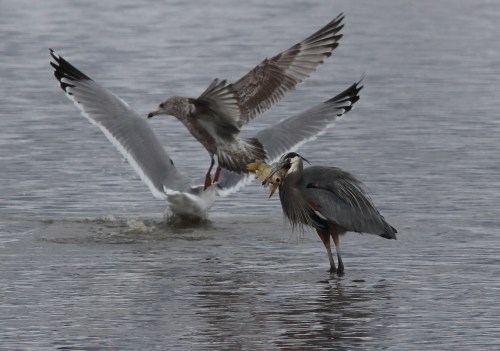


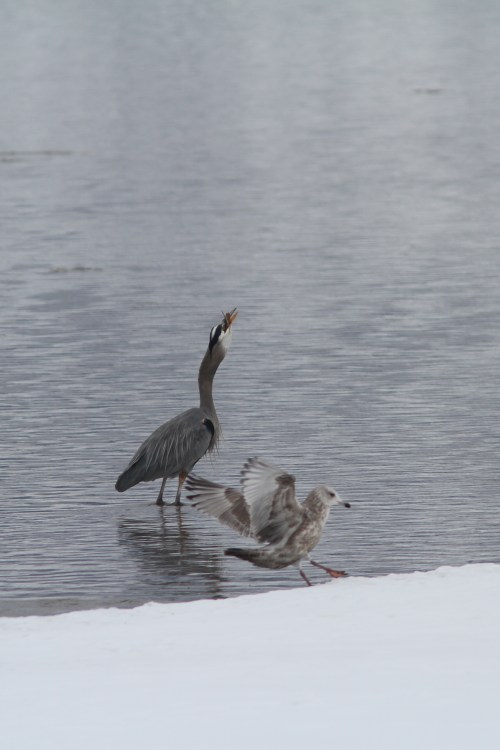
 You can see in the last photo where the fish still sits in the birds body. This will undoubtedly take a while to digest. I was impressed in the least. I absolutely love seeing predators eat, and the heron is one bird that always delights. I once came upon a photo of a Great Blue Heron that had killed and was holding in its bill a Least Bittern, about to consume the close relative. How bizarre.

 ornithologi.com