A studio for bird study

Tag: birds

Banding Calliope Hummingbirds in Idaho

by Bryce W. Robinson

_MG_7042

Palm release of a male Calliope Hummingbird – Selasphorus calliope

Last week I was fortunate to join my friends Jessica Pollock and Heidi Ware of the Intermountain Bird Observatory for some hummingbird banding near Idaho City, Idaho. The banding location is located in the mountains of central Idaho, consisting of healthy Ponderosa Pine forests complete with associated bird life.

_MG_7262

Last week was a bit early in the season, but we did have some luck catching Calliope Hummingbirds. We caught 7 birds, all males. Catching only males also indicates the early season, as in most species males are tasked with setting up territories before the arrival of females and are thus the first to arrive. The banding seemed to tell this story. Unfortunately the Rufous Hummingbirds weren’t around yet, but capturing a number of North America’s smallest bird was more than enough to satisfy my desire to see hummingbirds in hand.


_MG_7244

Weighing a male Calliope Hummingbird.

The whole day was excellent, but the perhaps the most exciting part of the day came with a recapture of a bird that has been captured every year for the past five years. It’s remarkable to hold proof of the resilience and livelihood of such a small and well travelled animal.

To find out more about IBO’s hummingbird work, please visit their website and get involved.

Singing House Wren on the Boise River

by Bryce W. Robinson


I recorded a singing House Wren (Troglodytes aedon) today while banding birds along the Boise River with the Intermountain Bird Observatory (note the bird is banded!).

Although spring migration hasn’t hit in its entirety at this site, the House Wrens seem to have arrived in full. There are at least three different individual males singing in the area, and I’ve noticed an additional four individuals in the area as well. The House Wren population at this site seems to be healthy.

Unfortunately the video I recorded does not capture the song of the House Wren. I wasn’t too far from the wren, but I believe the inability of the phone to capture the song is related to the masking of other noises in the environment (and the iPhone’s lack of a directional mic). First and foremost it was a windy day, which I believe is the main contributor to the masking. On top of the wind was the noise of the busy highway, the noise of the Boise River, and nearby construction (all large bandwidth, but mostly low frequency). With both natural and anthropogenic noise, I wonder how House Wren territory distributions differ between an area like this and a relatively noiseless area such as a remote forest location away from a river.

HOWR

House Wren (Troglodytes aedon) banded at the Intermountain Bird Observatory’s Boise River site on the east end of Boise, Idaho.

Despite the heightened noise, the wrens in this area seem to be thick and continuing with life as they would. A study may enlighten us on the human noise impacts coupled with natural noise (rivers, etc.) on bird territory distributions like in this case, but if I were to hedge a bet I’d say the House Wren is one species that seems to weather the added impacts of humanity enough to maintain a regular and healthy population within human disturbance areas.

Western Grebe with Young

by Bryce W. Robinson

IMG_0006.JPG

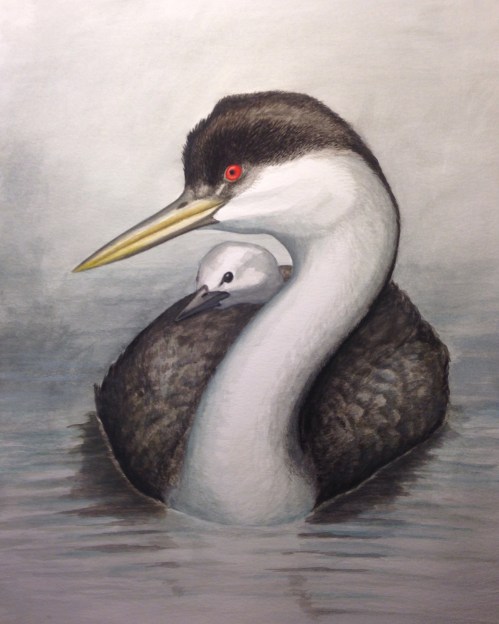
Western Grebe (Aechmophorous occidentalis) with young. 11 x 15″ Gouache painting. Copyright Bryce W. Robinson

I really enjoy the strange behaviors found in the bird world. The Western Grebe (Aechmophorous occidentalis) is then naturally a favorite, due to a few behaviors that are on the surface quite strange.

The first is the rushing, or the synchronous courtship dance where a pair runs in contorted posture across the water. I’ve never painted, photographed, or filmed this behavior but I hope to this coming spring.

The second is the behavior pictured above. Young grebes ride on their parents back, situated between the wings. The parent dives for fish with young in tow, then surfaces with a catch and feeds it to the young.

The third is perhaps the strangest of the behaviors. Grebes eat their own feathers, and parents feed their feathers to their young. There are many hypotheses of what they may do this, but perhaps the most plausible is to line their stomachs. Grebes of course eat fish, yet their gizzards may not fully crush the bone. To protect the soft tissue of their proventriculus and perhaps parts of the intestines, grebes then eat a large amount of feathers that line their insides.

Rather incredible….

Banded Golden-crowned Kinglet

by Bryce W. Robinson

_MG_4949.jpg

This past fall I helped the Intermountain Bird Observatory band birds on a number of occasions at a site along the Boise River. I’ve returned to the location on occasion throughout the winter to bird, and every time I find a small mixed flock with banded individuals throughout.

The other day I made attempts to photograph banded birds to capture band numbers and identify individuals. Easier said than done when the flocks are busy foraging. I came away with some good photos, but nothing that put together a full sequence or even the last few digits.

It can be said, however, that these birds are most likely the same birds that were banded here in October. The other most plausible explanation is that some were banded at IBO’s other site, only a few miles away on the top of Boise Peak. I’m unfamiliar with the literature on winter movements of the Golden-crowned Kinglet, so I don’t have an idea if holding a small range throughout winter is common for this species. Still, the birds I photograph seem to be staying put which surprises me in some way. Perhaps the inclination of the flock to stay within a small range speaks to the quality and perhaps importance of the habitat provided by this relatively wild portion of Boise’s section of the river.

Time to read, and think some more.