A studio for bird study

Tag: birdwatching

Rock Sandpiper – Calidris ptilocnemis, From Curiosity Stems Study

by Bryce W. Robinson

ROSA

Here in western Alaska I’ve been able to spend a bit of time pausing from a focus on Gyrfalcons to watch the Rock Sandpiper – Calidris ptilocnemis on its breeding grounds. My fascination with its appearance, behavior, and vocalizations caused me to look into what is known about their populations and distribution, a factor of bird biology that I’m growing evermore interested in studying. My investigation led me to understand that there occur three separate subspecific populations in Alaska, the nominate ptilocnemis of the Pribilofs, the tschuktschorum of the western mainland, and couesi of the Aleutian archipelago. As I am currently conducting research on the Seward Peninsula, I have been experiencing Calidris ptilocnemis tschuktschorum. 

After some further reading, I learned that the nominate ptilocnemis has the most northern wintering region of any North American shorebird. Remarkably, these birds spend their winters in the Cook Inlet of coastal Alaska. How they manage to find enough food and weather the extreme temperatures and conditions is above my current comprehension, but I was able to find some literature on the subject. Apparently, their is no physiological characteristic or attribute that separates ptilocnemis from other Rock Sandpiper subspecies that would give it the edge to winter so much farther north. The other Rocks could physiologically manage a winter in the north as well, but for whatever reason ptilocnemis is the only ssp. to do so. This seems like a peculiarity, and that is precisely why I am so fascinated by their distribution.

There are other Calidris species that are polytypic, and have separate wintering grounds for each subspecific population. Learning about such cases is extremely enlightening and begs for some contemplation on the matter. Perhaps a polytypic species such as the Rock Sandpiper, or the Red Knot will have an edge on anthropogenic induced changes affecting key migratory sites and their ability to survive the great journey. Perhaps the ability to buffer such disruptions is already built into their distribution at the species level. They are certainly better off than a monotypic species that stops over or winters wholly in a small and localized area. If the lower Pacific Coast of North America becomes a dead zone, then perhaps the subspecies couesi and tschuktschorum will be hard hit, but the nominate ptilocnemis may fair well and maintain a presence for the Rock Sandpiper in North America. As we attempt to be aware of our ever increasing impact, it sure would be nice to know that some birds will be able to wear the disruption, even if it is to a minor degree, so we can then put more energy into those more sensitive.


Referenced information:

Gill, Robert E., Pavel S. Tomkovich and Brian J. Mccaffery. 2002. Rock Sandpiper (Calidrisptilocnemis), The Birds of North America Online (A. Poole, Ed.). Ithaca: Cornell Lab of Ornithology; Retrieved from the Birds of North America Online:http://bna.birds.cornell.edu/bna/species/686

Ruthrauff, D. R., A. Dekinga, R.E. Gill, and T. Piersma. 2013. Identical Metabolic Rate and Thermal Conductance in Rock Sandpiper (Calidris ptilocnemis) Subspecies with Contrasting Nonbreeding Life Histories. The Auk 130 (1) pp. 60-68

Happy International Guillemot Appreciation Day (IGAD)

by Bryce W. Robinson

BLGULast year my friend Frank, a great birder, asked me a simple question, “Did you celebrate International Guillemot Appreciation Day this year?” I told hime no, and that I had no idea what he was even talking about. He explained that July 27th, if I remember correctly, has been designated to recognize the Black Guillemot. Sounded great to me.

I researched the history a bit, and it seems there is some confusion of whether or not IGAD is July or June 27th. This year, I’ll be celebrating the existence of Guillemots on July 27th. I’ll get it sorted out next year and celebrate in line with what was originally designated as the day to recognize the small Alcids.

This year I illustrated the above Black Guillemot. I haven’t been illustrating much this summer on account of my focus on Gyrfalcon field work, but I made it a priority to put this image together in honor of the birds. I also plan to head to my favorite sea watch spot and watch for an hour or so. I should turn up a few Pigeon Guillemots, and who knows, perhaps a Black or two. The bird would be notable here in Western Alaska in summer, but with birding you never know!

Appreciate a Guillemot today. They sure are class act creatures!

BLGU

The Power of Feathers in Determining Shape and Appearance

by Bryce W. Robinson


BANS_03

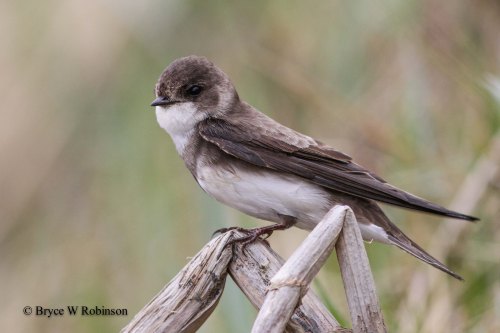
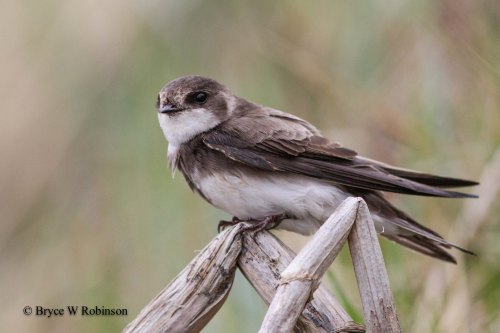
Consider the photo above and the photo below. The differences in shape are rather dramatic, as the photo above looks rather non-typical of a Swallow. These two photos are of the same Bank Swallow – Riparia riparia, taken seconds apart. 

BANS_02

Photographing swallows in flight itself is either a challenge or futile, I haven’t quite decided. But, if you sit long enough and forget about photography for a moment, you become aware of some incredible bird behavior. I sat alongside a tundra pond a few days ago, where two Bank Swallows and one Tree Swallow made rounds picking emerging insects from the water top. The interactions between the two species, and even between the two conspecifics were entertaining, but the real thriller was their interactions with me. Multiple times the birds flew within inches of my face, all the while giving me close looks at swallow feeding strategy and behavior.

Occasionally, the birds would perch to rest. A few times they choose perches only feet from me. When they landed, the would preen and chatter. One interesting observation during these resting periods was their change in appearance when they roused, or fluffed their feathers. The birds would lose the sleek swallow shape altogether, and in some postures appear more flycatcher-like than a swallow. This made me ponder the power of feathers, as they govern a birds appearance. It’s a bit bizarre, and a useful thing to consider when looking at a far bird, or a photograph that doesn’t quite make sense. Shape is one of the most useful factors in bird identification, but can at times be misleading without extended observation.

A minor complexity in the world of birds, but nonetheless fascinating.

Red Knot Research and Photography: Clashing or Cooperative?

by Bryce W. Robinson


Red Knot - Calidris canutus roselaari

I’ve written about the use of photography to aid in re-sighting banded birds before, but I’d like to return to the subject and explore fully the idea that metal bands and color tags “ruin” a beautiful photograph of a wild bird.

Observing the Red Knot – Calidris canutus on it’s breeding grounds in Alaska is meaningful. At least, it is meaningful to me.

In Alaska there exists a small portion of the Red Knot population that breeds in the interior highlands of the Seward Peninsula and portions of the North Slope tundra. Any satellite portion of the distribution of a given species interests me greatly. So, in planning my summer in Western Alaska, I put high on the list to find and experience the Alaskan breeding Red Knot, subspecies roselaari.

There are folks here on the peninsula engaged in a demographic study of this Calidrid. I haven’t been able to make contact with these researchers yet, but as far as I understand it in the small bird world here, the time is coming. I’m interested to hear their thoughts and ideas considering the species. Until then, I have only the knowledge of what I observe myself, and what I can read.

Red Knot - Calidris canutus roselaari

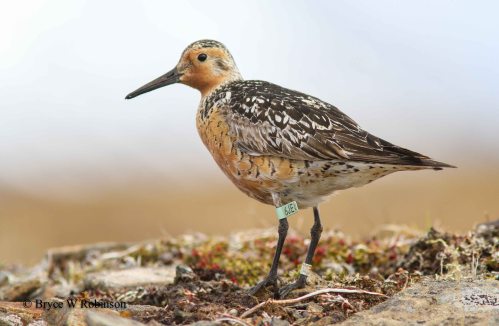
Do the metal band and sea foam green leg tag take away from the beauty of this bird?

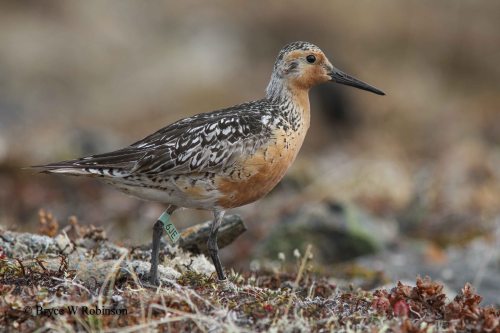
I found an individual the other morning, high on a hillside in the very western parts of mainland Alaska. Immediately I noticed the colored leg tag. As a young researcher, my resolve to photograph the bird strengthened with my desire to aid my peers with a “re-sight”. As you can see, I was successful to a degree. I came away with photos of the bird, and it’s identification tags.

The experience and resulting photos brought an issue to mind. Many bird photographers I have met and know dislike the identification jewelry because it tarnishes an otherwise natural and beautiful image. After capturing photos of the bird, I was left contemplating the idea.

I’d like to offer some of my thoughts as a young and aspiring ornithologist. As I’ve already stated, I love finding and photographing birds with color tags. To me, it is akin to trapping the bird and recording its location and identity, with the added benefit of no stress to the bird. Clean research! At least after the initial attachment of the tag.

Red Knot - Calidris canutus roselaari

On the other end are the photographers (I’m in part on this end as well, I confess) that are of the opinion that the tags diminish the quality of the images they are after. They work to capture natural images of birds, void of the tarnish of human interaction.

I’m sympathetic to the photographers view, but I believe that the proportion of individuals that we are able to outfit with these identification tags are minimal, and the chance of interacting with them again is remote. So, when a photographer has a subject that happens to have a tag, it ought to be viewed as fortuitous and an opportunity to learn about the bird and aid research efforts.

I photograph birds for many different reasons, but high on the list is to learning. Being something of an artist, I understand the drive to capture the most aesthetically pleasing image, but I propose instead a new avenue for the aesthetically driven. This is the art of bird study, to capture an image that is both beautiful and informative. This image would have the natural beauty and allure of the bird, but also the context of its interactions with humanity, holding in its information tag a history unique to the individual and the potential at snapshots of a story as beautiful as any image anyone could gather.