A studio for bird study

Tag: birdwatching

Canyon Wren- Catherpes mexicanus

by Bryce W. Robinson

I went to a reliable spot for Rosy-Finch today in hopes of getting some footage of the birds returning to roost. I won’t go into great detail, because I still want to get the footage and share the peculiar behavior of the flock. I was unable to get any decent video of the Black Rosy-Finch I saw there, but I was able to get some decent clips of a very interactive Canyon Wren.

This clip is very short, but I had to share it anyway. I’ll be back to visit this critter again soon to film some more, and make another try at the Rosy-Finch. Until then, this will have to do.

Increases in Harris’s Sparrow Reports in Idaho Highlight the Benefits of ebird

by Bryce W. Robinson

Immature Harris's Sparrow- Zonotrichia querula. 9X11" Prismacolor on bristol board

Immature Harris’s Sparrow- Zonotrichia querula. 9X11″ Prismacolor on bristol board. Illustration copyright Bryce W. Robinson

This winter, I’ve personally found five Harris’s Sparrows in the Great Basin. These sightings have been supplemented with about the same number by folks in my birding circle, anecdotally suggesting higher than average reports for Harris’s Sparrows. My friend Jay Carlisle posed the question; Is it a matter of a good breeding year for Harris’s Sparrow and an increased widespread juvenile distribution, or an increase in birding effort and ebird reporting? His conversation with a friend gave him additional anecdotal information that there were higher than average reports for Montana as well.

Obviously these questions are difficult to answer. What the presence of increased Harris’s Sparrow detections illustrates is the importance for birder’s to report their sightings to ebird and state records committees. This way we will be able to more fully trust these resources for historic distributions of any given species.

After reviewing Idaho’s past records of Harris’s Sparrow in ebird, it became apparent that this year stood out. You can review frequency charts on ebird for Idaho here.

But, it is important to consider that there are more participants in ebird as the years progress. What we will be able to see, if the birding effort continues for years to come, is how this winter compares to future years. With ebird, each year we will add to the data set, and incrementally increase the accuracy of range maps for species across the world.

This years Harris’s Sparrow numbers haven’t taught me much about the bird’s place in Idaho, but they have illustrated the benefits and need for filing ebird reports whenever I go birding.

Study What is Common

by Bryce W. Robinson

SOSP_2014_0103

Song Sparrow- Melospiza melodia.

Study what is common. I’ve heard this piece of advice many times, and I think it is one of the most important keys to becoming a better birder. I’m a relatively inexperienced birder, and I’ve been seeing a lot of progress in my birding in the last year. I believe my growth has come solely on my conscious decision to stop and study every bird I see, even those that are around me everyday.

I see the Song Sparrow- Melospiza melodia, daily. I know the bird well, but I still seem to learn something every time I’m watching and listening to them. The more you watch, the more you notice, and there is so much satisfaction in that discovery.

The Song Sparrow flocks I have been around lately have been very diverse in plumage. The diversity in plumage is a function of their different subspecies. I’d like to learn the appearance of each subspecies, so that I can better understand where the individuals I interact with during the winter breed. I’ve done so with the Dark-eyed Junco, and I really enjoy seeing mixed flocks of individuals from completely separate populations. Some of the most satisfying moments in my birding lately have been finding birds that are out of their expected range, and having the background knowledge to understand how far out of the way they’ve wandered.

Wild Boise: The Belted Kingfisher

by Bryce W. Robinson

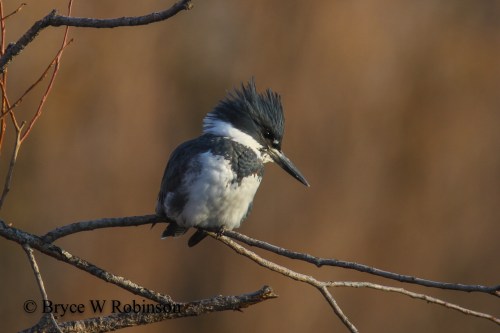
BEKI

Male Belted Kingfisher- Megaceryle alcyon

When I first arrived in Boise, I was impressed by the wild corridor that runs through the middle of the busy western city. Since then, I’ve taken the time to familiarize myself with the areas around the city where I now live. For the remainder of my time here, which is undetermined, I’d like to feature the bird life that this wild corridor, the Boise River, supports. I’ll be featuring species in segments titled “Wild Boise”.

The Boise River travels through the busiest parts of Boise, Idaho. The most raucous of the birds that frequent this city stream is the Belted Kingfisher- Megaceryle alcyon, a seemingly ornery critter that is always voicing its opinion.

These birds are always present around the university where I spend most of my time, and as such are accustomed to people. I recognized the opportunity to study them in the beginning of my time here, but I haven’t sat and watched the birds at length. Today, I decided to take some time and attempt to interact with the kingfisher a bit. It was a great way to start the new year. Next, I’ll be grabbing a tripod and filming their antics. It will be a challenge though, as they are quite an active bird, always switching perches, taking new views of the river where they glean their livelihood.

Stay tuned for the next feature for Wild Boise. I’d like to make these segments weekly, but as a graduate student, that might be a challenging schedule. Time will tell, I suppose.