A studio for bird study

Tag: hawk

Birding Blythe, CA

by Bryce W. Robinson

Blythe, California is not a destination for most. The small town is a bit run down and simple, not necessarily what anyone would have in mind when thinking of southern California. Still I have found beauty here. Surrounding the small town are green fields of alfalfa and other agricultural developments. I find myself here for work, living from a motel, and birding the surrounding farmlands for leisure. Possibly my favorite part of being in Blythe is the proximity of one of the west’s greatest river, and undoubtedly my favorite, the Colorado. As you can imagine, the unnatural clear waters of the southern Colorado draw in a number of birdlife and create a wonderful scene for  birding adventures. Truly the river is the only reason numerous green fields scatter the desert countryside.

While out birding the agriculture fields Yesterday, a co-worker spotted a treasure just outside of town. Along the roadside, atop an irrigation sluice gate, sat a docile Burrowing Owl. We watched the bird as it dozed, occasionally glancing around but otherwise disinterested in going-ons. I couldn’t stop myself from snapping shots, but due to the size of the bird, and our distance, I was dissatisfied with any of the photos I came away with.

Today I took hope in the chance that the bird would be in the same place, and sure enough the bird sat vigil to the same scene. This time around I resolved to decrease the distance between the owl and myself. I succeeded and the bird payed no mind. Still, the photos I have leave me wanting, but with the excitement of the experience and my desire to share, I have decided to include the bird in my report.

Burrowing Owl- Athene cuniculeria

Burrowing Owls are one of the most charismatic members of the avian community. Their mannerisms can be extremely amusing at times. I will surely be visiting this bird often, and documenting our time together.

I haven’t spent much time birding outside of Utah, and as a result, I am seeing many new birds. Among these include a few flycatchers that are not present or numerous back home. Apparently someone spotted a Vermillion Flycatcher the other day by the river, so I will certainly be after that till I see it. I did have a little related luck today in finding a tyrant, the Black Phoebe. This bird is wonderful, and I believe it has entered my mind as a candidate for future illustrations. Soon, very soon. Until then, a photo will suffice.

Black Phoebe- Sayornis nigricans

Another Tyrant that I have not known well till now is the Say’s Phoebe. Here in the Mojave, the Say’s are numerous, but I do not complain. They are a treat to and a wonder to watch, drawing me into their world.

Say's Phoebe- Sayornis saya

Of course with flooded green fields come insects and food for numbers of birds. I was delighted and surprised when I found a flock of white birds in an alfalfa field. It has been years since I have seen the Cattle Egret. These small birds belong to a group that are special to me. Watching them brings me back to my younger years of birding, and reminds me what I am searching for when watching birds. As with most of the birds of the day, the egrets I found were tolerant and cooperative.

Cattle Egret- Bubulcus ibis

The shores of the river housed a great deal of birds. As always, waterfowl were scattered across the mellow current. The American Coot was numerous, but intermixed and occasionally, I found some interesting birds. The other waterfowl that floated along included the Ring-necked Duck, the Canvasback, the Mallard, and a few Common Goldeneye. While watching a small group of Goldeneye, I noticed a Barrow’s Goldeneye grouped with a Common. This is probably a normal occurrence, but it was new to me.

Female Common, Male Barrow's, and Male Common Goldeneye, respectively.

Our raptor total of the day was incredible. Within a five minute interval, we saw three species of Falconidae, ending with a circling Prairie Falcon. I was unable to get any acceptable photos of any of the birds. This will be a task for the time to come, but for now I would like to share a photo that is a first of mine. I have never photographed the Turkey Vulture in flight, yet I felt the need and took the time and I believe it paid off. It is indeed a task of mine to maintain a comprehensive photo library, and the Turkey Vulture is certainly and integral part of a complete list.

Turkey Vulture- Cathartes aura

While working, I have been monitoring a few nesting Red-tailed Hawks. Of course the bird is a favorite and even a fascination of mine. I must admit I was surprised to see the difference in the birds this far south from those present back home.. The birds I have seen so far only add to my desire to learn more about plumage variations in this incredible buteo. I have been chasing some birds in hopes of photographing the them in good posture from below, illustrating in whole their plumage, to cross reference with the photos I have from the birds back in Utah. So far I have been unlucky, but I will continue to try.

Adult Light-morph Western Red-tailed Hawk- Buteo jamaicensis calurus

I wouldn’t recommend Blythe as a destination for most, but for birders, I would suggest spending the time, as you pass through on I-10, to exit and visit the river and the adjacent farmlands. If you have never birded the desert of southern California then I certainly suggest. I will continue to bird the area, and report what I find. Soon, I hope to convey the unrecognized ecological treasures that the town of Blythe presents.

Illustrating Light Morph Harlan’s on the Wing

by Bryce W. Robinson

Light morph Harlan's Red-tailed Hawks- Buteo jamaicensis harlani, in flight

Embracing my extreme fixation with Harlan’s of late, I decided to devote my free time today to illustrating a bird I am very unfamiliar with. I have only seen one light morph Harlan’s Hawk in the field, and I see that as a problem. To learn the bird better, I referenced  an article written by Jerry Liguori and Brian Sullivan, detailing the plumage characteristics of Harlan’s Hawks in detail. An extension of the article provided me with numerous photographs to utilize in putting together my interpretation of a light morph bird.

Illustrating raptors on the wing is a test for me. Proportion is perhaps the most important aspect to creating a natural and realistic looking bird. Hawks in the air create an image of deep detail, and it becomes a challenge to lay out the detail and form to present a realistic flying bird. I painted two birds, which are actually meant to be one bird, shown at two angles common to the hawk watcher.

Ferruginous Hawk Headshot

by Bryce W. Robinson

Ferruginous Hawk- Buteo regalis. Watercolor on paper

Due to the number of experiences I have had with Buteo regalis this winter, I thought it appropriate to take a break from packing today and paint a headshot of the fierce looking bird. Listening to music and enjoying the mood of the last snow storm I will endure for a time, I created this large portrait of what is now a very familiar bird. I have difficulty accomplishing my goals with watercolors, and this exercise was no different. Still I was pleased enough with the outcome to share. If the bird intrigues, please take the opportunity to easily see the bird as it occupies farmlands for winter. It truly is a regal as its name implies, and I will miss the regular interactions I have had with the bird. Still life goes on and there are others out in the wide world to find and know, and so I will go.

Winter Raptor Surveys- The Third and Final Stint

by Bryce W. Robinson

My last week surveying for wintering raptors started slow. I spent the first day scanning for birds, finding a few Golden Eagles atop rock faces, and a Prairies Falcon fighting the wind while perched upon a greasewood. Windy it was, and the high desert landscape seemed to find little rest against the frigid gusts. The birds I saw were far, and there were little opportunities for photos.

It seemed the only birds present in the high desert valleys, save the occasional raptor, were numerous flocks of Horned Lark that flushed and fought the winds. On occasion I was lucky to find small groups of Sage Sparrow. Sparrows of the desert seem to be a favorite of mine. I took a minute after a scan to sketch the bird, and after reaching home, I resolved to paint a simple watercolor. Utilizing David Allen Sibley’s field guide, I found the inspiration to emulate his prolific work and begin a more diligent effort to paint birds as I see them.

Sage Sparrow- Amphispiza belli. Watercolor painting on paper.

There were a few other passerines that I found. Of course the numerous flocks of White-crowned Sparrow frequented farmlands and littered fence lines. In the high desert valley of the Wah-Wah, I was able to find a few flocks of Mountain Bluebird. These strikingly blue birds set against the pale ghostly green of the sage create a subtle beauty unique to the landscape and special to my eyes. Unexpectedly I found the other bluebird of the west, in fact, the Western Bluebird. I didn’t realize how far south I was until I saw a flock of orange breasted blue birds fluttering around a canyon stream.

The week went along with the second day as uneventful and windswept as the first. I was lucky enough to find myself headed to a more action packed area for my third day. When arriving at a field for the beginning of my survey, I was eager to see the numerous raptors that sat and watched for prey. The previous stint had yielded some twenty raptors in this one field. My first bird was a juvenile Ferruginous Hawk, however, the only other birds in the area were a solitary Bald Eagle, and a juvenile Red-tailed Hawk perched atop a power pole. The day began slow, and after traveling roads into the backcountry, I found myself in the midst of a white out that quickly covered the ground with snow. I was nervous that I might get snowed in, but continued.

Before the roads became white from snowfall, I came upon something lying directly in my path. I always get excited when I find dead animals. I do not celebrate in the loss of life, and actually mourn those that fall victim to detrimental human interactions such as being hit by a car. Still the world is wild and animals die, and if I cross paths with an unfortunate fatality, I take full advantage at the opportunity for close study of the creatures anatomy.

The dead headless Long-eared Owl- Asio otus

The bird I found in the middle of the road was of course a headless Long-eared Owl. I say of course because this bird is now the third Long-eared Owl that I have found, victim to predation from some fierce winged creature. The absence of the head, and the way the innards were obviously consumed leads to the avian culprit, however I admit that from there I am not so knowledgable as to come to a firm conclusion of who did the deed. I would guess that the Great Horned Owl is the killer. The bird is mean, and is a threat to many animals, even a fellow owl.

My final day was spent in an area of raptor abundance. Finally I had the opportunity to use my camera. I have photographed a few Ferruginous Hawks lately, but I have failed to get a photo from below that highlighted the true plumage of the bird. In my attempts to create my own personal library of raptor photos for reference, I lacked the proper photo of Buteo regalis. Finally, I remedied the problem as a light morph Ferruginous Hawk circled over head, cooperating enough for me to take some acceptable photos.

Adult light morph Ferruginous Hawk- Buteo regalis

After using Jerry Liguori’s camera the last few times I have gone to photograph raptors, it was a bit frustrating returning to my own equipment. I decided to give a go at shooting manual, and I believe it paid off. I was not able to get the quality that came from using Jerry’s camera, but I believe that I came away with some good shots.

I have shared a great deal of Rough-legged Hawk photos, and they have all been of juvenile birds. Those of you that read this and have grown tired of redundant juvenile Buteo lagopus shots, I apologize for including some more. Actually, this bird is not a juvenile. I was excited to find a few individual Roughies this time around that were not juvenile birds. The first Rough-legged Hawk I found was in fact a beautiful adult male, with multiple bands on his tail and a lighter belly band. Unfortunately I was unable to photograph the bird.

Adult Female Rough-legged Hawk- Buteo lagopus. Note the dark eye and pearl white head and breast, as opposed to the cream color of the juvenile.

I did however photograph a very cooperative adult female Roughie. I spotted the bird from afar because of the striking contrast of the dark belly band and bright white head and breast. The lightly streaked head was unlike the juveniles I had seen, and the dark eye showed that this bird was an adult. I was excited to photograph the bird in the air, showing the dark terminal tail band and dark line on the terminal edge of the remiges. These signs indicated that the bird was an adult female.

Adult Female Rough-legged Hawk- Buteo lagopus

I was very pleased with the number of birds I saw on my final day of the survey. I would say the highlight of the day was actually the first bird, an adult dark morph Harlan’s hawk. I was very disappointed at failing to get a photo of the bird, but the sight itself was rewarding enough.

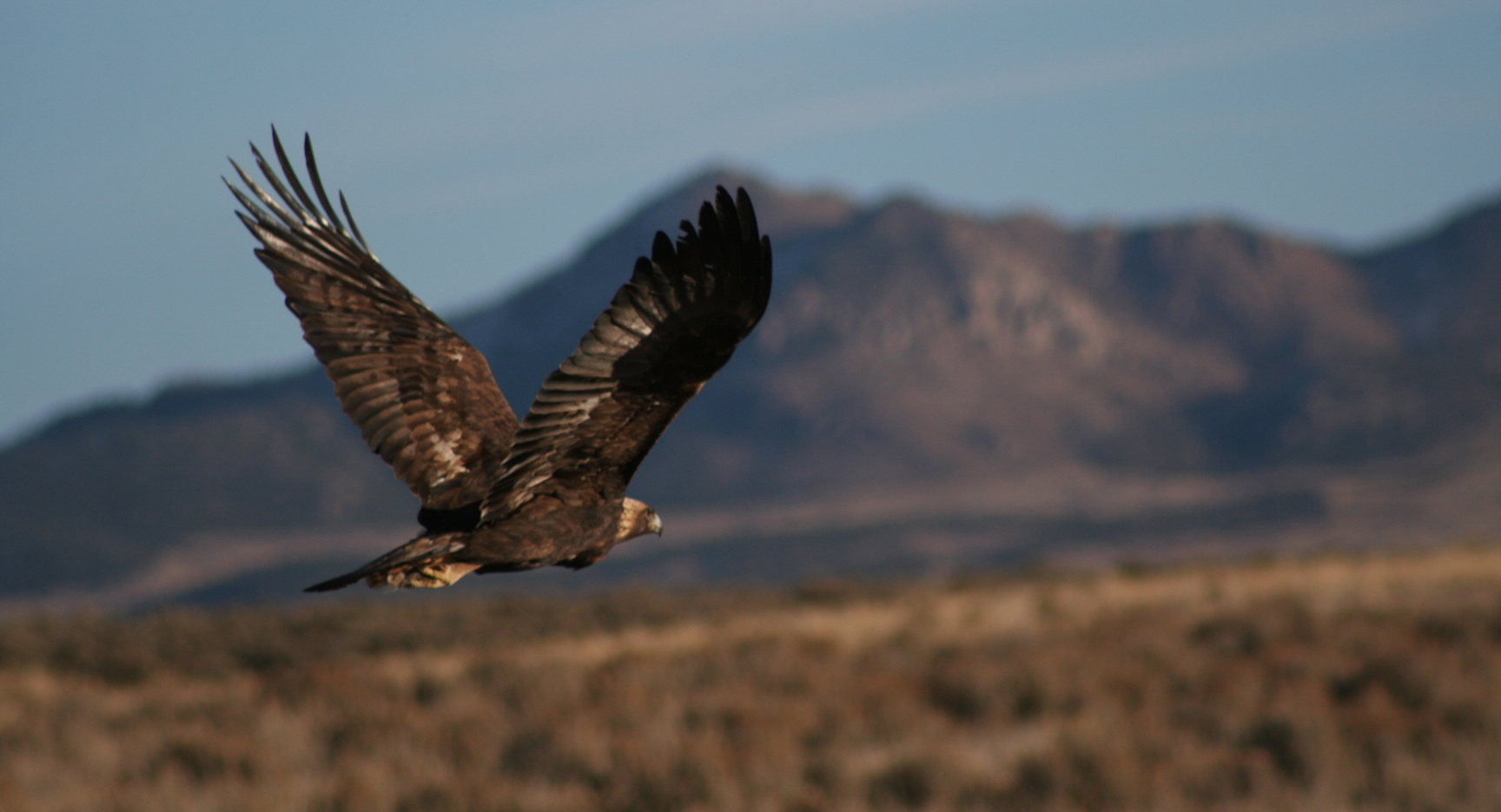
As I drove towards the interstate to head home, a golden hue highlighted the frozen blue of the winter landscape. Alongside the road ahead, I noticed a large bird on the ground. It appeared to be eating a meal, and as my vehicle neared, the large bird took to the air. I fired a number of shots, and stopped to watched the bird as it circled high in hopes that I would move along. The large creature was a Golden Eagle, and the setting sunshine against its golden brown plumage created a sense of peaceful beauty in my soul. Curious at what the birds meal was, I investigated and found that I had interrupted a Golden Eagle feasting upon a wild Coyote. What a wonder and a symbol of the ferocity and harsh nature of the winter world. I have no way of knowing how the canine met its end, but regardless, the image of the eagle feasting upon another fierce carnivore, coupled with the finding the headless Long-eared Owl gave me a sense of sobering mortality.

The sun seemed to send me along my way north. As it set I pondered. It seemed to be a chapters end in my life. With the end of the winter surveys I am now to continue south to California, where I will undoubtedly find many adventures and learn more and more about the wonders of the wild world of birds.

The retreating Golden Eagle, full of Coyote flesh. A symbol of my chapters end.