Aging Accipiters
by Caitlin M. Davis

Hatch year (left) and adult (right) Sharp-shinned Hawks, Accipiter striatus
What a difference a year makes!

Hatch year (left) and adult (right) Sharp-shinned Hawks, Accipiter striatus
What a difference a year makes!

Ferruginous Hawk- Buteo regalis. 8×11″ Prismacolor on bristol
I’m currently in the midst of my first semester of graduate school. I’m pursuing a degree in raptor biology, which entails loads of technical study and analytical understanding. While I’ve saturated myself with technical thinking, I often feel the urge to exercise creativity. This urge has come to conflict with my current aspirations and responsibilities, but after some reflection, I’ve settled on a solution to this conflict by accepting the urges and managing my time in a way that allows me to embrace and express my creativity. I really believe that in the end, maintaining a creative outlet will ultimately strengthen my study of raptors, and strengthen my critical thinking.

Rough-legged Hawk- Buteo lagopus. 8×11″ prismacolor on bristol.
I’ve featured two Illustrations that I’ve done since I started classes. I am going to continue with the raptor illustrations, but I’ve decided to start focusing on painting again as well. If anyone has a request of something they would like to see me illustrate or paint, feel free to let me know. I always appreciate a little direction.

Above is a photo of an immature light morph Swainson’s Hawk that I took on the 7th of September, 2013 at the Goshutes Raptor Migration Sight in eastern Nevada. Notice the red band on the birds left leg. I’ve cropped the image a great deal, but below I’ve enlarged the section of the image to show the band in greater detail. At this resolution, the image becomes pixelated, which is unfortunate.
 I contacted the BBL in hopes of tracking down someone that might recognize the band. I am so very grateful for their organization, as they quickly sent out emails asking those they have permitted for color banding SWHA. Within a day or two, I had a hit.
A man name Chris Briggs contacted me and gave his firm assurance that this bird was a bird he had banded earlier this year as a nestling. He mentioned his use of special characters such as the obvious < symbol on this birds color band. He thought that the other character on the right was either an 8 or a 9. One cannot be too certain, but he did assure me that the band was certainly his.
As the birds age was apparent from its plumage, I was really interested in where the bird originated. Chris informed me that this bird was banded as a nestling near Macdoel, California, a town near the northern border just south of Klamath Falls, OR. He sent me the photo below.

Photo courtesy of Chris Vennum
How exciting! It is nearly certain that this bird is the same bird as the bird I photographed in Nevada. I am so thankful that the organization exists such that a photographer can capture a photo of a bird with a band, and if the band is legible, can track that very same bird to the place that it was banded, without ever trapping the bird. The invasiveness of trapping hawks is curbed with the advent of the camera! Revolutionary….
Well, my question is then why are we as raptor researchers, or ornithologists as a whole not employing this technique more often? Some may state the added detriment of more bands is not worth while, and I do not discount this contention. However, how much more detrimental will one color band be to an already banded raptor? It is a discussion worth having, because with the amount of folks armed with cameras today, we could find ourselves with a lot more re-sight records, and a better understanding of spatial ecology in particular species.
I’d like to include another recent instance for emphasis. A few months ago, my friend and obscenely talented photographer Ron Dudley photographed a young Prairie Falcon in Montana. It happened to have a color band, and he was able to track down where the bird was banded. As it happened, his bird was also from California. You can read the story in detail on his blog.
How peculiar, this bird that fledged from its nest, and for whatever reason did not disperse directly south, but in a somewhat north east direction. North east enough that it passed by the Goshutes in early September on its way south. In my own personal study, I’ve learned that this non southward directionality of post fledging dispersal is something many people tracking birds of prey are seeing. The old north to south paradigm is becoming a bit more complicated than initially thought, and young birds seen traveling south on their fall migration, aren’t necessarily birds fledged from the north.
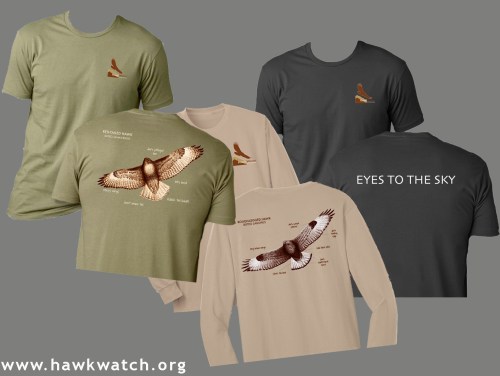
HawkWatch International recently released a few shirt designs featuring artwork of mine. My friend Mike Shaw had the great idea for a design that took a field guide type format, and put it on the shirt. The shirts feature two Buteos, the Red-tailed Hawk- Buteo jamaicensis, and the Rough-legged Hawk- Buteo lagopus. These illustrations feature callouts that give the viewer a few key tips at identifying the bird. I love the idea, and the shirts turned out great.
A little background on the development of one shirt, the Red-tailed Hawk, might be interesting to some. I really love this illustration for its purity. While counting the raptor migration last fall on the Goshutes Raptor Migration Site in eastern Nevada, I had plenty of time in the evenings to sit by candle light and draw some of the things I saw that day. This illustration was done at nine thousand feet, on the top of a mountain, in the middle of the magic of migration, by candle light. It makes it more special to me, and I hope those that now know where that illustration was born, might enjoy it all the more. I love things with a story attached.
Here are a few images of the illustration on the mountain:
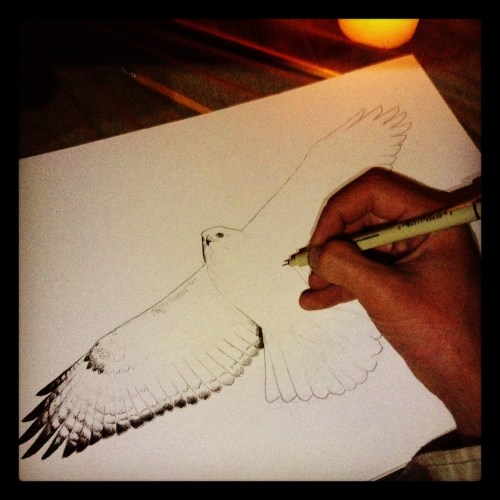
The inception of the illustration
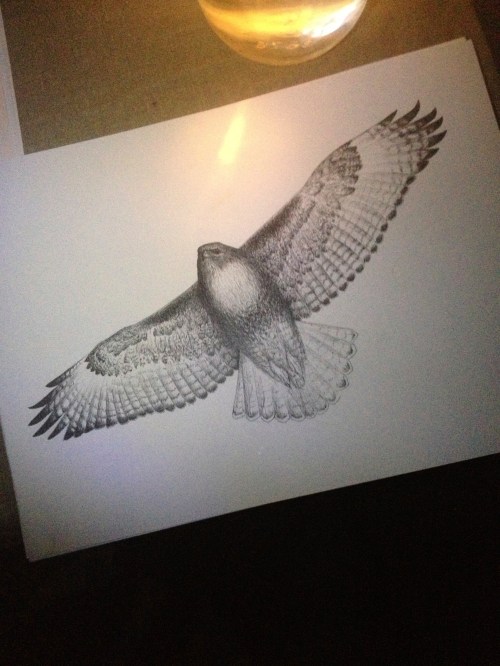
The result, with a splash of the candle light that helped create the image
If you would like to check out the shirts, or would like to buy any HawkWatch International merchandise follow the link below:
New Shirt Designs Featuring the Art of B William Robinson
HawkWatch International is an incredible organization. I encourage you to support them by purchasing one of their new items. To be transparent, I do not benefit financially from the sales of these shirts. I simply want to see more people joining conservation initiatives. It would be neat to meet someone on the road that I didn’t know from Adam, garnished in one of these shirts, supporting and spreading the good will of conservation, and of course the knowledge and fun of raptor ID.
 ornithologi.com