Photo of a female Gyrfalcon holding a surviving nestling following partial collapse of the nest. Photo published in Robinson, B. W., N. Paprocki, D. A. Anderson, and M. J. Bechard. 2017. First record of nestling relocation by adult birds following nest collapse. Wilson Journal of Ornithology 129 (1) 216-221
Since I’ve been hard at work in central America for the past month, I haven’t had the time to share a recently published article from my Gyrfalcon work. The article details the behavioral response of a female Gyrfalcon following the partial collapse of a nest. The photo above shows her holding the only surviving nestling following the partial collapse of their nest on a cliff side in Alaska. Just moments later, the female took the nestling to safety at another ledge farther down the cliffside. This behavioral response to threat is the first documented case in altricial birds!
Singing Brewer’s Sparrow (Spizella brewer) on sagebrush. Gouache on watercolor paper.
One of the best parts of spring in the Sagebrush landscape of western North America are it’s singing inhabitants. The Brewer’s Sparrow may be my favorite, because of its subdued but beautiful plumage and distinct trill song. On a spring morning at sunrise, one can walk through a healthy stand of sagebrush, songs erupting all around, as multiple males sing atop their sagebrush posts.
Brewer’s Sparrows have a distinct buzzing song, that sounds superficially simple and distinct. But, their songs can be variable and have multiple types as described in Rich (2002). See the figure below to gain a familiarity with the variability.
Song types of the Brewer’s Sparrow, long (A) and short (B). Figure taken from Birds of North America Online, adapted from Rich (2002).
Rich (2002) found that the variability seen above seems to follow no geographic trend or isolation, nor does there seem to be any song sharing among neighbors. High turnover among territories and potential for natal dispersal could limit the development of local dialects, etc. Interesting stuff…
If you’re unfamiliar with the sound of a singing Brewer’s Sparrow, be sure to visit Xeno-Canto and explore.
My friend Eli is wrapping up some research investigating the impacts of anthropogenic noise on sagebrush inhabitants in southwest Idaho. Breeding Brewer’s Sparrows were among a few focal species of her study. She’s currently working through the publication process, and when her work comes to surface in print, I’ll be sure to share. I expect that anthropogenic noise has some masking impacts on a Brewer’s Sparrow song, and in turn could potentially change the dynamics of song structure under anthropogenic noise blankets, etc. More research and time will tell.
Here is a short clip of a singing Brewer’s Sparrow in Idaho that I took through my Zeiss scope. The song is barely audible because of how distant I was from the singing bird:
Referenced Literature:
Rich, T. D. 2002. The short song of Brewer’s Sparrow: individual and geographic variation in southern Idaho. Western North American Naturalist 62(3): 288-299.
When I was a kid, I poured over the Great Blue Heron (Ardea herodias). I’d spend hours near my house in Ithaca, NY, stalking this bird to get a better look. I was studying the bird, its habits and its behaviors, though I didn’t quite realize what I was doing at the time. I’d also spend hours sketching the bird. It was the first bird I drew, and I drew tirelessly.
Since I was a kid I’ve done a few Great Blue Heron illustrations and started a few paintings, but due to my diversified passion for birdlife I haven’t finished a painting of this subject since I was a kid. Finally, I had the opportunity to do so.
I look at the painting and I see loads to improve upon, but it’s so satisfying to see my illustrations as a child against the painting above. As I do, I reflect on my journey thus far in life and look forward to many more paintings to come.
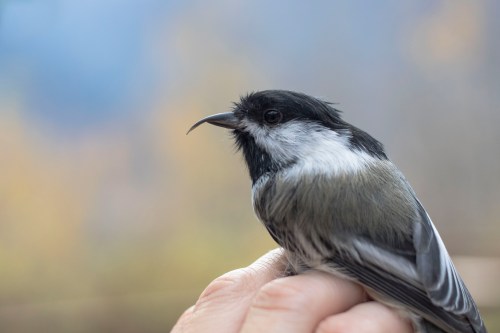
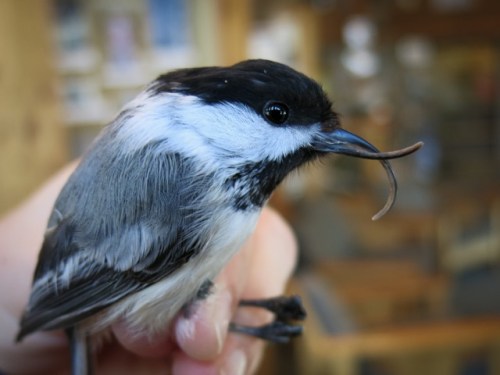
Photo 1. Female Black-capped Chickadee (Poecile atricapilla) with bill deformity.
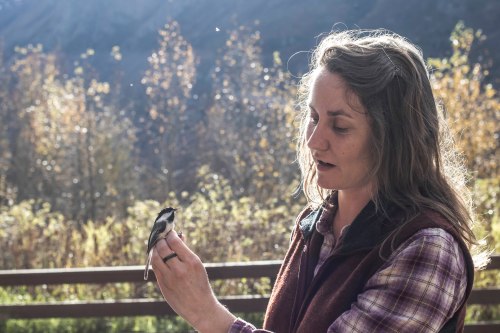
I recently had the pleasure of spending a few days with my friend Rachel Richardson of USGS trapping birds in the Eagle River Valley of south-central Alaska. We captured a few species such as Black-capped and Boreal Chickadees (Poecile atricapilla and P. hudsonicus, respectively), and Red-breasted Nuthatch (Sitta canadensis). USGS has been trapping in these areas for years with the main focus of monitoring bill deformities, the prevalence of Avian Keratin Disorder, and the prevailing causes of a new found virus, Poecivirus.
The Alaska Science Center of USGS in Anchorage is part of a team of researchers, including the California Academy of Sciences, and the University of California San Francisco that have been investigating the causes of Avian Keratin Disorder for over ten years. Avian Keratin Disorder was first documented in Alaska in the 1990’s by Colleen Handel of USGS who leads the research team at the Alaska Science Center. In an article in Molecular Biology that came out in July 2016 (Zylberberg 2016), the team reports on the discovery of a new virus they termed Poecivirus, which may be responsible for the bill deformities.
Appropriately, the discovery is receiving a good deal of press. Below are a few links to national and international articles that detail the work and the discovery. All are worth a read (or a watch):
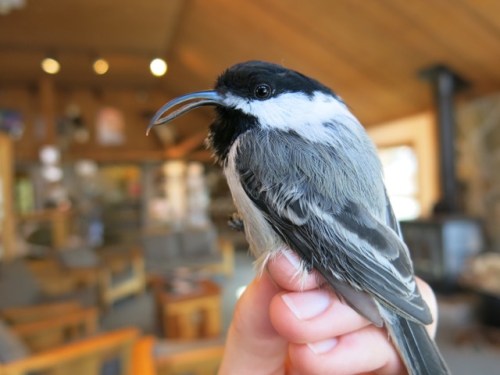
Photo 2. Rachel Richardson of the USGS Alaska Science Center holding a female Black-capped Chickadee (Poecile atricapilla) with a bill deformity.
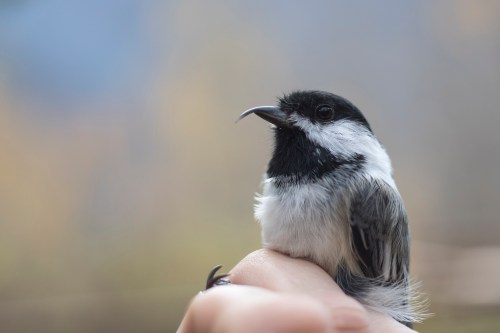
On the day I spent with Rachel in the field trapping birds, we only had one Black-capped Chickadee show up with a deformity. However, the one bird had an interesting story. This female (Photo 1) was first captured in 2015 and had no signs of any deformity. This year she obviously has a developing deformity. Her bill grew 5.1 mm in one year, a 70% increase in length. Whether or not this developing deformity will impact her ability to forage, preen, or even breed and provision young is yet to be determined. There are reports of deformed birds successfully rearing offspring, however it is without question that the deformities present a handicap that will ultimately reduce the individuals fitness.
It is important to track the rates and severity of deformities across the world. Because of this, the Alaska Science Center has developed a submission form for anyone to report their sightings of deformities. Please contribute to this effort and submit details of any sightings of elongated bills, including photos and location along with any other evidence for Avian Keratin Disorder at the following website:
Photo 3. Female Black-capped Chickadee (Poecile atricapilla) with bill deformity.
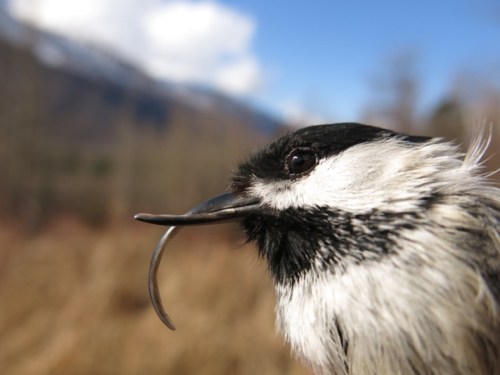
Below are additional examples of AKD in Chickadees that have been captured as part of the Alaska Science Center’s efforts near Anchorage. These individuals unfortunately have more developed deformities than the chickadee we caught while I was tagging along.
Photo 4. Black-capped Chickadee (Poecile atricapillus) with bill deformity. Photo copyright Rachel M. Richardson.
Photo 5. Black-capped Chickadee (Poecile atricapillus) with bill deformity. Photo copyright Rachel M. Richardson.
Photo 6. Black-capped Chickadee (Poecile atricapilla) with bill deformity. Photo copyright Rachel M. Richardson.
It’s excellent to have a breakthrough and a step forward. However, the problem still remains as well as the daunting task of discovering the correlation between Poecivirus and bill deformities, the causes of both, and what role humanity plays in the prevalence and transmission of either. I’d like to tip my hat to those who have done so much great work on this issue thus far. Keep up the good work.
Referenced Literature
Maxine Zylberberg, Caroline Van Hemert, John P. Dumbacher, Colleen M. Handel, Tarik Tihan and Joseph L. DeRisi. Novel Picornavirus Associated with Avian Keratin Disorder in Alaskan Birds. mBio, July 2016 DOI: 10.1128/mBio.00874-16



 ornithologi.com