A studio for bird study

Tag: nature

Gluttony and the Great Blue Heron

by Bryce W. Robinson
IMG_2756

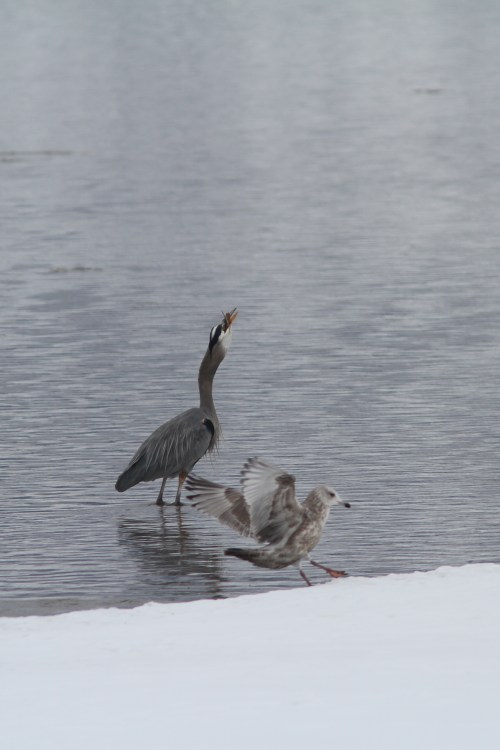
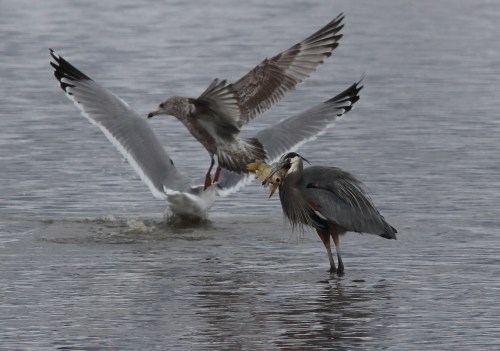
The other day I observed a Great Blue Heron- Ardea herodias, that had caught a fish seemingly too large to handle. The above image is directly after the bird had speared the fish, and was working on a way to get the meal down its throat. Yes, I did say spear. Before this instance, I was under the impression that herons never speared their prey, rather they stabbed at the prey only to grasp it in its bill. This bird speared the fish, effectively killing it, then retrieved it from the water. I believe that if the bird had not done so, the large fish would have been too strong as it struggled to escape the herons clasping bill.

I also was taken aback at the size comparison this photo illustrates between the Herring Gull- Larus argentatus, and the Great Blue Heron. Heron’s seem like such large birds when standing alone. Anyway, I took a sequence of photos of the heron struggling the fish down its throat. The sequence is as follows:

IMG_2765

IMG_2771

IMG_2784

IMG_2788

IMG_2815You can see in the last photo where the fish still sits in the birds body. This will undoubtedly take a while to digest. I was impressed in the least. I absolutely love seeing predators eat, and the heron is one bird that always delights. I once came upon a photo of a Great Blue Heron that had killed and was holding in its bill a Least Bittern, about to consume the close relative. How bizarre.

Anyway, I felt lucky to see this instance, even luckier to capture it on film.
 

Illustrating Birds

by Bryce W. Robinson

IMG_0002


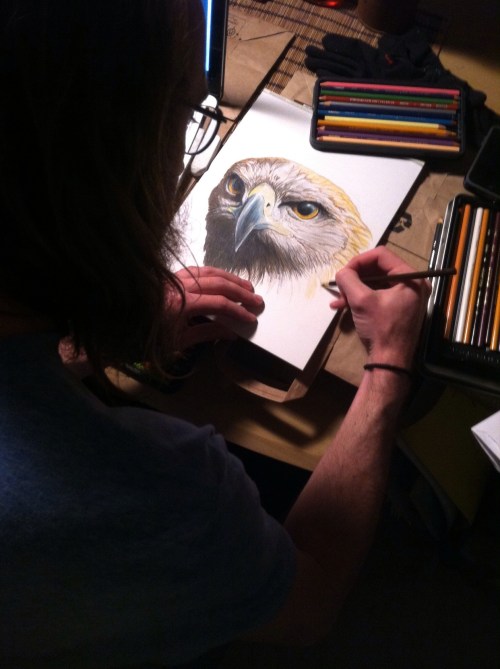
I love the process of illustration nearly as much as I love watching birds. Nothing calms my mind more than putting on some music, drinking a full bottle of wine, and losing myself in the exercise of illustrating an avian subject. I will draw until the day I die.

Red-tailed Hawk- Buteo jamaicensis Consuming Prey

by Bryce W. Robinson


I took this video the other day. At the beginning, you can see the bird reject the intestines of the rodent. Everything else is consumed. It is a bit long, but worth a watch. The hawk gets very animated towards the end. It is quite the treat to view, as a great deal of detail is visible.

I wonder about this bird. In the winter, it is difficult to distinguish visitors from residents. This is a unique looking bird. White on the lores, crown, and supercilium is not common amongst Utah’s western Red-tailed Hawks. Perhaps this is a bird from the north country. One cannot be sure, but it is fun to wonder.

Gray Partridge- Perdix perdix

by Bryce W. Robinson

IMG_2311


I was out wandering the frozen landscapes of the west the other day. My task to discover the regions wintering eagle population in its entirety all too often warrants views of other creatures that endure the ice and snows of winter. I must be honest and say that I make my best attempts at stifling my urge to digress from my task and take a quick look at those that are other than the eagle. I, all too easily, fail in the exercise. Call it an attention disorder, a lack of conviction, or any other explanation of poor behavior, but I must admit, I am stricken with this ailment.

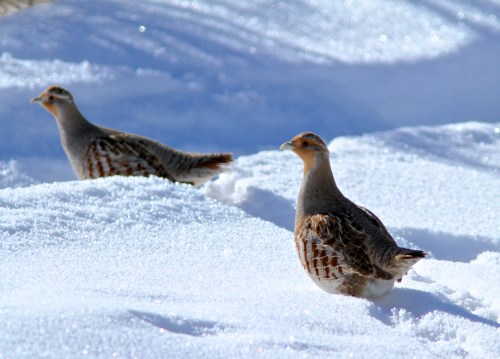
The other day I came upon, and for the second time, a small group of Gray Partridge. I was giddy. These are a rare sight for me, and as with most small Galliformes, they are quite charismatic. I do feel that I failed in procuring a decent image. No Catchlight, a wildlife photographer’s rookie mistake. I hope Ron does not judge too harshly. I may have failed mainly because both I and the partridge were a bit rushed. Me to get back on the eagle hunt, they to escape the crazed heavily haired human with the imposing lens. We were both on our ways into the world too soon, to meet again, when I do not know.