A studio for bird study

Tag: nature

A Bounty of Summer Buteos

by Bryce W. Robinson
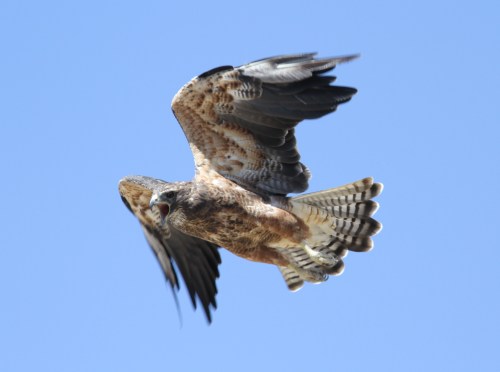
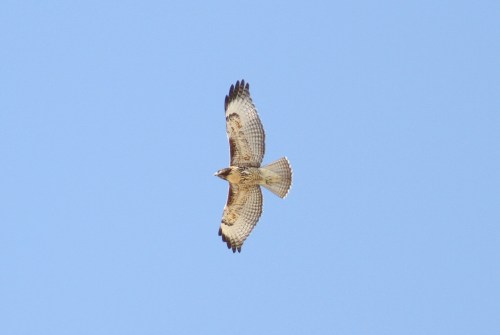
“Intermediate” morph Swainson’s Hawk- Buteo swainsoni.

Yesterday I ventured out to find some raptors with Jerry. We found found an area covered with “summering” Buteos, in densities unprecedented in my young and limited experience with the raptor world. I am enthralled with the ecology of wintering birds of prey, primarily for the interspecies interactions that occur in high density hunting grounds. Yesterday, I found the same densities and something of the same diversity. I have never seen so many Swainson’s Hawks and Ferruginous Hawks in one area. I was very delighted to observe numerous interactions between each species. Surprisingly, the bully seemed to be the Swainson’s Hawks. The Ferruginous didn’t seem to mind the Swainson’s, but a few times I observed Red-tailed Hawks being bullied by the summer migrants.

One particular incident made my day, and provided me with a glimpse of something I’ve never seen, and actually was unaware existed. A Swainson’s hawk and Red-tailed Hawk soared together rather high in the noon sky. The Swainson’s began buzzing the Red-tailed Hawk, resulting in some dramatic arial displays as they twisted to push the other away. Finally the climax of the interaction came when the two birds latched talons and began tumbling through the air. After multiple rolls, the birds broke, sending the Red-tailed Hawk fleeing from the scene. I have seen tumbling between Red-tailed Hawks as they engage in talon clasping to reinforce pair bonds, but never as an aggressive territorial interaction between two different species. The birds were some distance away, so the photos I came away with are not ideal, but interesting nonetheless.

Red-tailed Hawk (top) and Swainson’s Hawk (bottom) engaged in an aggressive tumbling interaction.

Birds blanketed the valley. Every other telephone pole supported a perching buteo, and the irrigation lines were covered with ravens and buteos as well. On one particular raven-less wheel line I counted eleven birds, comprised evenly of Swainson’s and Ferruginous Hawks. Not only was there interspecies diversity, but within each species, variation in plumage was present as well. I love dark morph Ferruginous Hawks, and a few flew around. These birds were leery of our intrusion, so I was unable to get any good photographs. I did photograph a very interesting adult Ferruginous. I assume it to be something like a rufous morph, perhaps in the midst of body molt, however its present state gave it a tiger like appearance. This is by far the most spectacular Ferruginous I have found to date.

“Tiger” Ferruginous Hawk- Buteo regalis
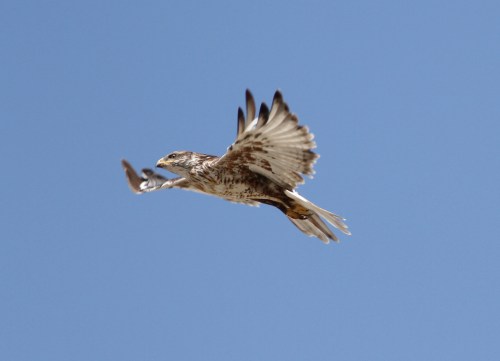
“Tiger” Ferruginous Hawk- Buteo regalis

I’m a plumage enthusiast when it comes to buteos, so this day was all that I could hope for. The diversity in Swainson’s Hawks was a treat. These birds vary immensely. I found the typical light morph birds, rufous birds, dark birds, and even some that exhibit mottling, perhaps intergrades between the morphs or showing body molt. I remember one particular bird near the end of the day that was nearly black, but it had extensive mottling not unlike a dark Harlan’s. Regrettably, I failed in my attempts to photograph this bird.

Intermediate Swainson’s Hawk- Buteo swainsoni
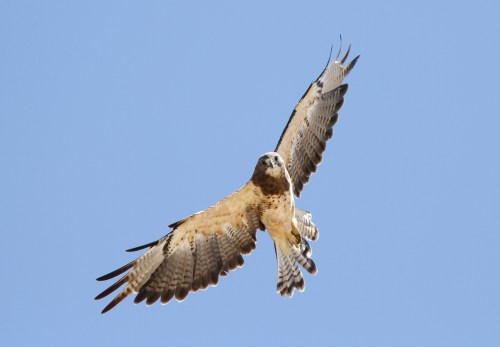
Light morph Swainson’s Hawk- Buteo swainsoni

It was surprising to find an area so devoid, relatively, of Red-tailed Hawks. There were few hanging about, most likely due to the attention they received from the gangs of Swainson’s Hawks. Still, we found a few birds and were able to come away with some photos.

Light morph Western Red-tailed Hawk- Buteo jamaicensis calurus

Juvenile light morph Western Red-tailed Hawk- Buteo jamaicensis calurus

The above birds was found sitting in a tree with a nest, and another young bird. Given their behavior, Jerry thought this bird to be very young, which is surprising given that most birds fledge early in the year. A late nest is peculiar, but it is highly probable that these birds have only recently taken to the air.

I have a few qualms about the photos I have shared. Although they are the best I have taken thus far, I failed to capture the catch light in most images, and for whatever reason many of the wings are blurred. I resolve to figure out how these problems can be corrected, but I feel great about my successes thus far. My homelessness and beatnik birding lifestyle continues for little longer, but in the small amount of time much will be chronicled. Let the good times soar.


Great Blue Heron- Ardea herodias

by Bryce W. Robinson

Great Blue Heron- Ardea herodias. 11×15″ prismacolor on bristol.

My childhood was spent in study of the Great Blue Heron. I stalked the large wader all summer, learning its habits and admiring its stoic poses. I became engrossed in a passion for the bird, and for what reason I will never know. This childhood connection will forever be an integral part of who I am. I spent many hours illustrating the bird in multiple positions, always enjoying the process of recording the creature I so admired. Today, I feel troubled that I have not put the same passion and effort into this bird. I took the morning to do so, and resolved to schedule a goal for myself. As the Great Blue Heron is responsible for my introduction into the world of birds, I find it so appropriate to write an essay detailing my admiration, feelings, and understanding on its life history. I have only posted one essay thus far, and feel that I must rectify my lapse in writing with a second essay, appropriately paying homage to the most special bird to me. This is only a preview, and I will undoubtedly take my time putting the essay together. In two weeks I will leave society to count migrating hawks for some months, and will have no opportunity to work on the essay. So it may be long coming, but be assured it will. I only found it necessary to voice my goals, as an exercise to solidify the plan for my own sake.

Animated is the Avocet

by Bryce W. Robinson

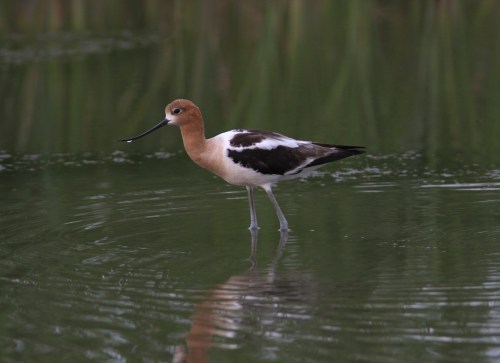
Animated is a proper term describing the unique American Avocet. I have photographed this common wetland denizen in the past, but given my newly acquired gear, I thought a return to the rusty colored subject would prove fruitful. The birds themselves are striking. The Avocet provides an aesthetic presentation; A rusty orange neck, balanced by long blue-grey legs and contrasting white and black body. As always, I found watching the avocets a delight, as they fed and flew around the shallow wetland waters.

When the avocet stands still it holds itself with poise. The slight upturn of the bill is delicate, and demands reverence. As it moves through the water, it maintains alertness, while conducting its business. The avocet feeds on micro-biota, utilizing its upturned bill to sift through mud and water.

Any area the avocet frequents will carry the sound of the recurvirostra call. Kleet kleet fills the air, neither loud nor obnoxious.  Often, the talkative birds lift to the sky, circling the waters. For minutes the bird flies, finally fulfilling whatever need that put it to the air, and calmly settles back to the water. The avocet is active, in voice, in feeding, in flying. Watching this wetland walker touches upon every aspect I enjoy in birding. Unique sights, unique sounds, unique experiences. A glimpse into a world so alive and independent from my own, its existence commands my respect and admiration.

I began birding in wetland areas. These inhabitants are special to me. Although my study has focused much on birds of prey, and will undoubtedly continue in that direction, I will not forget my roots. I love nothing more than walking among the reeds, listening to the birds, enjoying the long light of the setting sun. I am at that moment, engrossed in a world I certainly respect, but not a part of. I record my findings to pay homage, and draw attention to the fact that other worlds exist outside of humanity, equally integral and important.


A New Stride in My Study of Raptors Through the Lens

by Bryce W. Robinson

Swainson’s Hawk- Buteo swainsoni

And finally it has happened. An update from the Beatnik Birder, and a new development making a lengthy stride in fulfilling his study. After too long, I have upgraded my camera equipment. My lapse in posting of late is attributed to many happenings in my life. I have been birding, or out working with owls, but I have not had the time, drive, or energy to share my experiences. I have felt the void this has caused, and I am confident that the lull has passed.

The new drive comes from my new camera, the Canon 7D. Coupled with the camera, I purchased a 300mm f/4.0 telephoto lens and a 1.4x teleconverter. I’ve taken the camera out a few times already, and am working to learn all that I can as quickly as possible. I figure the amount of time I invest will be directly related to my success. I must now go to work. The camera will not only create loads of fun and play, but will become and invaluable tool for the research I’d like to accomplish on the world of birds.

I knew as soon as the camera came that I had a subject I was extremely interested in capturing. A few weeks ago, Mitch Tall and I went west along I-80 to see what we might find. We came upon a large number of Swainson’s Hawks hunting the pastures to the north of the highway. I was very surprised at the number of birds present in such a small area. Among the light, dark, and juvenile Swainson’s was also a young Ferruginous Hawk. This bird was the first Ferruginous I had ever seen in the Salt Lake Valley. I was pleasantly surprised, to say the least.

Now armed with my new equipment, I thought it fruitful to return to the spot in hopes of finding the same number of birds as before. The night before I had found a group of eight Swainson’s on a thirty acre plot near my parents. A trend perhaps, and future investigation will add to my ideas about migrant grouping in hunting grounds for raptors. I was certain I would come away with some great shots if the birds were again hunting the fields along the interstate.

When Mitch and I made it to the area where the group had been, we were a bit disappointed to find only a few birds perched and in the air, scattered much farther than before. Two young Red-tailed Hawks circled above, but had risen on thermals a bit too high to get a spectacular photo. Still reviewing the shots I did come away with, I was tickled and impressed with my new gear.

Juvenile Light Morph Western Red-tailed Hawk- Buteo jamaicensis calurus

I was lucky enough to find a few members of my target species. Most of the birds were circling far from the road, far out of range of my camera. Finally we had luck, coming upon a perched Swainson’s Hawk only two hundred meters or so from the road. Far enough to feel comfortable with our intrusion, but close enough for some worthwhile photography.

Swainson’s Hawk- Buteo swainsoni

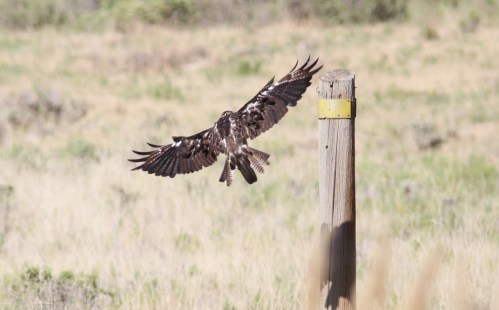
After watching the bird for some time, and taking many many photos, we were fortunate enough to watch as the bird lit off pole #36. I missed the chance at photographing the bird as it left the post, but I did catch him gliding feet above the ground.

Topside of gliding Swainson’s Hawk, showing some apparent body and flight feather molt.

After seeing the bird fly, and land on a post farther down the road, I could tell that this bird was molting. From the photo of the bird pulling up just before landing on the post, you can see that P1-5 are fresh new feathers, and many of the outer retrices are actively growing in. Also, from the mottled look of the scapulars and upper wing coverts, it is apparent that the bird is undergoing a body molt as well. I reviewed some photos of the bird as it flew, and I a under the impression that this bird is molting into its first adult plumage. I love this stuff. I haven’t sent any of these to Jerry Liguori for conformation or review, but I’ll be sure to. After which, I will correct any mistakes I made, or even elaborate on what can be told from this bird.

Swainson’s Hawk- Buteo swainsoni. Note the remige and retrix molt, as well as the body molt of the upper wing coverts. The darker wing feathers, P1-5 are newly grown feathers, as well as the central retrices.

My main fascination with Buteos is the diversity in their plumage. Using my camera for a recording tool, I’d like to add to the work of Jerry Liguori in documenting the vast varieties that present themselves in these winged predators. My images at the moment are not near the quality they could be. I want to correct that. I know they won’t reach the Ron Dudley quality, but I will do my best.

Here is to the future of my study. Finally my photography will progress. Let’s hope the birds cooperate.

Juvenile Swainson’s Hawk- Buteo Swainsoni