A studio for bird study

Tag: ornithology

Pacific Loon, a Load of Feathers

by Bryce W. Robinson
PALO

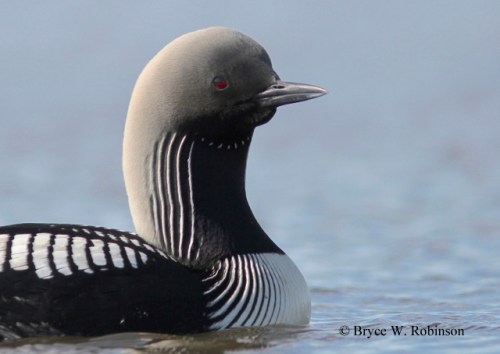
I’ve seen Pacific Loon in all states of plumage. I’ve always been impressed by a loons looks, but this summer I had the chance to get very close to many Pacific Loons, and really gain an appreciation for their feather composition.

I think that most consider tropical birds to be among the most decorated, and striking in plumage. Colors that come from the tropical regions of the world are truly unique, but I consider some birds of the northern hemisphere to be equally exotic, and equally striking.

The Pacific Loon in full breeding plumage is breathtaking. At close proximity, you notice the velvet appearance of the throat, and its iridescent qualities enhanced. Purple, on an Arctic bird, is awe inspiring. The ghostly grey of the head and nape always leaves me mesmerized. I think that the numerous, dense, and fine quality of the feathers gives the bird a shape and form unlike any other feathered creature. In fact, the form does not even seem feathered at all.

The patterns of the loon are of note, as they are unlike any pattern I’ve ever seen in a creature. The fine lines and stripes are neat, organized, and crisp. This sharp appearance matches well with the behaviors of the bird. It holds its head high, glances about with confidence, and dives with absolute grace. In fact, the regality of the Pacific Loon impresses me, as I admire all creatures who frequent this world in confidence and style.

In winter, it interests me that the bird seems more sleek, and thin. I’ve yet to get close to a wintering Pacific Loon. When I do, I hope to study the difference in feathers and shape, and compare and contrast the two looks of the same bird. It fascinates me, that evolutionarily, two molts have evolved for this bird, and the two resulting plumages are dramatically different.

I can’t explain my fascination with the bird any further. As I’m scheduled to frequent the Arctic summer again for the next two years, I’ll be seeing breeding loons once more. At every opportunity, I’ll record the behaviors and appearance of each individual, and communicate their beauty the best I can. As I’ll be in Western Alaska, there is a great chance I’ll happen upon the Arctic Loon. It will be fascinating to compare my images between the Arctic and the Pacific, two birds that are very similar. I suppose I’ll have to wait and see what comes about, but when it does, I’ll be sharing.

 

Some Notes on the Gray-crowned Rosy Finch- Leucosticte tephrocotis

by Bryce W. Robinson

IMG_8747

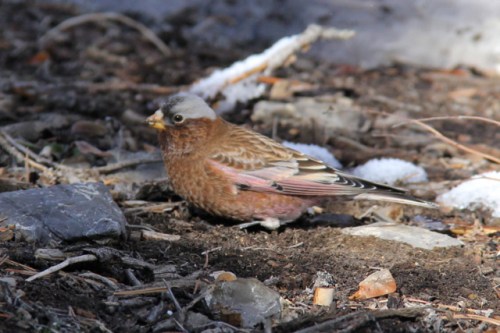
Juvenile “tephrocotis” Gray-crowned Rosy Finch. Brooks Range, Alaska. July

Caitlin Davis recently shared some photos with me of a small group of Gray-crowned Rosy Finches that visited her this fall at the Goshutes in eastern Nevada. The photos showed two different types of Gray-crowned Rosy Finch, one with gray cheeks, the other with brown. The photos reminded me of the flocks I saw while counting migrants there last fall. I remember seeing the two cheek colors, along with a few Black Rosy Finches intermixed in the flocks, which was exciting. My exposure to the birds did not end with the Goshutes. Over the course of the winter I saw a number of birds, and studied the differences in plumage that I observed.

Adult "Tephrocotis" Gray-crowned Rosy Finch. Goshutes Mountains, Nevada. October

Adult “tephrocotis” Gray-crowned Rosy Finch. Goshutes Mountains, Nevada. October

"Hepburns" Gray-crowned Rosy FInch. Goshutes Mountains, Nevada. October.

“Hepburns” Gray-crowned Rosy FInch. Goshutes Mountains, Nevada. October.

The two types of plumage illustrated in Caitlin’s photos are a function of subspecies. There are six recognized subspecies in North America, most easily distinguished by the color of their cheek. Three subspecies have gray cheeks, while the others have brown cheeks. The”Hepburns”, a coastal gray cheeked group ranging from Alaska to northern California, winters in the interior west with another group, a brown cheeked bird, the nominate tephrocotis, an interior subspecies ranging from the Brooks Range of northern Alaska to the Rocky Mountains of the lower 48.

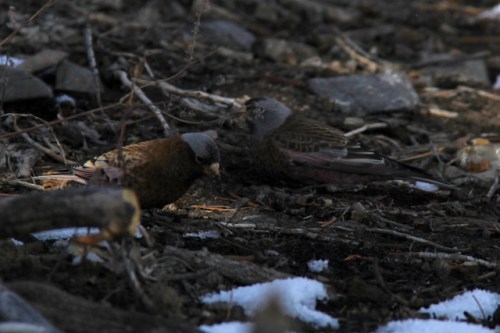
"Tephrocotis" (left) and "Littoralis" or "Hepburns" (right). Goshutes Mountains, Nevada. October.

“tephrocotis” (left) and “littoralis” or “Hepburns” (right). Goshutes Mountains, Nevada. October.

I find it interesting that these birds form these large flocks, intermixed with obviously separate populations. What this speaks to is the nature of flocking in this species. I’d love to track each group, as they break apart with the onset of spring, and then form into their winter groups with the inception of fall.

After the past winter, I found an interest in the small fringillid. I spent a bit of time studying and learning parameters of the subspecies. After making plans to drive to the great north, I realized the potential of seeing the tephrocotis at the northern extent of its range. That thought was ultimately exciting, but even more so was my excitement when I actually found a small group in the Brooks Range of northern Alaska. I was only able to get photos of one cooperative juvenile, regrettably. The adults were very shy, and stayed far from range of my lens.

I plan to locate some flocks this winter, in hopes of studying the birds in the field and getting some additional photographs. What I would like to work out is the ability to sex each individual, and hopefully find a bird in its first basic plumage. I’ve learned some of the characteristics of each sex, now I just need to test those in the field.

After reviewing a photo from last winter, I noticed an aspect of the birds plumage I haven’t read about or heard of. In the photo below, the bird has a great deal of black on the cheeks, rather than brown or grey. This is worth some thought, and one of the reasons I’m anxious to find a large flock and see if there are other instances of variability. Perhaps it is an expression from a lineage closely tied to the Black Rosy Finch. After all, I’ve heard buzz of the possibility of the North American Rosy Finches being once again lumped as a single species. It would be fun to really get to the bottom of how different each population truly is.

"Hepburns" Gray-crowned Rosy Finch, exhibiting a great deal of ashy black on its cheek. West Desert of Utah, January.

“Hepburns” Gray-crowned Rosy Finch, exhibiting a great deal of ashy black on its cheek. West Desert of Utah, January.

Maybe, if I have some luck this winter and really get to know this species, I can illustrate what I’ve learned about how to distinguish individuals to age, sex, and subspecies. And the intellectual journey continues.


Referenced information:

Macdougall-Shackleton, Scott A., Richard E. Johnson and Thomas P. Hahn. 2000. Gray-crowned Rosy-Finch (Leucosticte tephrocotis), The Birds of North America Online (A. Poole, Ed.). Ithaca: Cornell Lab of Ornithology; Retrieved from the Birds of North America Online:http://bna.birds.cornell.edu/bna/species/559 doi:10.2173/bna.559 Accessed 11/10/2013

A “Meridionalis” Turkey Vulture

by Bryce W. Robinson

IMG_4268

I gave my Turkey Vulture warts, for a reason. As I’ve stated in previous posts, I’ve began pursuing a degree in Raptor Biology at Boise State University, under the direction of David Anderson at the Peregrine Fund, and Marc Bechard, who has been with BSU since the 1980’s. Dr. Anderson is a great man himself, and I’m sure I’ll have plenty to tell about him later, but for this post, I’d like to mention some things about Dr. Bechard.

Last week Dr. Bechard accompanied me and a few of my peers, along with Greg Kaltenecker of Idaho Bird Observatory to attempt to capture migrating Turkey Vultures. Ultimately we failed, but I feel like I learned some things about Dr. Bechard and his interest with Cathartes aura, commonly called the Turkey Vulture. While trapping hawks in the blind at Lucky Peak, I picked his brain for insights into the life histories of the Turkey Vulture. He told me many things, but one aspect that stuck was his discussion of the subspecies of the Turkey Vulture, their regional distribution, and their migratory habits.

We in the west see what is called subspecies meridionalis, which is the subspecies I’ve illustrated above. Those in the east see septentrionalis. In Arizona, you find the nominate aura at its northern extent. These three sub groups comprise the Turkey Vultures found in North America. Of course in S. America, there are others. It is not often that you find a man who specializes on vultures. I find myself lucky to be working under such a man. At the moment, he is in Gambia, trapping Hooded Vultures with Keith Bildstein of Hawk Mountain Sanctuary. Lucky him, as he is off chasing exotic vultures while I teach his classes. I’m perfectly fine filling in while he’s gone, so long as he teaches me all that he knows!

Juvenile "Western" Turkey Vulture- Cathartes aura meridionalis

Juvenile “Western” Turkey Vulture- Cathartes aura meridionalis


Ruddy Turnstone- Arenaria interpres

by Bryce W. Robinson

IMG_4992 copy

It’s been a real treat to see the Ruddy Turnstone on its breeding grounds. These birds have quite a story. Their name is fitting, as they are known to turn stones in search for food, but even more incredible in my eyes is a peculiar piece of their diet. The Ruddy Turnstone eats the eggs of other nests, a behavior quite unlike any other shorebird that I know. They are also quite tenacious. I’ve observed these birds chasing jaegers out of their territory, and while I was taking some time to watch and photograph a pair, they were unreserved in expressing their intolerance of my intrusion. It’s expected when I am hazed by territorial jaegers, but having a turnstone flying at my face comes rather unanticipated. It’s an experience worth having, trust me.