
Manifesting My First Hermit
by Bryce W. Robinson

Hermit Warbler- Setophaga occidentalis. 11×14″ colored pencil on bristol.
I sat in the sun, waiting for the others. Of course I was on a high from the Townsend’s Warbler ten minutes earlier. I had been looking for the bird for a week. People had been telling that the Townsend’s had been seen regularly across the desert for the past week. I’d never seen the bird, so I spent the week with my eyes out, actively checking every tree for the hyperactive warbler. Finally on Saturday morning the bird found me.
After seeing my first Townsend’s, more began showing up. I realized that there were other warbler’s migrating through the area that I had never seen. One bird in particular was a close relative to the Townsend’s, the Hermit Warbler. It was the next on the list, I had to see it.
So, sitting in the sun, talking with a friend Jeff, I began voicing my wishes to see the Hermit Warbler. I raised clenched fists, exclaiming to the sky, HERMIT WARBLER! Jeff responded in the same fashion, but exclaiming MANIFEST IT! Afterwards, I explained that I knew that the bird migrates through southern California, however, I didn’t know if it came through the desert. It was my next life bird to see. Literally seconds later a shadow flew overhead. Jeff and I both raised our glasses.
The bird had landed in a Palo Verde only ten feet to the north. It took a while for the spastic warbler to show itself enough to glean anything. When it finally came forward from the green shrubbery, it was unmistakable. Jeff and I had manifested a life bird, the Hermit Warbler. Possibly the most miraculous birding experience I have ever had.
Jeff loves warblers. I give him credit for turning me to my most recent interest in the bird world. After seeing the Hermit, he kept mentioning how incredible it would be to find a Townsend’sxHermit hybrid. As rare as the bird is, I couldn’t help but think of the possibility of finding the cross. After all, we had manifested my last life bird.
Today we saw many warbler’s, and believe it or not, one bird made us think. At first I thought it to be a drab Hermit, but after some research and consultation, I’ve decided to settle on a hybrid. Given the streaking on the flanks, and the markings on the auriculars, I am fairly confident the bird we found is a first spring HermitxTownsend’s Hybrid. Migration is a beautiful thing, especially in the warbler realm.

Possible 1st spring Hermit X Townsend’s Warbler Hybrid
I also thought I would include a photo of a Townsend’s Warbler I found. These birds are striking. Hope to see more.
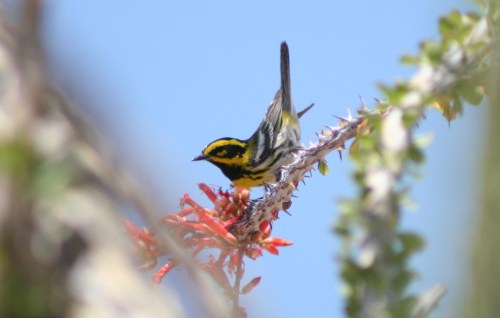
Townsend’s Warbler- Setophaga townsendi
It’s been quite the spring migration, and it is only the midpoint. Tomorrow undoubtedly brings more!


 ornithologi.com