A studio for bird study

Tag: predator

Swallow-tailed Kite Movements

by Bryce W. Robinson

Swallow-Tailed Kite - Elanoides forficatus. 11 x 17

Swallow-Tailed Kite – Elanoides forficatus. 11 x 17″ prismacolor on bristol.

I illustrated this Swallow-tailed Kite for my friend Russ. He found Arizona’s first state record back in 2012, so understandably the Swallow-tailed is a special bird to him. You can see the accepted record here:

http://abc.azfo.org/ABCVote/_ABCReports_Public_View_list.aspx

It would be so exciting to see an unexpected X soaring high above the desert. Lately, Swallow-tailed Kites have been showing up in some odd places. For whatever reason a few birds have strayed farther north than their normal range. In this past weeks Rare Bird Alert on the ABA Blog, four separate sightings of the species were made in three different states: Illinois, Indiana, and Kansas. Sometimes birds make strange movements in great distances. You never know, you might be at a hawk watch this fall somewhere in the west and see a large X soaring in the sky. Better start scanning…

Light Morph Harlan’s Hawk – A Noteworthy Specimen

by Bryce W. Robinson

Adult light morph "Harlan's" Red-tailed Hawk - Buteo jamaicensis harlani

Adult light morph “Harlan’s” Red-tailed Hawk – Buteo jamaicensis harlani

I wanted to share this specimen I found today while going through the small bird collection at Boise State University. It is a great example of the variable traits of the Red-tailed Hawk subspecies harlani. I really enjoy the variable plumages of the Red-tailed Hawk in North America. At the top of my list, as with most Red-tailed Hawk fans, is the Harlan’s.

Here are a few things I found interesting when I first found the bird:

  • Some tell-tale light Harlan’s traits – whitish head with streaking, red/pink tail fading to white/gray at the base (Harlan’s tails are ultra variable, but I’ve seen this regularly on light Harlan’s), Harlan’s spotting on tail, warm tones in upper tail and dorsal area, blotchy streaking on belly band.
  • Some not so Harlan’s traits – orange barring on leggings (typical of western RTHA), and barred belly band accompanying blotchy streaking. Strange and neat! Also of note is the amount of red in the tail. Common in Harlan’s, but often confused as a sign of intergradation.

I’m a bit disappointed that the tail wasn’t spread at preparation, so it was difficult to get a full glimpse of each feather. Additionally, there was no informative data accompanying the specimen, apart from a tag that read “Red-tailed Hawk”. As I’ve become more familiar with the art of museum preparation and the usefulness of specimens in research, I’ve become more aware of how important information is to put a specimen into context.

Even though the data is lacking, I’m really appreciative of the opportunity to look at this bird and take some photos. It’s a really interesting light morph Harlan’s that deserves some recognition. It made my day.

For some more insight into variability in light morph Harlan’s, check out this article by Jerry Liguori:

http://www.hawkwatch.org/blog/item/810-atypical-harlan-s-traits

Gluttony and the Great Blue Heron

by Bryce W. Robinson

IMG_2756

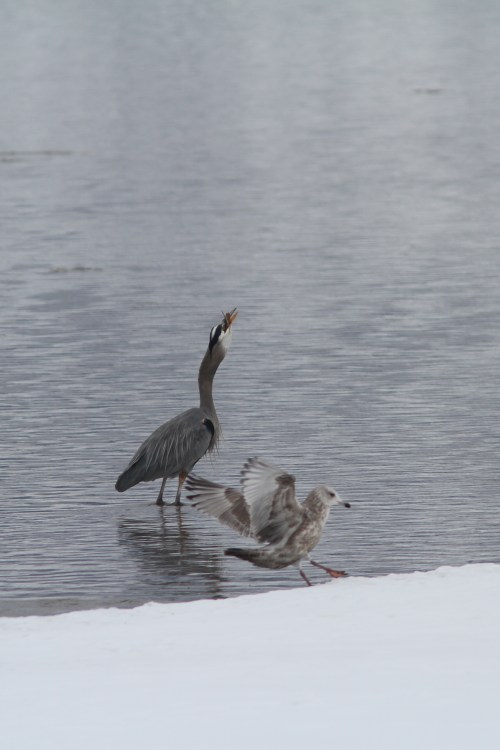
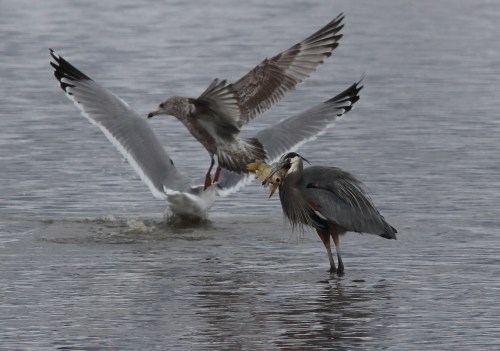
The other day I observed a Great Blue Heron- Ardea herodias, that had caught a fish seemingly too large to handle. The above image is directly after the bird had speared the fish, and was working on a way to get the meal down its throat. Yes, I did say spear. Before this instance, I was under the impression that herons never speared their prey, rather they stabbed at the prey only to grasp it in its bill. This bird speared the fish, effectively killing it, then retrieved it from the water. I believe that if the bird had not done so, the large fish would have been too strong as it struggled to escape the herons clasping bill.

I also was taken aback at the size comparison this photo illustrates between the Herring Gull- Larus argentatus, and the Great Blue Heron. Heron’s seem like such large birds when standing alone. Anyway, I took a sequence of photos of the heron struggling the fish down its throat. The sequence is as follows:

IMG_2765

IMG_2771

IMG_2784

IMG_2788

IMG_2815You can see in the last photo where the fish still sits in the birds body. This will undoubtedly take a while to digest. I was impressed in the least. I absolutely love seeing predators eat, and the heron is one bird that always delights. I once came upon a photo of a Great Blue Heron that had killed and was holding in its bill a Least Bittern, about to consume the close relative. How bizarre.

Anyway, I felt lucky to see this instance, even luckier to capture it on film.