A studio for bird study

Tag: raptor

Views of Migration- An Update From the Goshutes

by Bryce W. Robinson

Immature Northern Goshawk- Accipiter gentilis

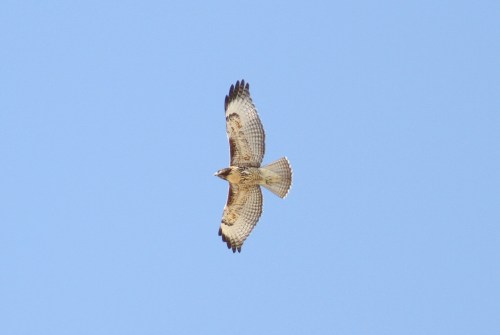
Progressively, the daily totals are rising. After a month of counting, the season total has already surpassed 3000. I’ve left the mountain for a day, so I would like to take the opportunity to make a brief report of the season to date. I haven’t the energy or the time to put much into the writing of this post, so I hope poor grammar and diction can be overlooked. Pay attention to the images, as I attempt to convey some of the images of the ridge top raptor migration at the Goshutes.

Broad-winged Hawk- Buteo platypterus


The highlight of the season thus far has been the Broad-winged Hawks. Six have flown through, and the above photo is the first of the season. This bird is actually a first for me. I had never seen a Broad-winged before. When I noticed the bird, and knew what it was, I could hardly contain my excitement. Hooting and hollering ensued, and I celebrated for minutes following. The western migration of Buteo platypterus was a thing of rumor in the past. It was thought that the bird did not migrate through the inter-west, and did not pass by the Goshutes migration sight. Jerry Liguori was the first to discover that the bird did indeed use the flight line, and many have been counted in the years since his revolutionary discovery. I hope to see many more to come, and am holding high hopes for a dark morph bird in close proximity to the observation point.
Red-tailed Hawk- Buteo jamaicensis

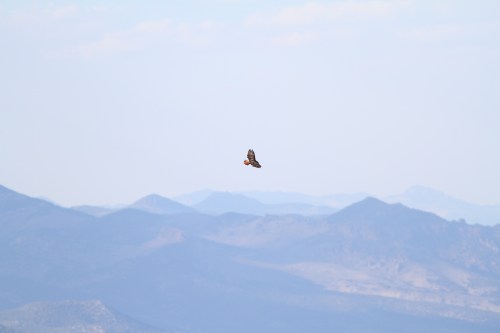
I’ve been able to get some amazing photographs from passing birds, many very close and detailed. I am saving the best for a future project, so for now I would like to present some photos that show what it is really like at the sight. Mainly, while watching the migration, the observer gets distant views at birds. Identifying the birds to species, sex, or age can be extremely difficult at times. Jerry Liguori has written two books to aid the observer in this task, illustrating a vast amount of tips and tricks to gleaning positive Identifications from distant specs. These books have become invaluable in my study.
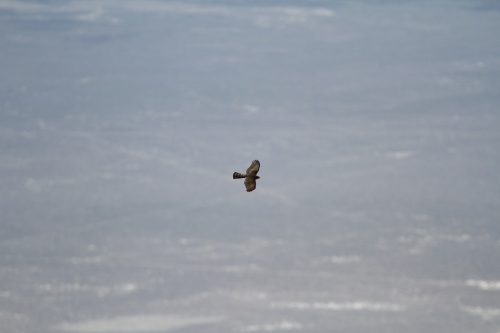
SSHA

Sharp-shinned Hawk- Accipiter striatus

Even better, Jerry has joined me many times at the sight this season. It has been great to have one of the best raptor experts, and arguably the best migration counter, on the ridge to teach me and aid me in becoming a better and more effective counter. I am in intense study of raptor migration, and I am neither overwhelmed or exhausted by this fact. It has been remarkable. My only complaint is that the season will end too soon.

Osprey- Pandion haliaetus

One of my favorite passers-by is Pandion haliaetus, the Osprey. We usually see a few a day, each bird a delight. I have heard of the bird carrying with it a fish, a next meal. I look forward to the day I witness this peculiar behavior myself. Hopefully it is soon, and I am able to get photos.

Male American Kestrel- Falco sparverius

The evenings on the ridge are dramatic, to phrase it lightly. The long light casts shadows across the mountains, highlighting hills contrasted against dark canyons. Often birds will catch light streaming through deep canyons, lighting up agains the dark hillside. The beauty is indescribable, and so often leaves me with a feeling of peace as my soul settles and I fall upon thoughts of comfort. I am in the right place, doing the best thing, feeling no anxiety, and having zero complaints. I am fulfilled, and for the first time in a long time, I have found a home.


From the Field Journal- Golden Eagles at the Goshutes

by Bryce W. Robinson

Two full weeks have passed at the Goshutes, and already I have accumulated many incredible stories. Life on the mountain is as close to heaven as I can get at the moment, I am sure. I’ve decided to chronicle my time here in a field journal. I will share my experiences from the journal by posting particularly interesting accounts. What follows is an entry I made last week, after observing one of the most spectacular wildlife events I have ever witnessed.

August 21st, 2012

Early August has been fairly bird-less as far as migration goes. Although birds haven’t been moving through, a great host of local raptors are keeping me entertained. I have many stories and experiences to tell of a whiny young Goshawk, pestering Sharp-shinned Hawks, bold and curious buteos, and countless others. For now, I’d like to tell of an experience I had today on my observation post. Jerry and Deneb were helping me with the count, as my co-counter Steve had yet to arrive on the mountain. Jerry and Deneb are old friends of seasons past here at the Goshutes. It was rather enjoyable to listen to their banter as they interacted as old friends often do. Jerry helped pass the time, taking it upon himself to teach me the tricks and tips he has accumulated from some thirty years of experience counting migrating raptors. Needless to say the lack of birds was made up for with teaching, chatter and humor. 

About mid-day, the three of us, steeped in some conversation of trivial matters of the world, were rocked as an intense sound of friction filled the air. Looking above towards the source of the sound, we saw two large air masters pass directly overhead. In fact, what we observed were two large adult Golden Eagles engaged in a dramatic and deliberate stoop, heading directly east with conviction. Excited and in awe, we watched the birds descent. By sight and sound, the large Aquila birds resembled two fighter jets in arial pursuit. Near the bottom of the canyon, the two birds abandoned their stoop, spreading wings, slicing the air with legs hanging, a posture of aggression. As we watched, we realized their intention. Picking up a third bird, we saw the eagles close on a soaring buteo, an adult Red-tailed Hawk.

The unsuspecting buteo realized the danger just in time. It began evasive maneuvers to avoid the slashing talons of the eagles. The menacing eagles made pass after pass at the fleeing buteo. I was astonished at the sight of their cooperative offensive. Such slow soaring raptors had turned on their agile abilities, and it became apparent that these birds are masters of the wind and sky. The dog fight continued, and the skilled buteo somehow remained untouched by the merciless eagles. Finally, finding a bubbling thermal, the Red-tailed Hawk lifted swiftly in the air. The heavy eagles slowly pursued, but were unable to match the rising speed of the fleeing buteo. I was in awe at the violence I had witnessed. Such raw experiences rip away the feeling of fluffy beauty nature often promotes. The natural world is wild, harsh, and unforgiving. This time the hawk had evaded the eagles, and peace returned to the air. 

As we stood recounting the natural marvel we had just witnessed, our reflection was rocked by the majestic image laid out before us. To the east, against the expansive backdrop of the salt flats of western Utah, another Red-tailed Hawk joined the soaring victim of the eagles. Separated by hundreds of feet, two buteos above, two eagles below, raptors alike soared in unison, circling in the calm afternoon air. Taken aback, I again and for the hundredth time that week, voiced my feelings for the place. Full of magic and natural wonder, even before the migration has truly begun, the Goshutes has captured my heart, and I am truly at peace in this place. There is no where I would rather be, as I sit on a mountain top, feeling as close to heaven as is possible.

A New Stride in My Study of Raptors Through the Lens

by Bryce W. Robinson

Swainson’s Hawk- Buteo swainsoni

And finally it has happened. An update from the Beatnik Birder, and a new development making a lengthy stride in fulfilling his study. After too long, I have upgraded my camera equipment. My lapse in posting of late is attributed to many happenings in my life. I have been birding, or out working with owls, but I have not had the time, drive, or energy to share my experiences. I have felt the void this has caused, and I am confident that the lull has passed.

The new drive comes from my new camera, the Canon 7D. Coupled with the camera, I purchased a 300mm f/4.0 telephoto lens and a 1.4x teleconverter. I’ve taken the camera out a few times already, and am working to learn all that I can as quickly as possible. I figure the amount of time I invest will be directly related to my success. I must now go to work. The camera will not only create loads of fun and play, but will become and invaluable tool for the research I’d like to accomplish on the world of birds.

I knew as soon as the camera came that I had a subject I was extremely interested in capturing. A few weeks ago, Mitch Tall and I went west along I-80 to see what we might find. We came upon a large number of Swainson’s Hawks hunting the pastures to the north of the highway. I was very surprised at the number of birds present in such a small area. Among the light, dark, and juvenile Swainson’s was also a young Ferruginous Hawk. This bird was the first Ferruginous I had ever seen in the Salt Lake Valley. I was pleasantly surprised, to say the least.

Now armed with my new equipment, I thought it fruitful to return to the spot in hopes of finding the same number of birds as before. The night before I had found a group of eight Swainson’s on a thirty acre plot near my parents. A trend perhaps, and future investigation will add to my ideas about migrant grouping in hunting grounds for raptors. I was certain I would come away with some great shots if the birds were again hunting the fields along the interstate.

When Mitch and I made it to the area where the group had been, we were a bit disappointed to find only a few birds perched and in the air, scattered much farther than before. Two young Red-tailed Hawks circled above, but had risen on thermals a bit too high to get a spectacular photo. Still reviewing the shots I did come away with, I was tickled and impressed with my new gear.

Juvenile Light Morph Western Red-tailed Hawk- Buteo jamaicensis calurus

I was lucky enough to find a few members of my target species. Most of the birds were circling far from the road, far out of range of my camera. Finally we had luck, coming upon a perched Swainson’s Hawk only two hundred meters or so from the road. Far enough to feel comfortable with our intrusion, but close enough for some worthwhile photography.

Swainson’s Hawk- Buteo swainsoni

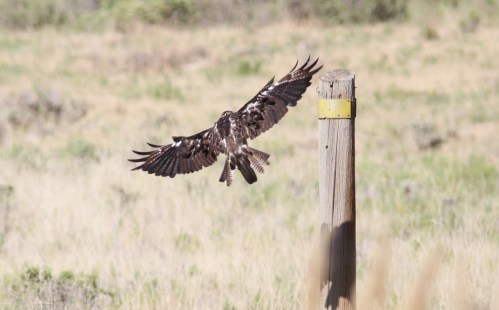
After watching the bird for some time, and taking many many photos, we were fortunate enough to watch as the bird lit off pole #36. I missed the chance at photographing the bird as it left the post, but I did catch him gliding feet above the ground.

Topside of gliding Swainson’s Hawk, showing some apparent body and flight feather molt.

After seeing the bird fly, and land on a post farther down the road, I could tell that this bird was molting. From the photo of the bird pulling up just before landing on the post, you can see that P1-5 are fresh new feathers, and many of the outer retrices are actively growing in. Also, from the mottled look of the scapulars and upper wing coverts, it is apparent that the bird is undergoing a body molt as well. I reviewed some photos of the bird as it flew, and I a under the impression that this bird is molting into its first adult plumage. I love this stuff. I haven’t sent any of these to Jerry Liguori for conformation or review, but I’ll be sure to. After which, I will correct any mistakes I made, or even elaborate on what can be told from this bird.

Swainson’s Hawk- Buteo swainsoni. Note the remige and retrix molt, as well as the body molt of the upper wing coverts. The darker wing feathers, P1-5 are newly grown feathers, as well as the central retrices.

My main fascination with Buteos is the diversity in their plumage. Using my camera for a recording tool, I’d like to add to the work of Jerry Liguori in documenting the vast varieties that present themselves in these winged predators. My images at the moment are not near the quality they could be. I want to correct that. I know they won’t reach the Ron Dudley quality, but I will do my best.

Here is to the future of my study. Finally my photography will progress. Let’s hope the birds cooperate.

Juvenile Swainson’s Hawk- Buteo Swainsoni


Osprey

by Bryce W. Robinson

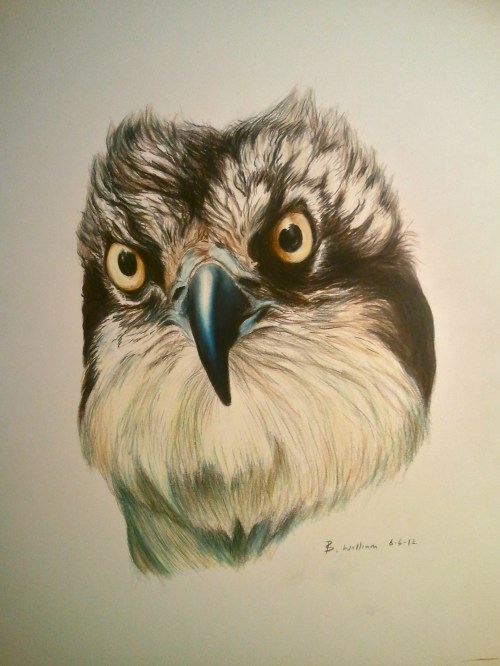
Osprey- Pandion haliaetus. 11×14″ colored pencil on bristol

Throughout my life I have had limited exposure to the fish hunter Pandion haliaetus. I’d like to spend more time in search of this bird, and really get to know all of it’s behaviors and characteristics. It stands true to say that there certainly is not a bird in the sky quite like the Osprey. It is remarkably unique, a fact that induces fascination and intrigue. Every time I find the Osprey, I sit in awe as it hunts the waters for its finned food.

In the past six months I have had two experiences with the Osprey. Of the two, one sits as a special memory in my mind. I was birding along the Colorado River in eastern California. I had come to see the Cibola Refuge, after hearing rumors of its birding grandeur. I wouldn’t say it lived up to its hype, however I certainly wasn’t disappointed. On my way out of the refuge, I passed a small inlet of calm water, separated from the Colorado much like an ox-bow. Catching a hovering silhouette in the golden light of the setting sun, I stopped the car to the spectacle of a hunting Osprey.

The Osprey hovers above water, watching for fish as they surface to glean their own food. Seeing a chance, the Osprey dives to the water with wings flexed back, talons stretched forward, open and ready for the grab. The osprey I watched seemed hesitant at each opportunity. It would dive, catching itself half way down as it lost lock on its fish, and the opportunity for food. It appeared as something of a dance, as the rhythm of the hover was periodically interrupted with a reverberating roll as it dove and rolled back into a hover. With the long light of the setting sun casting long shadows, all anxieties melted away as I let myself become fully involved with the hunting raptor. This instance is one of too few in my life, when my spirit settles and I am truly at peace.