A studio for bird study

Tag: research

Gyrfalcon Project Update

by Bryce W. Robinson

Female Gyrfalcon - Falco rusticolus

Here in western Alaska the bulk of the breeding Gyrfalcons are fledging young at the moment. We were able to install all ten cameras in nests this summer, and starting tomorrow will begin taking them out of the finished nests. I’ve been extremely pleased with the quality of the images that these cameras take. I’ll be spending all winter sorting through the photos to identify prey items brought to the nest. This will be a long process, as I should have somewhere around 1.2 million photos to look through. Quite an undertaking, but I’m excited to start the task.

It’s been a tough season to this point, full of challenges and some failures, but I’m happy with the success we’ve had to this point. Getting all ten cameras placed was a goal of mine, and I’m happy to have that success. For my first year, and the first year of the project, it has gone well. Above all it has been nothing short of an education. There are certainly fruits in difficulties, mistakes, and failures. Next year, I’ll have some experience to draw upon to increase the success and further the project goals.


Red Knot Research and Photography: Clashing or Cooperative?

by Bryce W. Robinson


Red Knot - Calidris canutus roselaari

I’ve written about the use of photography to aid in re-sighting banded birds before, but I’d like to return to the subject and explore fully the idea that metal bands and color tags “ruin” a beautiful photograph of a wild bird.

Observing the Red Knot – Calidris canutus on it’s breeding grounds in Alaska is meaningful. At least, it is meaningful to me.

In Alaska there exists a small portion of the Red Knot population that breeds in the interior highlands of the Seward Peninsula and portions of the North Slope tundra. Any satellite portion of the distribution of a given species interests me greatly. So, in planning my summer in Western Alaska, I put high on the list to find and experience the Alaskan breeding Red Knot, subspecies roselaari.

There are folks here on the peninsula engaged in a demographic study of this Calidrid. I haven’t been able to make contact with these researchers yet, but as far as I understand it in the small bird world here, the time is coming. I’m interested to hear their thoughts and ideas considering the species. Until then, I have only the knowledge of what I observe myself, and what I can read.
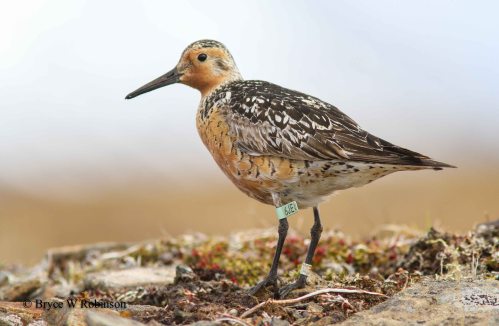
Red Knot - Calidris canutus roselaari

Do the metal band and sea foam green leg tag take away from the beauty of this bird?

I found an individual the other morning, high on a hillside in the very western parts of mainland Alaska. Immediately I noticed the colored leg tag. As a young researcher, my resolve to photograph the bird strengthened with my desire to aid my peers with a “re-sight”. As you can see, I was successful to a degree. I came away with photos of the bird, and it’s identification tags.

The experience and resulting photos brought an issue to mind. Many bird photographers I have met and know dislike the identification jewelry because it tarnishes an otherwise natural and beautiful image. After capturing photos of the bird, I was left contemplating the idea.

I’d like to offer some of my thoughts as a young and aspiring ornithologist. As I’ve already stated, I love finding and photographing birds with color tags. To me, it is akin to trapping the bird and recording its location and identity, with the added benefit of no stress to the bird. Clean research! At least after the initial attachment of the tag.
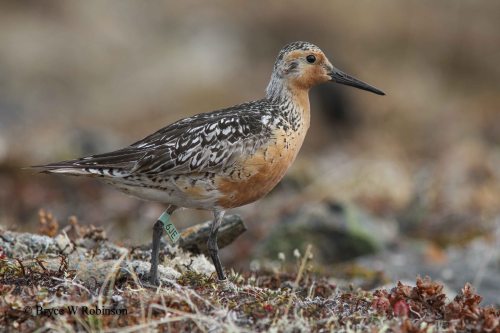
Red Knot - Calidris canutus roselaari

On the other end are the photographers (I’m in part on this end as well, I confess) that are of the opinion that the tags diminish the quality of the images they are after. They work to capture natural images of birds, void of the tarnish of human interaction.

I’m sympathetic to the photographers view, but I believe that the proportion of individuals that we are able to outfit with these identification tags are minimal, and the chance of interacting with them again is remote. So, when a photographer has a subject that happens to have a tag, it ought to be viewed as fortuitous and an opportunity to learn about the bird and aid research efforts.

I photograph birds for many different reasons, but high on the list is to learning. Being something of an artist, I understand the drive to capture the most aesthetically pleasing image, but I propose instead a new avenue for the aesthetically driven. This is the art of bird study, to capture an image that is both beautiful and informative. This image would have the natural beauty and allure of the bird, but also the context of its interactions with humanity, holding in its information tag a history unique to the individual and the potential at snapshots of a story as beautiful as any image anyone could gather.
Using Nest Cameras to Monitor Gyrfalcon Diet

by Bryce W. Robinson

Gyrfalcon Nest with Camera

While I’ve been sharing images and stories from Alaska concerning my work with Gyrfalcons, I’ve neglected to share any aspect of the work that has brought me here. I chose the image above to provide insight into the idea behind The Gyrfalcon Project. In the past month, Neil Paprocki and I have installed 6 motion sensor cameras in Gyrfalcon nests to monitor their diet during the nestling period. This information will give us a better idea of how changes in the system will impact the ability of these birds to reproduce. 6 cameras is a good start for the project, but I am capable of outfitting four more nests with cameras this season. The issue is access, and at the moment I’m scrambling to formulate a plan to put out the final four and round out the season with ten total cameras gathering valuable data of nesting Gyrfalcons. I’ll keep interested readers updated regarding our success. Please feel free to comment about questions, ideas, concerns, or general queries. I’ll do my best to respond when I’m able.  And the Gyrfalcon beat goes on!

The Gyrfalcon Project is on the Ground in Alaska

by Bryce W. Robinson

Adult female Gyrfalcon- Falco rusticolus

I’m in Alaska to start the first field season of The Peregrine Fund’s Gyrfalcon Project. I landed only three days ago, and hit the search for nests right away. At this point, the earliest nesting Gyrfalcons will have hatching eggs any day. For my research, I need to find them before they hatch.

Gyrfalcon Eyrie

Already I’ve located two occupied territories, with one nest well into incubation. With the help of my friend and field assistant Neil, I made my first entry into an eyrie yesterday to assess nest age, and gather other important data. While I was in the nest, Neil took advantage of the disturbance and documented two very responsible adult Gyrfalcons as they circled and watched my intrusion.

Adult Female Gyrfalcon- Falco rusticolus

After we finished our tasks of data collection, we left the nest. When we reached a distance of approximately 500 meters from the nest cliff, we turned around and took a look at the nest. We were happy to see the female had already returned to the nest to resume incubation. While I was in the nest, I was able to see that one egg had pipped, meaning that in a couple of days there will be some newly hatched Gyrfalcons.

Stay tuned as the summer progresses. There will be numerous reports over the course of the season. Soon there will be nestlings, and I’ll be there to photograph them. You can find out more about this work on ornithologi’s Gyrfalcon Project page, and be sure to check out the Peregrine Fund’s website and consider supporting my work, and raptor conservation as a whole. Here’s to a successful summer, with loads of Gyrfalcon’s!