
A studio for bird study

Tag: wildlife

Published in Western Birds: First Record of Eastern Phoebe Breeding in Alaska

by Bryce W. Robinson

48-2s-01 copy.jpg

My latest publication, and my first in the excellent regional journal Western Birds (Western Field Ornithologist’s), details the first documentation of successful breeding of Eastern Phoebe in Alaska. You can find the pdf on my Researchgate profile. It’s short and to the point, and worth a read for anyone interested in the birdlife of North America.

Last year, while working in Alaska with the US Fish and Wildlife Service’s Migratory Bird Program, I caught word of an Eastern Phoebe documented near Nome. I’m very familiar with Nome, since it is where I studied the Gyrfalcon for my master’s degree. I’ve birded the area heavily in the spring and summer months. There aren’t many Eastern Phoebe records for the state, so a bird showing up in Nome on the western coast is that much more exciting. I planned to be in Nome the following month to work with Red Knots, so I crossed my fingers that the bird would stick around long enough for me to see.

Surprisingly, a second Eastern Phoebe was documented soon after. Then came documentation of nest building, followed by nesting behavior and ultimately confirmed egg-laying and incubation. On my arrival at the start of July, I joined my friend Lucas DeCicco to see the pair on the outskirts of Nome. Since July is a time when the flow of birders ebbs in Nome, no one had checked on the nest for some time.

Sure enough, we found the birds feeding nestlings. After we had photographed and observed, Luke and I resolved to return regularly to document the success or failure of the pair.

In the end, the pair was successful. It was the first documented case of the species successfully breeding in Alaska, and on top of that in a location quite inhospitable and atypical of the species. The coast of Nome is not known for mild weather.

I told Luke that I thought it important to document this novel event in a publication, and he agreed. So we resolved to report the record, and asked for the help of those that originally found the first phoebe in June.

Thanks to Luke for his help with this seemingly simple publication. It wouldn’t be so clear, simple, and clean without him. Also, a big thanks to my co-authors who first found these birds – Aaron Bowman, Scott Hauser, John Wright. Thanks for the help with cleaning up the publication, and of course documenting the birds that led to this record.
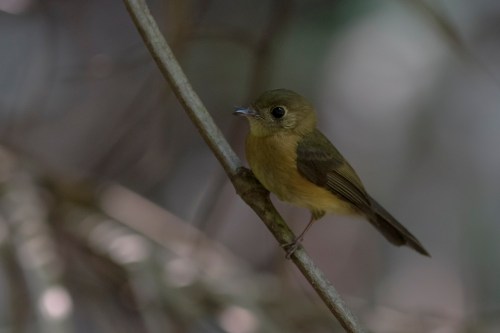
Sulphur-rumped Flycatcher (Myiobius sulphureipygius) Foraging in the Dark Understory of Southern Belize

by Bryce W. Robinson

2L3A8821

I’ve been in Central America for nearly two months, and I haven’t had the time or energy to post any stories, images, or illustrations from my experience thus far. There are of course many stories to tell.

Flycatcher (Family: Tyrannidae) diversity in Central America is very high. Getting to know this diversity has been an excellent challenge. I’ve had a lot of luck seeing most species that I might encounter in Belize, and among my favorite have been the small and endearing flycatchers of the rainforest, such as the Sulphur-rumped Flycatcher (Myiobius sulphureipygius).

2L3A8855.jpg

I’ve seen the bird only a few times. It sits low in the understory of the rainforest, near relatively open areas and perch hunts for insects. Its large eyes are obviously engineered to spot prey, and it tactfully watches and waits until it sees an opportunity. This can be for a minute or more.

These birds don’t seem to mind my close proximity when I’m watching and photographing, and seem only focused on its task of procuring food.

2L3A8794.jpg

Contrasting this seemingly patient and calculated technique with another small flycatcher, the Ruddy-tailed Flycatcher (Terenotriccus erythrurus) has been enlightening. From what I have observed, these birds are constantly making attempts at captures, and hardly sit still for more than a few seconds. It’s difficult to tell if these many attempts are all successful, because the insects it is after are much too small to observe at any distant.

Hopefully I’ll be able to capture both foraging techniques on video. There’s always another way to describe the behavior, whether it be writing, illustration, or video. I’d like to blend all three for these birds.

Singing Brewer’s Sparrow (Spizella breweri) on Sagebrush

by Bryce W. Robinson

brsp

Singing Brewer’s Sparrow (Spizella brewer) on sagebrush. Gouache on watercolor paper.

One of the best parts of spring in the Sagebrush landscape of western North America are it’s singing inhabitants. The Brewer’s Sparrow may be my favorite, because of its subdued but beautiful plumage and distinct trill song. On a spring morning at sunrise, one can walk through a healthy stand of sagebrush, songs erupting all around, as multiple males sing atop their sagebrush posts.

Brewer’s Sparrows have a distinct buzzing song, that sounds superficially simple and distinct. But, their songs can be variable and have multiple types as described in Rich (2002). See the figure below to gain a familiarity with the variability.

25025301.gif

Song types of the Brewer’s Sparrow, long (A) and short (B). Figure taken from Birds of North America Online, adapted from Rich (2002). 

Rich (2002) found that the variability seen above seems to follow no geographic trend or isolation, nor does there seem to be any song sharing among neighbors. High turnover among territories and potential for natal dispersal could limit the development of local dialects, etc. Interesting stuff…

If you’re unfamiliar with the sound of a singing Brewer’s Sparrow, be sure to visit Xeno-Canto and explore.

My friend Eli is wrapping up some research investigating the impacts of anthropogenic noise on sagebrush inhabitants in southwest Idaho. Breeding Brewer’s Sparrows were among a few focal species of her study. She’s currently working through the publication process, and when her work comes to surface in print, I’ll be sure to share. I expect that anthropogenic noise has some masking impacts on a Brewer’s Sparrow song, and in turn could potentially change the dynamics of song structure under anthropogenic noise blankets, etc. More research and time will tell.

Here is a short clip of a singing Brewer’s Sparrow in Idaho that I took through my Zeiss scope. The song is barely audible because of how distant I was from the singing bird:

Referenced Literature:

Rich, T. D. 2002. The short song of Brewer’s Sparrow: individual and geographic variation in southern Idaho. Western North American Naturalist 62(3): 288-299.