A studio for bird study

Tag: wildlife

Alaska Mosquitoes Are the Bane of All Existence, Even for the Willow Ptarmigan

by Bryce W. Robinson

IMG_7047 copy

What is the Alaska State Bird? Well, according to everyone I spoke to before my journey north, the Alaska state bird is the Mosquito. I’ll admit now, I understand their point. If there is no wind on the north slope, and temperatures are fair, the mosquitoes are intolerable. Luckily, one can prepare for the onslaught by bathing in carcinogenic 100% Deet and wearing cumbersome face nets.

One can prepare, if one is human. I saw first hand the other night that all blood carrying life here suffers from the miserable insects. I was watching a Sandhill Crane feeding in the short grass of the tundra. In an instant, the peaceful scene changed as two violent Willow Ptarmigan began a campaign to oust the crane from their area. I assume the behavior was due to the presence of a band of small young ptarmigans, hidden somewhere nearby.

After the crane wisely vacated the area, I took the opportunity to pair the striking summer plumage of the two ptarmigan with the golden evening sun for some spectacular photography. The Ptarmigan were cooperative. I set myself at an appropriate distance from the birds, and laid on the tundra to sit at their level. While I shot the birds, the Alaska state bird conducted its business on all of my vulnerable areas. It’s been three days, and I’m still itching.

What struck me most was the amount of mosquitoes on the head of the male Ptarmigan. The poor bird was constantly shaking the bastards off, but to no avail. He was being mercilessly bitten, and had no defense. I felt for the small feathered creature. In this instance we shared something; the misery of the mosquito, a fact of life in the north country.

IMG_7028 copy


A Mid-summer Arctic Midnight with Yellow-billed Loons

by Bryce W. Robinson

For those that forget, it never gets dark in the arctic during summer. The result is a night full of spectacular light for photography, if the skies are clear.

A few days ago, my friend Heather found a pair of Yellow-billed Loons thirty miles south of Prudhoe Bay. I have been hoping for this particular loon ever since I arrived on the tundra, while keeping in mind that it was likely I would never see one. They prefer areas farther west, with more lakes and less oil workers. Like minds, I guess.

Lucky me, to have a friend like Heather, checking areas that I’ve been unable to make it to lately. I only have a week left here, so the loon’s timeliness cannot be overstated. My friends and I made some time last night to make a trip to the loons, hoping they stayed put for the day. In my mind, if I came away empty handed, the midnight sun would provide great photo opportunities with other birds as well.

Too bad the night was full of dramatic rain clouds, letting the sunlight through only in pieces. Too bad for photography, but not for my spirit. It was a perfect night, with near perfect temperatures, and loads of mosquitoes.

Anyway, the photography for the evening was a bust, but the loons were at the pond waiting for us! I’m not sure how to communicate my experience with the birds. Life birds, as birders term the first sight of a bird in their lifetime, can be the most incredible experience, but some leave you wanting. Some birds, for whatever reason, have been a bit anti-climactic for me. Not the Yellow-billed Loon. Perhaps the scenery contributed to the experience, but I must say that my first Yellow-billed Loons exceeded expectations.

The Yellow-billed Loon is in my top ten for the best life bird experiences I’ve had over my years of birding. The night smelled of tundra wildflowers and arctic rain. I laid myself on the edge of the pond for a spell of time, and filmed the birds. Today, my body itches from the hoards of mosquitoes that had their feast on my blood, but the experience was worth the itch. The birds forgot me, and soon drifted close, acting naturally, and providing me not only with some footage, but with a feeling of peace and joy in experiencing an emblematic life of the Arctic Coastal Plain.

Although the light was poor, I am very happy with the footage. I film these birds to share with those who love them as much as myself, but really I film them selfishly, to capture the moment so that I can watch them in years to come, and revisit the feeling of laying on the edge of a tundra pond, watching a pair of Yellow-billed Loons conduct their business.


Black-bellied Plover- Pluvialis squatarola

by Bryce W. Robinson

Black-bellied Plover- Pluvialis squatarola. Prismacolor on bristol board

Black-bellied Plover- Pluvialis squatarola. Prismacolor on bristol board

Often, I am impressed by the aesthetic of particular birds. The Black-bellied Plover has always been a visual delight for me, resulting in my ambition to illustrate the bird appropriately. In what little free time I have at the moment, I put together an illustration of a bird I see often, but always celebrate the sight.

Illustrating this bird provided me an opportunity at a study of the depth and texture of layered feathers. Paying attention to such detail really impresses me with the intricacy of each type of bird, and the adapted structure that directly relates to their life history. If you are unsure what I mean, perhaps it is something I need to elaborate upon with further illustrations and detailed description. Perhaps indeed… New project.

American Golden-Plover- Pluvialis dominica

by Bryce W. Robinson

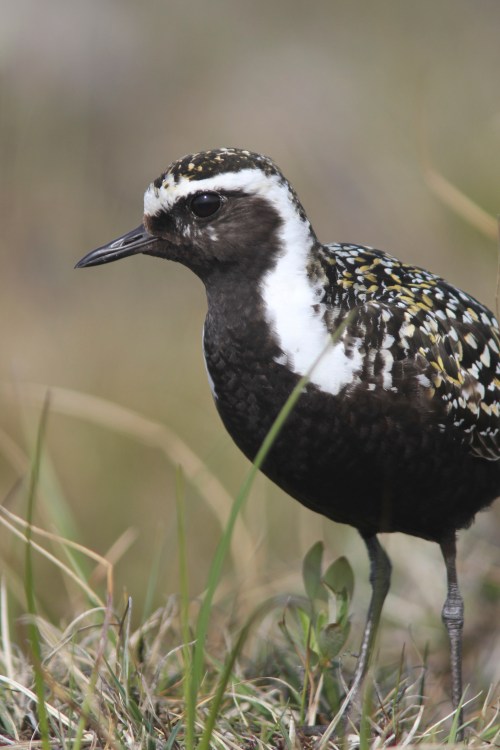
IMG_5677Lately I’ve discussed a problem I have with birds being too close to photograph. This plover has a nest I’ve been monitoring, and each time I visit, the bird does its best to draw attention to itself, and away from the nest. I’ve used this behavior to my advantage for photography, but so often the bird comes too close for the composition I like. My friend Ron, and exceptional photographer, commented on his own experiences, saying that he often embraces this closeness, capturing a headshot. I wanted to share this photo, because I too embraced the birds behaviors, and the result pleases me.

I turned the camera to capture the legs, and hopefully the whole body, but ended up clipping out the back end of the bird. Still, I really like the photograph.

Today, different bird was on the nest. The new bird appeared to be the female. Sadly, close by, the remains of the bird in the above photograph were found. Perhaps, in the line of duty, this bird lost its life distracting a predator from the nest. A sad instance in the life of the American Golden-Plover.