A studio for bird study

Tag: wildlife

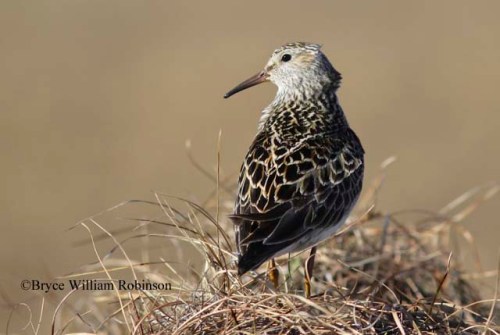
Ruddy Turnstone- Arenaria interpres

by Bryce W. Robinson

IMG_4992 copy

It’s been a real treat to see the Ruddy Turnstone on its breeding grounds. These birds have quite a story. Their name is fitting, as they are known to turn stones in search for food, but even more incredible in my eyes is a peculiar piece of their diet. The Ruddy Turnstone eats the eggs of other nests, a behavior quite unlike any other shorebird that I know. They are also quite tenacious. I’ve observed these birds chasing jaegers out of their territory, and while I was taking some time to watch and photograph a pair, they were unreserved in expressing their intolerance of my intrusion. It’s expected when I am hazed by territorial jaegers, but having a turnstone flying at my face comes rather unanticipated. It’s an experience worth having, trust me.

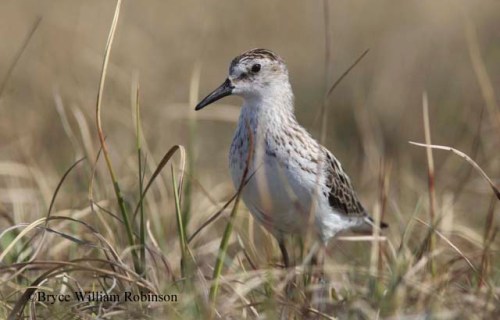


Semipalmated Sandpiper- Calidris pusilla

by Bryce W. Robinson

IMG_4352 copy

The most common shorebird I encounter lately is the Semipalmated Sandpiper. When displaying, the male flies about, even hovering with wings in rapid motion, calling consistently. The call is difficult to describe, but I’ll make an attempt. There is a sound from childhood, when we as imaginative children fastened a playing card to the spokes of our bicycles with a rubber band to simulate the sound of a motor. The sound of the playing card, while riding at moderate speeds, is much like the display call of the Semipalmated Sandpiper. I ought to simply record the audio…

This bird does not like to leave its nest. When it does, it makes adorable chatter and distressing sounds. As with other ground nesting birds, it has developed distraction techniques in attempts to lure an intruder from the nest. Often, as I process the contents of the nest, the bird wanders closely chatting at me. I find it adorable, but that is the human in me.

IMG_4482 copy

I’ve very much enjoyed experiencing this species on a daily basis. The schedule shows that of the nests I’ve recorded to this point, a few should be hatching in as little as two days. I plan to capture what these delicate birds look like as they first venture into the world. I’m sure it is “face melting”, as they say.

Pectoral Sandpiper- Calidris melanotos

by Bryce W. Robinson

IMG_3735 copy

The Pectoral Sandpiper is one of the most common sandpipers in the areas I’ve been frequenting. These birds have one of my favorite flight displays. The male flies low over the tundra, filling his anterior air sacs with air to increase the resonance of his calls. Close your mouth, and in a low voice repeat goo goo goo goo, and you have produced the sound of the displaying male Pectoral Sandpiper. I’m making attempts to record this behavior, but all I have so far are some very poor photographs. I thought I’d share one just to help paint the picture of the bizarre behavior.

IMG_3491

The behaviors here are fascinating. This is only a taste of the smorgasbord of incredible bird life that is available here in the thawing tundra summer. I can’t wait to capture and share more.

Dunlin- Calidris alpina

by Bryce W. Robinson

IMG_3794 copyI’ve been on the Arctic Tundra now for a few weeks, and I’m loving it. The birds are everywhere, and they are all new to me. Everything is my favorite, everything is the most interesting, and everything excites me more than the next. To say that I’m immersed in learning is an understatement. My experiences in the past few weeks have been invaluable.

The above photo features a female Dunlin, returning to her nest. I’ve found two Dunlin nests thus far. They are in fact my favorite.

In the next few weeks everything will be hatching. The tundra will be crawling with fuzzy precocial birds, and I will be there to soak it all in. I’ll try to share along the way, but the nesting season is keeping me very busy, and very tired. In the end, I’ll have a lot to share. Photos, video, illustrations, and stories. Till then, happy birding.