A studio for bird study

Tag: wildlife

The White Owl of the North

by Bryce W. Robinson
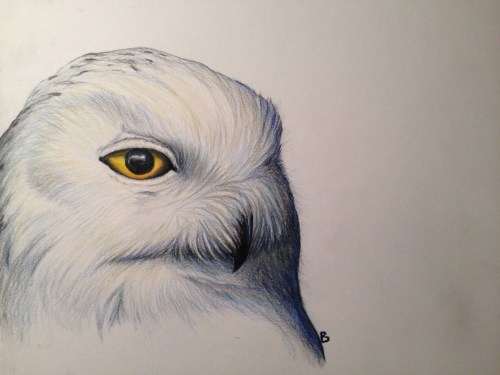
Snowy Owl- Bubo scandiaca. 9x12" prismacolor on bristol.

Snowy Owl- Bubo scandiaca. 9×12″ prismacolor on bristol.

Sometimes the internet, or electronics, take so much away from life. I wanted to write in depth about my experience of seeing my very first glimpse of a Snowy Owl last week. I powered out a long story about the experience. When I went to post the story, the page reset and I lost everything. For whatever reason the regular save as you go feature was not working. Oh the misfortune, but life goes on.

So now I have neither the time nor the energy to write about that day. I just wanted to share an illustration I did of the bird. It was too far for any photographs, so I decided to capture and celebrate the experience by illustrating the white owl. I have found that illustration is always an appropriate way to pay homage to new experiences. This way, all I need to do is look at this image, and memories will flood into my mind of the evening that I first saw the white owl of the north.

Short-eared Owl at Sunrise

by Bryce W. Robinson

Short-eared Owl- Asio flammeus. 9x12" prismacolor on bristol.

Short-eared Owl- Asio flammeus. 9×12″ prismacolor on bristol.

After such an amazing winter with Short-eared Owls, I knew I needed to sit down and illustrate at least one bust of the bird. Here is Asio flammeus, with a distant gaze, as if it were perched in Skull Valley as I have seen them, watching the rise of the sun and the inception of a new day.

The Gyrfalcon as a Milestone

by Bryce W. Robinson

Gyrfalcon- Falco rusticolus

Gyrfalcon- Falco rusticolus

Today I ventured north into Idaho with Jerry Liguori and Caitlin Davis. We were in search of a Gyrfalcon, the largest falcon in the world, a dweller of the arctic. I really didn’t hold my hopes too high for finding any Gyrfalcons, mostly to curb any disappointment, but really we were on the hunt for a wandering creature on wings, in a vast and open land. In my eyes, the odds were stacked against us.

We made our heading to the area where the bird had been reported, and upon arrival, began our diligent search for what was truly a needle in a haystack. Not thirty minutes following the inception of our search, we spotted a perching raptor some telephone poles down the line. My excitement quickly grew, as I realized I was approaching what was to be the first falco rusticolus of my life, a veritable holy grail to my raptor watching.

How quickly we found the bird was remarkable. It went far better than expected. The bird turned out to be an adult, not the juvenile we were after. That meant that two Gyrfalcons were in the area. Quite spectacular to me, but perhaps something more common than anyone is yet to realize. Or maybe it is just this winter, as it seems many species of the north have ventured in large numbers to our lower lands.

I feel I dropped the ball as they say, so far as photography goes. I did my best for good photos of the bird, but honestly, the photo was not what the experience was about for me. It was a first in my life. I saw a bird on a long journey, from a harsh landscape far to the north, escaping a place so frigid and formidable it chose a winter setting in Idaho to ensure its survival. This bird is rare, it is beautiful, it is tough. This bird is wild. And today marks a great milestone in my exposure and education in the world of birds. I finally, with the help and direction of Jerry, saw Falco rusticolus, the Gyrfalcon.

Gyrfalcon- Falco rusticolus

Gyrfalcon- Falco rusticolus

Gluttony and the Great Blue Heron

by Bryce W. Robinson

IMG_2756

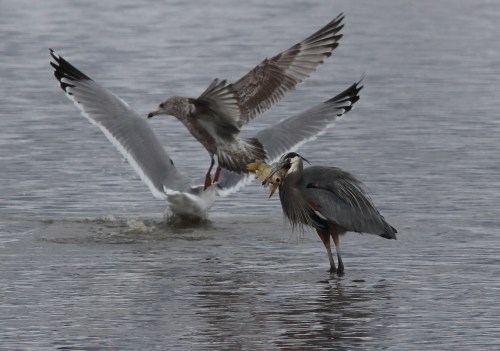
The other day I observed a Great Blue Heron- Ardea herodias, that had caught a fish seemingly too large to handle. The above image is directly after the bird had speared the fish, and was working on a way to get the meal down its throat. Yes, I did say spear. Before this instance, I was under the impression that herons never speared their prey, rather they stabbed at the prey only to grasp it in its bill. This bird speared the fish, effectively killing it, then retrieved it from the water. I believe that if the bird had not done so, the large fish would have been too strong as it struggled to escape the herons clasping bill.

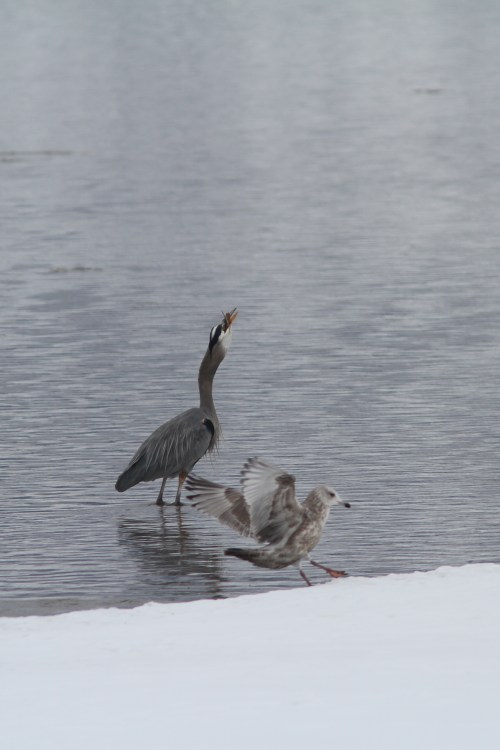
I also was taken aback at the size comparison this photo illustrates between the Herring Gull- Larus argentatus, and the Great Blue Heron. Heron’s seem like such large birds when standing alone. Anyway, I took a sequence of photos of the heron struggling the fish down its throat. The sequence is as follows:

IMG_2765

IMG_2771

IMG_2784

IMG_2788

IMG_2815You can see in the last photo where the fish still sits in the birds body. This will undoubtedly take a while to digest. I was impressed in the least. I absolutely love seeing predators eat, and the heron is one bird that always delights. I once came upon a photo of a Great Blue Heron that had killed and was holding in its bill a Least Bittern, about to consume the close relative. How bizarre.

Anyway, I felt lucky to see this instance, even luckier to capture it on film.