
A studio for bird study

The Benefits of Photography for Mapping Avian Movements

by Bryce W. Robinson

IMG_9497

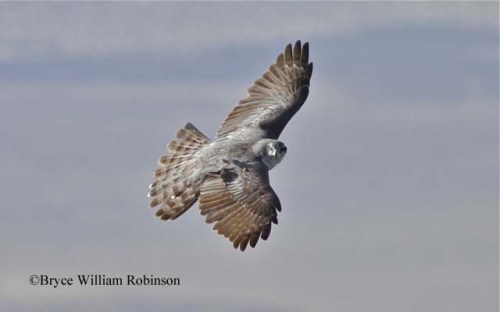
Above is a photo of an immature light morph Swainson’s Hawk that I took on the 7th of September, 2013 at the Goshutes Raptor Migration Sight in eastern Nevada. Notice the red band on the birds left leg. I’ve cropped the image a great deal, but below I’ve enlarged the section of the image to show the band in greater detail. At this resolution, the image becomes pixelated, which is unfortunate.

SWHA MAGI contacted the BBL in hopes of tracking down someone that might recognize the band. I am so very grateful for their organization, as they quickly sent out emails asking those they have permitted for color banding SWHA. Within a day or two, I had a hit.

A man name Chris Briggs contacted me and gave his firm assurance that this bird was a bird he had banded earlier this year as a nestling. He mentioned his use of special characters such as the obvious < symbol on this birds color band. He thought that the other character on the right was either an 8 or a 9. One cannot be too certain, but he did assure me that the band was certainly his.

As the birds age was apparent from its plumage, I was really interested in where the bird originated. Chris informed me that this bird was banded as a nestling near Macdoel, California, a town near the northern border just south of Klamath Falls, OR. He sent me the photo below.

IMG_5115

Photo courtesy of Chris Vennum

How exciting! It is nearly certain that this bird is the same bird as the bird I photographed in Nevada. I am so thankful that the organization exists such that a photographer can capture a photo of a bird with a band, and if the band is legible, can track that very same bird to the place that it was banded, without ever trapping the bird. The invasiveness of trapping hawks is curbed with the advent of the camera! Revolutionary….

Well, my question is then why are we as raptor researchers, or ornithologists as a whole not employing this technique more often? Some may state the added detriment of more bands is not worth while, and I do not discount this contention. However, how much more detrimental will one color band be to an already banded raptor? It is a discussion worth having, because with the amount of folks armed with cameras today, we could find ourselves with a lot more re-sight records, and a better understanding of spatial ecology in particular species.

I’d like to include another recent instance for emphasis. A few months ago, my friend and obscenely talented photographer Ron Dudley photographed a young Prairie Falcon in Montana. It happened to have a color band, and he was able to track down where the bird was banded. As it happened, his bird was also from California. You can read the story in detail on his blog.

How peculiar, this bird that fledged from its nest, and for whatever reason did not disperse directly south, but in a somewhat north east direction. North east enough that it passed by the Goshutes in early September on its way south. In my own personal study, I’ve learned that this non southward directionality of post fledging dispersal is something many people tracking birds of prey are seeing. The old north to south paradigm is becoming a bit more complicated than initially thought, and young birds seen traveling south on their fall migration, aren’t necessarily birds fledged from the north.

Revisiting Past Works, for Revision!

by Bryce W. Robinson

Peregrine Falcon- Falco peregrinus. 11x18" prismacolor on bristol

Peregrine Falcon- Falco peregrinus. 11×18″ prismacolor on bristol

I was unpacking some things this evening at my new place in Boise, Idaho. I pulled out some older pieces of artwork that never found a home. When I found the Peregrine Falcon I had drawn a few years ago in the southern California desert, I immediately remembered what I did not like about the image. I immediately felt the urge to sit down and fix some things. I’m not sure if I have ever shared the image on my blog, but regardless, I thought I’d share the revision.

I’m currently working on a very in depth project for someone. Its rather taxing, and I haven’t strayed to work on anything else since I started. I will say that I’ve needed to. At times, getting a break and working on something else for a bit can be refreshing, and give you a different perspective. I believe it is ultimately beneficial.

Anyway, after two years of sitting in a box, I finally felt the gumption to resolve my issues with this illustration. And I like it. Let’s hope this bird can find a home…

It’s the Most Wonderful Time of the Year- Fall Migration

by Bryce W. Robinson

IMG_2503 copy

Adult Northern Goshawk- Accipiter gentilis

I’ve landed myself in Boise, Idaho where I’ll be starting graduate school. I wanted to share a photo from last year at the Goshutes, as a reminder that fall migration is beginning. I’ve already spent a few days at Lucky Peak in the trapping blind, and helping with passerine banding. I plan to spend as much time as I can up there this fall, but it is likely that I won’t be able to watch much of the migration. The idea that I won’t be counting raptors at the Goshutes migration sight in eastern Nevada has been very difficult for me to swallow. Especially when my girlfriend is up there trapping and giving me daily updates about the flights. Lucky Peak will help, but it just isn’t the same. I hope all bird people are able to spend loads of time this fall experiencing this phenomenon at their favorite spots. It truly is one of the greatest wonders in life, happening all around us. Lets all pay homage by acknowledging the mass fall movement of the avian world.


An Arctic Ocean Alcid: The Black Guillemot

by Bryce W. Robinson

photo-6 copy

I’ve seen little of the worlds Alcids. Perhaps my lack of exposure is the reason for my heightened fascination with this bird group. While on the shores of the Arctic Ocean this summer, I knew I had one bird to see, Cepphus grylle, the Black Guillemot. Guillemots are not uncommon in coastal ecosystems, but they are delightful birds in my opinion. Their red flesh, in the mouth especially, is what really draws me to them. The common and very close relative the the Black Guillemot is the Pigeon Guillemot. Superficially the birds are identical, except for a few key features. My task was not only to find the Black Guillemot and get some great photos, but to document the differences that separate the bird from the Pigeon Guilly. In doing so, I would learn the difference for myself.

The area around Prudhoe Bay lacks any coastal cliffs, so I knew I’d be out of luck finding a nest colony. I  had to muster my patience for the guillemots to show up when the sea ice had melted sufficiently. Luckily, the intense nesting season of the shorebirds kept me busy and entertained enough to keep the itch to see the Black Guilly at bay. In early July, the ice was gone, and I began to look for the bird.

There is a drill pad sitting in the middle of the bay, accessible by road. They call the pad Endicott. Imagine a monstrous monolith sitting in the Arctic Ocean. A large steel structure, an emblem of the beauty of human advancement and industry, entirely appropriate of the name ENDICOTT. Lucky for me, the shores of Endicott are gravel covered, and in some areas the shore is comprised of concrete barrier blocks. I believe this adequately imitates coastal cliff regions, which draw in alcids such as the Black Guillemot. One afternoon I finally found the birds at Endicott, very close to shore, chasing snow buntings and feeding on the shore bottoms. At the time, I could only look, but resolved to return.

When I finally did return, I was escorting a bird man named Richard Crossley around the oilfields ( A story in and of itself). I remember walking along the slanted concrete blocks with a few friends, rediscovering the black and white alcids, and sitting patiently, waiting for them to wander closer to our lenses.

There I sat with my friends, Crossley, Jie Kim, and Caitlin Davis, watching the Arctic Ocean and the Black Guillemots. Finally a bird came near, and we let our shutters fly. I was certainly pleased with the experience. After a few minutes of shutter clicks and giggles, the bird became wise to the human admires, and fled. While it fled, I photographed, and caught one telling feature that separates the Black from the Pigeon Guillemot, the white underwing.

IMG_7313_original copyThe white underwing of the Black Guillemot separates it from the gray or dark underwing of the Pigeon. Of course, at this point I would love to supplement the photo with a photo of the Pigeon’s underwing, but I didn’t do my duty of photographing the bird extensively when I was watching hoards of them along the pacific, earlier this year. Jerry Liguori has told me countless times that I should photograph everything all the time, just in case, and I’m just starting to see the negative impacts of not heeding his advice. Well, I’m learning…. I’m beginning to think I’ll always say that.