A studio for bird study

Tag: biology

Birding Kachemak Bay, Alaska, by Boat

by Bryce W. Robinson
2L3A9761

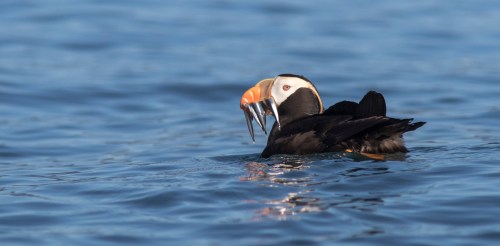
Tufted Puffin (Fratercula cirrhata) with a bill full of fish to take back to its burrow to feed young. Kachemak Bay, Alaska.

I had the pleasure of taking a few days to visit Homer, Alaska and get in some much needed birding on the southcentral Alaskan coast. I was after Alaska state bird additions, as well as a few potential lifers. I needed to get on a boat so I scheduled a trip with Bay Excursions for a morning around the bay.
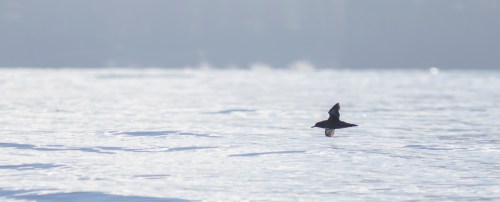
2L3A9621

Sooty Shearwater (Ardenna grisea). Kachemak Bay, Alaska.

I was after both Kittlitz’s Murrelet (Brachyramphus brevirostris) and Red-faced Cormorant (Phalocrocorax urile). Karl, who leads the trip and captains the boat, mentioned concern that it was too late for Kittlitz’s and that the cormorants were scarce in the bay this year. With the poor forecast, I still thought it equitable to make the trip and gain experience with other birds. Anytime on a boat, in good weather, is equitable.

Homer is great. There are plenty of camping spots right on the spit. I camped on the shore, woke up in the morning, and had a five minute walk to the boat ramp where I boarded and we set off. Joining me were the expected crew of older folks with cameras and an excitement for seeing wildlife. But they weren’t necessarily birders, so I knew that I was outnumbered and would have to accept that we wouldn’t be spending much time studying murrelet behavior, shearwater ID, or following any curiosities I’d have. Such is birding on a boat I suppose.
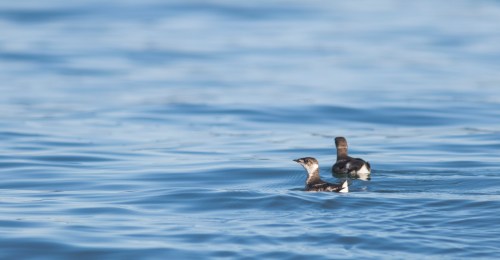
2L3A9607

Marbled Murrelet (Brachyramphus marmoratus). Paler individual on the left cause pause in hopes of it being a Kittlitz’s, but no luck. Kachemak Bay, Alaska.

Immediately out of the harbor we began to see murrelets. I checked every bird, and for a while Karl paused to give the folks on the boat good looks at the endearing birds. After a short time the group grew tired of the murrelets so we unfortunately cruised by too many groups that I wanted to spend a little more time with in hopes of a random Kittlitz’s popping up amongst the marbled.

I was able to get the boat stopped for some shearwaters. I caught a handful of birds cruising about 1 km west, and once the boat had stopped a few had circled us and I was able to ID them as Sooty Shearwater (Ardenna grisea). We spotted one set on the water that happened to be a Short-tailed Shearwater (Ardenna tenuirostris). With my limited experience observing procellariids on the water I felt satisfied with the short encounter.
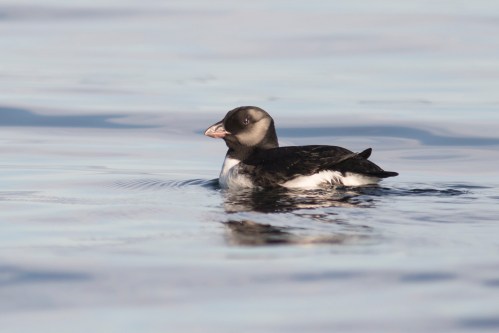
2L3A9664

Juvenile Horned Puffin (Fratercula corniculata) alone on the water. Kachemak Bay, Alaska.

One of the neatest birds we found on the water was a juvenile Horned Puffin. It’s bill was extremely small, nothing like the ornate bill of a matured bird.

Some of the strangest birds to encounter from the boat were Song Sparrows on every island we passed. I also caught a Steller’s Jay in the air above a larger island with some conifers. Island living passerines, neat to see.

Overall I was happy with the few hours on the water. I do think that the trip deserves more time, as I could have likely spent another few hours on the bay watching alcids and looking for a Red-faced Cormorant. I also would have liked to venture a bit farther out of the bay to encounter more shearwaters, and whatever else we might have happened upon farther out to sea. In the end I missed my two hopefuls, but the time on the water was excellent. I’ll be back again when the time is right for the missed species.
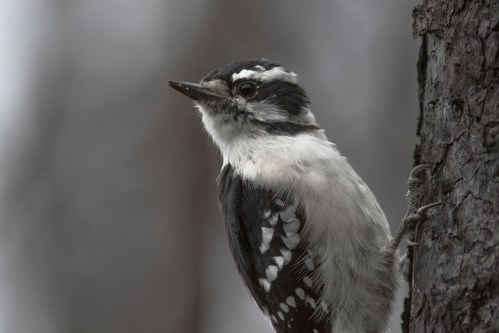
 

Mixed Woodpecker Flocks in an Alaskan Burn

by Bryce W. Robinson

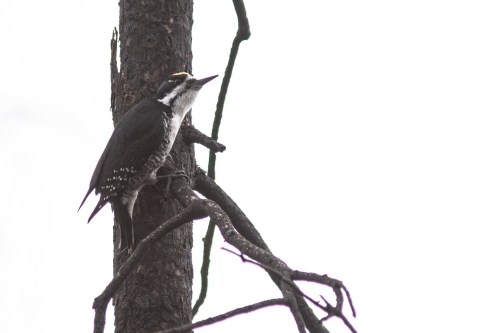
2L3A9410

Male Black-backed Woodpecker working his way through a burn near Willow, Alaska. 

My friends Luke, Charlie, Linnaea and I recently visited a year old burn site near Willow, Alaska. Our purpose for the visit was to find a rarely encountered woodpecker species, the Black-backed Woodpecker (Picoides arctics). Luke had visited the site a year prior, only about a month after the burn, and found quite a few woodpeckers already foraging on the burned spruce. We were hoping to have the same luck.

When we reached the burn, we took a few roads that led towards the location Luke had luck in the year prior. While driving I noticed tan bark chippings flecked off of the charred trees, a sure sign of foraging woodpeckers.

2L3A9457

Downy Woodpecker foraging on a burnt spruce.

We set out on foot down a two track that led into a portion of the forest. Only two hundred meters down the track we heard woodpeckers. We first heard a Hairy Woodpecker (Leuconotopicus villosus), but soon after came the husky call of a Black-backed. We quickly had visual, and soon after had others. Multiple Black-backed Woodpeckers, the magic of the burn.

The flock foraged along through the forest, much like a winter passerine flock foraging through deciduous groves. Soon the birds had gone, and we continued down the track only to find more woodpeckers.

2L3A9447.jpg

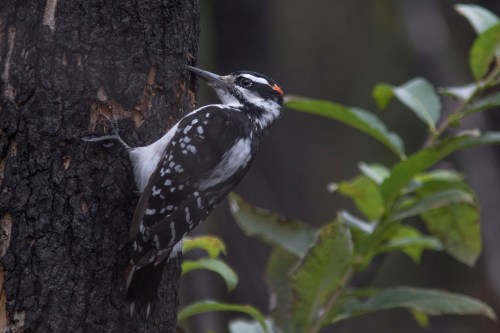
Hairy Woodpecker foraging low on a burnt spruce.

We counted many individuals. At one point we were surrounded by Downy Woodpeckers (Picoides pubescens). Other birds joined the flock, including White-crowned Sparrow (Zonotrichia leucophrys), Ruby-crowned Kinglet (Regulus calendula), Myrtle’s Warbler (Setophaga coronata coronata), and Wilson’s Warbler (Cardellina pusilla). It was interesting to watch the woodpeckers interact with the passerines. Many times the Myrtle’s Warblers would chase the Downy and Hairy Woodpeckers.

Mixed flocks are excellent. Even more, a mixed flock is a symbol of fire ecology and the importance of natural fire cycles for many species, particularly Black-backed Woodpecker. Unfortunately I wasn’t able to get the photos I really wanted of the birds and their foraging behaviors. I’ll make it back to the burn soon, hopefully to film some behaviors as well. That way I can fully portray the importance of burns for these birds, and the excellent behavior of flecking bark in search of food.

Spurting and Filter Feeding Behaviors of a Juvenile Red-necked Stint (Calidris ruficollis)

by Bryce W. Robinson


Apart from its scarcity and place as a formidable ID challenge, juvenile Red-necked Stint (Calidris ruficollis) is an excellent late summer encounter in Alaska because of its focus on feeding and building fat stores for migration. This focus makes the stint a great subject for close proximity observation, photography, and video. Interactive birds that tolerate your respectful but close proximity are the most fun.

While taking advantage of one such bird, I noticed a somewhat atypical feeding behavior. I was able to capture the behavior in the clip above, as the bird sifts through the water, filter feeding in a way, and consumes small items when it happens upon them. I’ve seen this before in other peeps, but it is certainly an uncommon feeding behavior.

Spurting is an even more uncommon feeding behavior, but one that is regular in many shorebird species (Fellows 2013). Fellows (2013) offers the following description of the behavior: “the bird dips its bill into the water for a couple of seconds, or sometimes a bit longer, presumably to obtain food. It then withdraws its bill and slightly pushes its head forward, usually (though not always) with the bill lowered and then ejects or spurts a stream of water, as if ridding itself  of surplus liquid taken in while feeding underwater. The bill is then reinserted in the water and the sequence is repeated“.

I’d never seen anything spurt before until I watched this juvenile Red-necked Stint  filter feed in shallow water this summer. Unfortunately the video above doesn’t capture anything but filtering, but I was able to manage a decent photo of a spurting event.

2L3A8935.jpg

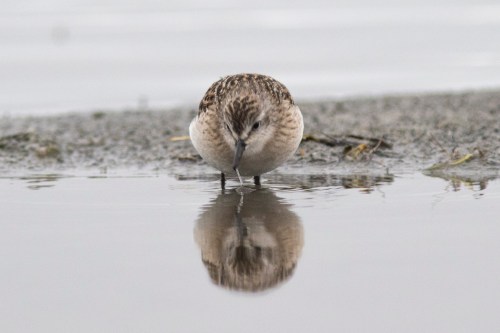
Photo 1. A spurting juvenile Red-necked Stint at Safety Sound, Alaska. Note the stream of water trailing from the birds bill.

I feel quite fortunate to bear witness to spurting behavior. Special thanks to my friend Luke for not only knowing the name of the behavior, but also letting me know of a note that names and details the behavior in shorebirds (Fellows 2013). Excellent behavior and excellent birding.

Referenced Literature:

Fellows, B. 2013. Spurting Behaviour in Wading Birds. Wader Study Group Bulletin 120(3) pp. 208-209

Does Illness drive Procellariids Inland?

by Bryce W. Robinson

NOTES ON BEACH SIGHTINGS OF TWO MEMBERS OF PROCELLARIIDAE ON THE SOUTHERN SHORE OF THE SEWARD PENINSULA, ALASKA

IMG_0447

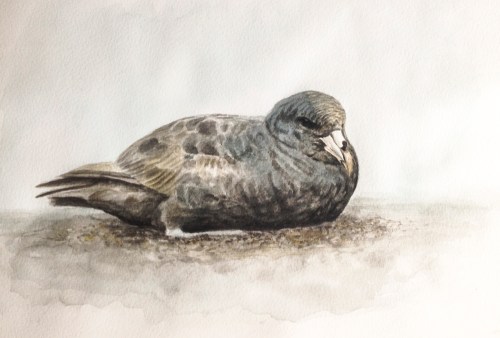
Photo 1. An unfinished watercolor sketch of a dark morph Pacific Northern Fulmar (Fulmarus glacialis rogersii) from my Nome 2016 sketch journal.

In late July my friend Luke DeCicco and I spent quite a bit of time studying gulls along the southern Seward Peninsula coast east of Nome, Alaska. The gulls at this time of year are in their first to second cycle transitive molt (first pre-basic molt), and represent an excellent challenge and education for those of us who care. But this post isn’t about gulls. This post details some anecdotal observations Luke and I made on procellarids we observed while on the coast studying gulls.

2L3A7624

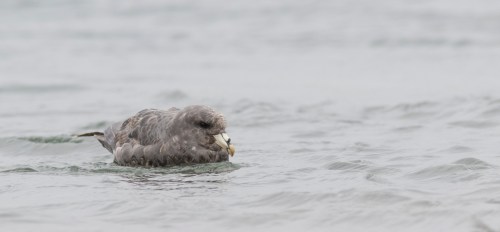
Photo 2. Dark morph Pacific Northern Fulmar (Fulmarus glacialis rogersii) sitting on the mouth of the Nome River. Nome, Alaska.

While studying gulls at the Nome River mouth east of Nome, Luke noticed a small dark bird sitting onshore amongst a large flock of gulls. He immediately recognized the bird as a dark morph Pacific Northern Fulmar (Fulmarus glacialis rogersii). Soon after noticing the bird, the flock took to the air and mixed up. The fulmar flew upstream and landed 200 meters up river, drifting back downriver towards the coast.

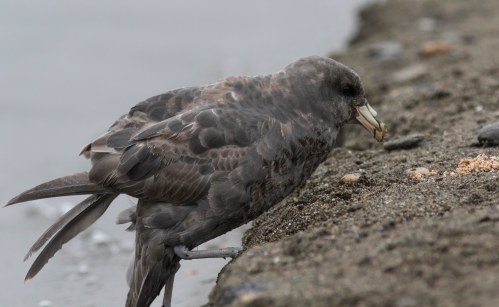
I took photos as the bird drifted downriver. When the bird neared my location it started moving towards the shore. It soon reached the river bank and climbed onshore directly in front of me (Photo 3). I was shooting with my 300 mm f4.0 and 1.4X teleconverter, to give some understanding of how close I was to the bird. I still don’t understand the behavior, but I suppose the bird was quite ill and needed to be off water to feel secure.

2L3A7634

Photo 3. Dark morph Pacific Northern Fulmar (Fulmarus glacialis rogersii) climbing onto the river bank to rest on land. The bird came directly towards me, climbed onshore in front of me, and sat looking towards me.

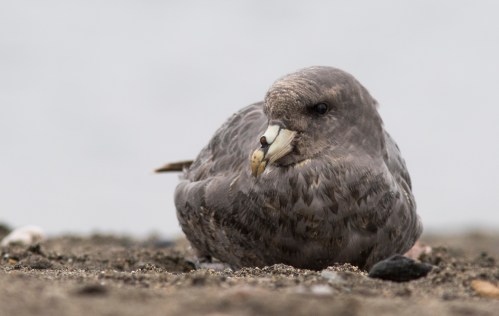
The bird sat and seemed content and alert. Other than sitting on land only meters in front of me and surrounded by many other people as well, there didn’t appear to be anything aberrant about the birds behavior. I did notice the striking plumage of the dark fulmar, especially the difference between the brown toned retained feathers and the cobalt colored fresh feathers. The bird was in the midst of its pre-basic molt. After about 10 minutes the bird took off and flew out to the ocean and landed ~200 meters offshore. It seemed to fly fine but I still think the reason the bird was on the coast was due to illness.

2L3A7679

Photo 4. Resting dark morph Pacific Northern Fulmar (Fulmarus glacialis rogersii) on the river bank at the mouth of the Nome River, Nome, Alaska.

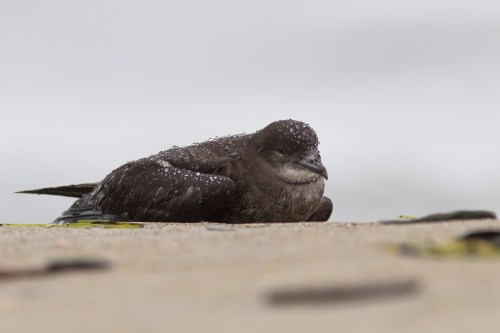
Later the same week Luke and I were frequenting the coast of Safety Sound in our attempts at finding and trapping juvenile Red Knots. While checking the coast for knots we came upon a Short-tailed Shearwater sleeping on the beach in the rain. The bird had drooped wings, a sullen posture, and was very wet. It was quite clear the bird was ill and likely wasn’t going to last long.

2L3A8170

Photo 5. An ill Short-tailed Shearwater (Ardenna tenuirostris) on the beach of Safety Sound on the Seward Peninsula, Alaska.

Over the next week Luke and I came upon 2 more dead Short-tailed Shearwater on the coast of Safety Sound. The high number of shearwaters and the lone fulmar left me thinking about ill seabirds and their possible inclination to seek land for comfort. I haven’t been able to find any literature on the matter, but I’ll keep looking.


Last year I discovered a Short-tailed Shearwater only 20 meters off shore of Safety Sound at approximately the same location as the bird photographed above (photo 5) and the two other dead shearwaters we discovered this season. I remember last year having thoughts on the health of the near shore shearwater. You can read my write up from last year here: https://ornithologi.com/2015/08/08/short-tailed-shearwater/

I haven’t spent much time on the coast, nor have I much experience studying the family procellariidae, so I’m unsure whether or not these birds seek shelter on the coast if they are ill. I have found seabirds dead on the coast, but in these cases the birds appeared to have been washed to shore after dying in the ocean.

Although a grim subject I couldn’t help but share my observations and thoughts. It’s quite interesting, and for someone who hasn’t spent much time at sea observing these birds it was quite exciting. I’m open for discussion on the matter and would love to hear of any similar experiences from those living on coastlines.