A studio for bird study

Tag: birds

Birding in South West Idaho

by Bryce W. Robinson

LESA110213

It has been a while since I’ve posted to this blog, due mainly to the fact that some poor luck fell on me, and my laptop was stolen from my desk in my office while I was off teaching. Luckily, most of my photos and video were backed up, but it’s been rough not being able to share anything while I’ve searched for a solution. For the meantime, I’ve found a temporary fix in borrowing a computer. This has allowed me to look through some photos I’ve gathered while I was computer-less.

Anyway, the photo above was taken yesterday morning. I went for a day of birding with some new and talented Idaho birding friends to a large reservoir on the west end of the Treasure Valley. It was a great day with some good birds. We ventured to Deer Flats Reservoir in the early morning, making it to the mudflats just as the sun rose. The light was electric, and luckily we found some tolerant Least Sandpipers. I again found myself on my elbows and knees, shooting shorebirds, remembering my summer in the north.

I don’t know much about birding in Idaho, but I sure am learning. We found a juvenile American Golden-Plover, which is a great bird here. It was a lifer for one of the fellows in our group. That is always fun to be a part of, in my opinion, even if it is not you who gets to see something new.

Here are the ebird checklists for those interested in knowing what we found:

http://ebird.org/ebird/view/checklist?subID=S15553530

http://ebird.org/ebird/view/checklist?subID=S15553364

http://ebird.org/ebird/view/checklist?subID=S15553253

http://ebird.org/ebird/view/checklist?subID=S15553246

I really enjoy the new birding community I’ve found here in Idaho. Lots to learn as always, and hopefully now that I have a way to blog again, I’ll keep the posting regular.



Hoary Redpolls on the Breeding Grounds

by Bryce W. Robinson

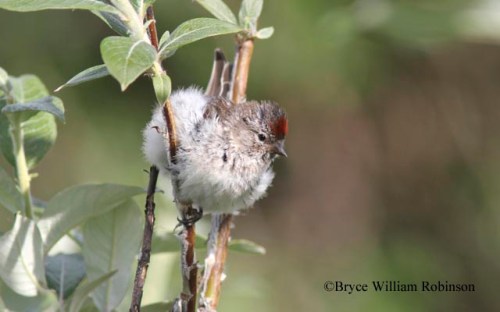
IMG_8096 copyBirders are obsessed with finding vagrants, the wayward members of any given species. They love the game of the rare encounter of a lost bird, and they love the game for good reason. I have had a year where I’ve experienced an aspect of birding quite the opposite of that game that the birders love. This year, I’ve been fortunate to be the vagrant myself, encountering many of North America’s species for the first time, but on their home grounds. This experience has been extremely satisfying, and I’d like to touch upon a few aspects of why, with one species, Carduelis hornemanni, the Hoary Redpoll.

IMG_8170 copy

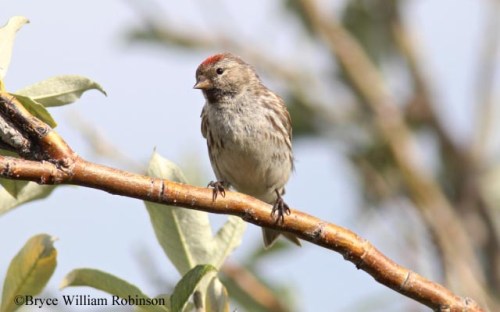
On my way south from the Arctic Coastal Plain this past July, accompanied by Caitlin Davis and Richard Crossley, I resolved to experience a number of species as much as I was able. On the top of the list was the Hoary Redpoll. Luckily, both Richard and Caitlin were not in any hurry, and had the same agenda as myself. So we stopped a number of times along the Sagavanirktok River to search through the willow thickets in search of redpolls, among other species.

We were successful, as expected. One family group of redpolls were a bit cooperative, so I stood with Richard taking photos of as many individuals as I could as they passed along through the tickets. Richard and I discussed what we were seeing, and one topic of our discussions still sticks in my mind. The redpolls were not the bright white birds I had expected. Richard spoke openly about his ideas of the counterintuitive aspect of birds wearing darker, rather than our expectations of feathers fading to light. I liked his ideas, and thought it rather intuitive actually, that white feathers would degrade with age and the worn appearance would give the birds a dirty, dusky look. That certainly is what we saw with the redpolls.

IMG_8120 copy

The most satisfying aspect of seeing the Hoary Redpoll on its breeding grounds was seeing the juvenile birds in their juvenal plumage. Those birders that fail to wander to the extreme north and into the breeding range of the Hoary Redpoll will not get to see the birds at this stage, as the redpolls undergo their pre-formative molt before they depart for their wintering grounds. This was exciting for me, as I am making it an effort to experience as many bird species as possible at each stage of their lives. I want to see it all.

IMG_8112 copy

This experience introduced me to a new concept. I gained two lifers from seeing the Hoary Redpolls on their breeding grounds; of course the life bird, but also a life plumage type for the bird. As you age in your birding, you begin losing the opportunities of firsts, as far as species go, but if you supplement the experience with firsts for ages and plumage types, the list grows and the opportunity for new experiences becomes almost endless. Birding is wonderful in this regards, as it parallels the creed that in learning, the more you learn, the more you learn you didn’t know. And then the journey becomes endless, and to me, that is beautiful.


A “Meridionalis” Turkey Vulture

by Bryce W. Robinson

IMG_4268

I gave my Turkey Vulture warts, for a reason. As I’ve stated in previous posts, I’ve began pursuing a degree in Raptor Biology at Boise State University, under the direction of David Anderson at the Peregrine Fund, and Marc Bechard, who has been with BSU since the 1980’s. Dr. Anderson is a great man himself, and I’m sure I’ll have plenty to tell about him later, but for this post, I’d like to mention some things about Dr. Bechard.

Last week Dr. Bechard accompanied me and a few of my peers, along with Greg Kaltenecker of Idaho Bird Observatory to attempt to capture migrating Turkey Vultures. Ultimately we failed, but I feel like I learned some things about Dr. Bechard and his interest with Cathartes aura, commonly called the Turkey Vulture. While trapping hawks in the blind at Lucky Peak, I picked his brain for insights into the life histories of the Turkey Vulture. He told me many things, but one aspect that stuck was his discussion of the subspecies of the Turkey Vulture, their regional distribution, and their migratory habits.

We in the west see what is called subspecies meridionalis, which is the subspecies I’ve illustrated above. Those in the east see septentrionalis. In Arizona, you find the nominate aura at its northern extent. These three sub groups comprise the Turkey Vultures found in North America. Of course in S. America, there are others. It is not often that you find a man who specializes on vultures. I find myself lucky to be working under such a man. At the moment, he is in Gambia, trapping Hooded Vultures with Keith Bildstein of Hawk Mountain Sanctuary. Lucky him, as he is off chasing exotic vultures while I teach his classes. I’m perfectly fine filling in while he’s gone, so long as he teaches me all that he knows!

Juvenile "Western" Turkey Vulture- Cathartes aura meridionalis

Juvenile “Western” Turkey Vulture- Cathartes aura meridionalis


The “Lifer” Great Grey Owl

by Bryce W. Robinson

IMG_9716 copyI still have a massive collection of experiences to share from the past year of my beatnik travels across the continent in search of birds. At the top of the list is seeing my first Great Grey Owl in the Yukon Terrritory. 

Caitlin Davis and I stopped in a small town, a village really, called Haines Junction, to meet with our friend Bill Clark, who was in the Yukon chasing and banding Harlan’s Hawks. Bill and I share a passion for the Harlan’s, and I couldn’t pass up the opportunity to spend the day with him chasing the enigmatic hawk. In the morning we set out with Bill and a young graduate student, Megan Mayo, who is doing her thesis on the genetics of pigmentation (broad description) in the Red-tailed Hawk. It was a very damp day, raining regularly, but the Harlan’s were plentiful.

IMG_9709 copy


While Traveling down the highway, scanning for Harlan’s, Megan spotted a large dark creature perched on a snag. Indeed the large figure was the Great Grey Owl, watching the roadside in the rain, hoping for a meal. 

This Great Grey was my first, and Caitlin’s first, and Megan’s first as well. The bird had six eyes entranced on its behaviors. While Megan and Caitlin approached the owl to experience it in more detail, I set up my video equipment and chatted with Bill. He had seen many in his day of course, but I could tell the bird still brought him some joy. I was rushing as the girls approached the bird. I felt some anxiety at the possibility of setting up and having the bird retreat before I could take a clip. Bill reassured me that the bird wouldn’t mind the intrusion, as in his experience, they are very tame in temperament. Of course he was correct. The bird tolerated our presence.

IMG_9355 copyBoth Caitlin and I took many photos. I’d love to share everything, but at the moment I’ve settle on the three. Notice the feather structure of the bird. It is fascinating, as the rain dampened the birds feathers, creating incredible textures. Caitlin’s photo shows the birds face at an angle that displays the deep inset eyes, showing the extent of which the birds mass is comprised of feathers. I really can’t describe what it was like to be so close to such a creature. There is a reason people talk about this bird as if it were the top of their list, the bird they seek most. I encourage bird lovers to make the Great Grey Owl a priority. It is one of the birds that lives up to the hype, one that will surely not let you down.